
 by
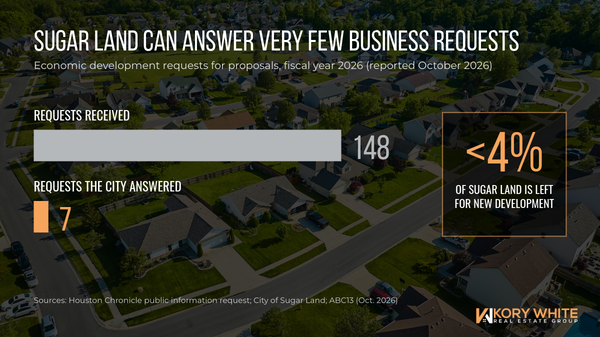
Sugar Land is almost out of room. City officials say less than 4% of the land inside the city is still available for new development. That one number shapes a lot: where new homes can go, how the city pays its bills, and what you should expect when you buy or sell here.
In this guide, I break down what Sugar Land redevelopment actually looks like, what it means for taxes and home choices, and where buyers look when Sugar Land doesn’t fit the budget.
Why Is Sugar Land Running Out of Land?
Sugar Land is running out of land because it is nearly built out and boxed in by neighboring cities. According to the city’s own planning FAQ, all land around Sugar Land is either already incorporated or inside another city’s extraterritorial jurisdiction (ETJ), so it can’t simply annex more acreage.
The squeeze showed up clearly in economic development numbers. As ABC13 reported, the city received 148 requests for proposals from businesses in the last fiscal year and responded to only 7.
Here’s the context behind those numbers:
- Big sites are gone. Prospective projects typically want 40 to 50 acres, and some ask for as much as 1,000 acres, the Houston Chronicle reported.
- 148 requests is not 148 companies. Requests come through the state, the Greater Houston Partnership, site selectors and brokers. The city then decides whether it has a site that fits.
- Some requests needed more than land. Certain projects called for runway access, deep water, rail or very large power loads.
- The dollars were real. Records the Chronicle obtained show at least $30.8 billion in potential investment from projects Sugar Land didn’t submit sites for, including a $12.5 billion manufacturing project and a $10 billion semiconductor campus.
So instead of chasing raw land, the city is focused on getting more out of what it already has.
That means redevelopment, infill and new uses for older commercial centers.
What Sugar Land Redevelopment Projects Are Happening Now?
Three areas lead the conversation: the Imperial Historic District, Lake Pointe Green on the former Fluor campus, and the Sugar Land Town Square area. Each one changes a different part of the city.
Imperial Historic District and the Char House
In June 2025, the City of Sugar Land bought the roughly 40-acre Imperial Historic District, home of the former Imperial Sugar refinery and the century-old Char House. The council approved a $50 million funding package for the purchase, preservation and utility upgrades.
Preservation work on the Char House was expected to start in April 2026 and run 18 to 24 months, according to ABC13. The city’s Imperial Historic District Strategic Vision Report floats ideas like a museum, food hall, event space, boutique hotel or rooftop lookout. Plans also call for shaded sidewalks and safer crossings that connect the district to Mayfield Park, The Hill, Constellation Field and nearby neighborhoods.
For buyers, this matters because the Imperial area sits next to established neighborhoods. Construction, traffic patterns and future uses can all change over the next few years, so it pays to ask questions before you buy close by.
👉 Search Homes in the Imperial Area and Nearby Communities
Lake Pointe Green on the Former Fluor Campus
Fluor moved its headquarters to Houston’s Energy Corridor in 2024 and left behind a 53-acre campus in the Lake Pointe area. Houston-based Lovett Group is turning it into Lake Pointe Green.
Current plans, as reported by Connect CRE, include:
- About 720 apartments
- About 350 single-family homes and townhomes
- About 10 acres of green space
- Possible ground-floor retail in the apartment buildings
- A total project value of about $400 million, with a goal of finishing in about 7 years
The city also approved incentives that include $7 million for park land, civic space and a Brooks Lake Trail expansion, plus reimbursements for demolition and public infrastructure. In other words, this is one of the few places where brand-new homes can appear inside Sugar Land city limits.
👉 Search Homes in Lake Pointe and Nearby Communities
Sugar Land Town Square and First Colony
Sugar Land Town Square and the surrounding First Colony area already have shopping, dining, offices and events. City officials named Town Square as a redevelopment focus, which usually means updating and densifying what’s already there rather than starting from scratch.
If you want walkable dining and events close to home, this part of town is worth a look. Just remember that redevelopment near commercial areas can bring more activity over time, so match the location to how you like to live.
👉 Search Homes in First Colony and Nearby Communities
How Does Being Built Out Affect Sugar Land Property Taxes?
Being built out can push the city tax rate up, because fewer new homes and buildings are added to the tax roll each year. Sugar Land’s own leaders made that connection when they raised the rate this fall.
For fiscal year 2026-27, the council adopted a city rate of $0.371116 per $100 of value, up 3.42% from $0.358827, Community Impact reported. Mayor Pro Tem Jim Vonderhaar said that with less new property bringing in revenue, the city has to raise the rate to keep up.
The city estimated that a home with a median taxable value of $369,495 would pay about $1,371 a year in city taxes, or about $58.83 more than last year.
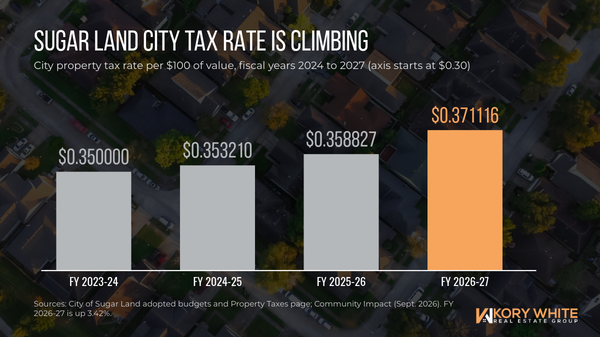
| Fiscal Year | City Tax Rate per $100 |
|---|---|
| FY 2023-24 | $0.350000 |
| FY 2024-25 | $0.353210 |
| FY 2025-26 | $0.358827 |
| FY 2026-27 | $0.371116 |
Sources: City of Sugar Land Property Taxes, City of Sugar Land adopted budgets, Community Impact.
Keep in mind that the city rate is only one piece of your bill. Most Sugar Land homes also pay Fort Bend County, a school district and drainage taxes. Some neighborhoods also carry MUD or levee improvement district (LID) taxes. You can check the exact taxing units for any address on the Fort Bend Central Appraisal District site.
Worked Example: City Tax on a $500,000 Sugar Land Home
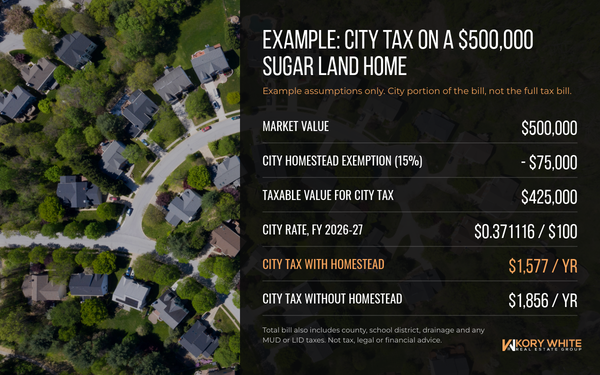
Here’s a simple example of the city portion only. These numbers are examples, not a quote for any specific home.
| Item | Example |
|---|---|
| Market value | $500,000 |
| City homestead exemption (15%) | minus $75,000 |
| Taxable value for city tax | $425,000 |
| City rate (FY 2026-27) | $0.371116 per $100 |
| Estimated city tax with homestead | about $1,577 a year |
| Estimated city tax without homestead | about $1,856 a year |
The city kept its homestead exemption at 15% for the 2025 tax year, so confirm the current figure on your appraisal notice. If you just bought, filing for your homestead exemption is one of the fastest ways to lower your bill. My Fort Bend County homestead exemption guide walks through the steps.
This example is for education only. It is not tax, legal or financial advice.
I walk through tax math like this, line by line, on The Kory White Show, so you can see how a rate change shows up in a real monthly payment.
What Does Sugar Land Redevelopment Mean for Homebuyers?
For buyers, it mostly means Sugar Land is a resale market. With so little open land, most homes for sale are existing homes, and new construction inside the city usually comes through infill, townhomes or projects like Lake Pointe Green.
Here’s what buyers commonly miss:
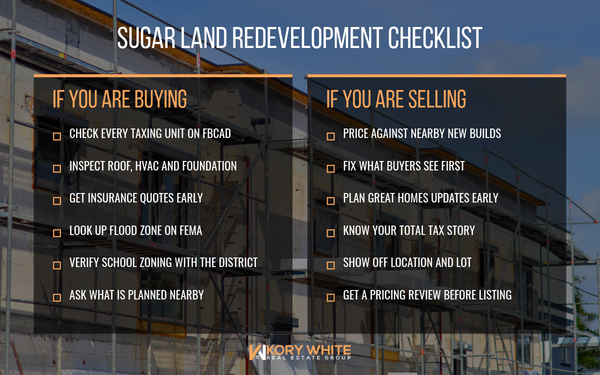
- Older homes need a closer look. Many Sugar Land neighborhoods are decades old. Budget for roof, HVAC, plumbing and foundation checks. If foundation movement worries you, read my guide on Houston-area fault lines and foundation due diligence.
- Insurance can swing your payment. Roof age and claims history matter. Get quotes early, and see why in my breakdown of Texas homeowners insurance costs.
- The city may help with exterior updates. Sugar Land’s Great Homes program reimburses part of eligible exterior projects, such as painting, roofing, driveways and windows. Homes in the bottom 3% of single-family values can qualify for up to 50% under the 2026 expansion. Check whether applications are open, and never start work before the city gives approval.
- Flood risk is address by address. Look up any home on FEMA’s Flood Map Service Center and ask for the seller’s disclosure.
- School boundaries can change. Sugar Land homes are served by Fort Bend ISD and Lamar CISD, depending on the address. Verify zoning with the district and review ratings on TXschools.gov. My post on Fort Bend ISD school closures explains why boundaries matter.
Before touring, know your real number. My guide to how much house you can afford in Texas includes taxes and insurance, not just the loan.
📘 Download the Texas Home Buyer’s Guide
What Does It Mean for Sugar Land Sellers?
For sellers, limited land means your home competes mostly with other resale homes nearby, plus new construction a few miles farther out. That second group matters more than most sellers expect.
Builders in Richmond, Rosenberg and Fulshear may offer incentives that a resale seller can’t easily match. So your pricing, condition and presentation have to make the case for location, mature trees, established neighborhoods and a shorter drive.
A few practical moves:
- Price against today’s competition. Houston-area inventory has climbed, as I covered in my post on the Houston housing market’s record inventory.
- Fix what buyers notice first. Curb appeal, roof age and obvious repairs shape offers.
- Plan exterior updates early. If you use the Great Homes program, approvals take time, so start well before you list.
🏡 See What Your Home Could Be Worth
Price. Location. Build Type.
Most buyers can get 2 of these 3, and Sugar Land makes the tradeoff easy to see:
- Location + new construction usually costs more. Inside Sugar Land, that means newer infill homes or townhomes.
- Price + new construction often means moving farther out, toward Richmond, Rosenberg or Fulshear.
- Price + location usually means buying a resale home in an established Sugar Land neighborhood.
Neither path is automatically better. It depends on your budget, commute and how much work you want to take on. I compare both sides in new construction vs. resale homes.
Nearby Areas If Sugar Land Doesn’t Fit
If Sugar Land is out of reach or you want something newer, these nearby areas often come up in the same search.
Missouri City and Stafford
Missouri City and Stafford sit right next to Sugar Land and offer similar access to US 59/I-69 and the Fort Bend Parkway. Most homes are established resale, while Missouri City also has newer master-planned options such as Sienna. Compare total tax rates, since many newer communities include MUD taxes.
👉 Search Homes in Missouri City, Stafford and Nearby Communities
Richmond and Rosenberg
West and southwest of Sugar Land, Richmond and Rosenberg are where much of Fort Bend County’s new construction is happening. Master-planned communities like Harvest Green and Aliana give buyers newer homes, though often with MUD or PID costs. If you plan to tour models, read my do’s and don’ts of visiting a builder community without your REALTOR® first.
👉 Search Homes in Richmond, Rosenberg and Nearby Communities
Fulshear and Katy
Farther northwest, Fulshear and the Katy area offer large master-planned communities such as Cross Creek Ranch and Jordan Ranch. The tradeoff is usually a longer drive for more house or newer construction. You can compare builders in my guide to home builders in Houston, and if you’re open to going even farther out, my Waller, TX guide shows how the numbers change.
👉 Search Homes in Fulshear, Katy and Nearby Communities
Should You Buy in Sugar Land Now or Wait?
It depends on your timeline, budget and how long you plan to stay. Redevelopment can add new amenities, but it can also bring construction, more traffic and changes to nearby land uses. Nobody can promise where values or rates go next, and market conditions can change.
What you can control is the decision itself. Know your full monthly payment, understand the taxing units on the address, and check what’s planned nearby before you write an offer.
📅 Schedule a Free 15-Minute Consultation
FAQ: Sugar Land Redevelopment
How much land is left to develop in Sugar Land?
Less than 4% of Sugar Land’s land is still available for new development, according to city officials. Because the city is surrounded by other cities and their ETJs, it can’t grow outward much, so most new projects will come through redevelopment and infill.
Why did Sugar Land respond to only 7 of 148 business requests?
The city only responds when it has a site that fits a project’s needs. Many requests sought 40 to 50 acres or more, and some needed rail, deep water, runway access or heavy power that Sugar Land couldn’t offer.
What is being built on the old Fluor campus in Sugar Land?
The former Fluor campus is becoming Lake Pointe Green, a 53-acre project by Lovett Group. Plans include about 720 apartments, about 350 single-family homes and townhomes, and about 10 acres of green space.
What is happening with the Imperial Sugar Char House?
The city bought the 40-acre Imperial Historic District in June 2025 and is preserving the Char House. Ideas for its future include a museum, food hall, event space, boutique hotel or lookout point, and the city is working toward a master development partner.
Did Sugar Land raise its property tax rate?
Yes. For fiscal year 2026-27, the city adopted a rate of $0.371116 per $100 of value, a 3.42% increase from $0.358827. City leaders tied the increase partly to having less new property added to the tax roll.
Are there new construction homes in Sugar Land?
Yes, but not many. New homes inside the city mostly come through infill, townhomes and redevelopment like Lake Pointe Green. Buyers who want more new construction choices often look in Richmond, Rosenberg, Fulshear or Missouri City.
Will redevelopment raise home values in Sugar Land?
No one can guarantee that. New amenities may make some areas more appealing, while construction and added density may concern others. Home values depend on the specific property, the neighborhood and overall market conditions. I talk through what to watch in local markets on The Kory White Show.
How do I check the taxes on a specific Sugar Land home?
Look up the address on the Fort Bend Central Appraisal District website to see the taxing units and values. Then ask your lender to estimate the full payment, including any MUD or LID taxes, homeowners insurance and HOA dues.
About Kory White Real Estate Group
Kory White Real Estate Group helps buyers, sellers, investors and relocating clients throughout Texas, including Dallas-Fort Worth, Greater Houston, Austin, San Antonio and surrounding communities. We help with buying, selling, relocation, new construction, first-time buyers, luxury homes, investments and leasing.
We help clients understand the home, the numbers, the market, and the deal.
From Sugar Land to Sherman. From Manvel to Mansfield.
📞 Houston: 281-738-4446 📞 Dallas: 469-336-3027 🌐 korywhiterealestategroup.com
👉 Search Homes for Sale or Lease
For agents: Infill, redevelopment and builder incentives change how you advise clients in markets like this. I break down the business side on Mentors + Masterminds = Escrows, and if you want coaching, systems and VA support behind your business, see what I’m building with CoFounders.
Information About Brokerage Services (IABS) | TREC Consumer Protection Notice

Join The Discussion