
 by
by 
Faults and Fault Lines in Houston: What Every Texas Home Buyer and Seller Should Know
If you’ve spent time house hunting in Houston, you’ve probably heard someone mention fault lines. The subject often comes up when people start talking about foundation repairs, cracked brick, sticking doors, or uneven floors.
If you’re relocating here from another state, the word fault may immediately bring California to mind. You may picture earthquakes, shaking buildings, and dramatic geological events.
That isn’t really the Houston story.
Houston sits above an extensive network of growth faults. Many developed millions of years ago as enormous amounts of sediment accumulated along the Gulf Coast. Some continue to move slowly today.
You probably won’t feel that movement happening. However, the effects can become visible over time in streets, sidewalks, utilities, drainage systems, and some residential foundations.
Should Houston Fault Lines Worry Home Buyers?
Usually, the answer is not nearly as dramatic as buyers expect.
Living near one of the Houston fault lines doesn’t automatically make a house a bad purchase. A fault also isn’t responsible for every foundation crack you see in Houston.
Expansive clay soil causes far more everyday foundation concerns throughout the region. Poor drainage, drought, plumbing leaks, trees, and changing soil moisture can also contribute to foundation movement.
The important question isn’t whether a fault exists somewhere near a neighborhood.
Instead, ask whether the specific property sits close enough to a mapped fault to warrant further investigation. Then look for evidence of movement and review the home’s repair history.
For Houston buyers, that approach can make the difference between an informed purchase and an expensive surprise.
If you’re relocating and still deciding whether Houston is the right Texas market for you, read my Dallas vs. Houston Cost of Living & Real Estate Guide. It provides a broader comparison of the two metros.
Houston’s Faults Aren’t the California Faults You’re Probably Imagining
Houston’s geology differs from the major earthquake-producing systems most people associate with the word fault.
The U.S. Geological Survey has identified more than 150 historically active faults in the Houston metropolitan area. Many are growth faults associated with the enormous buildup of sediment along the Gulf Coast over millions of years.
As layers of sand, clay, silt, and other material accumulated, their weight caused portions of the underlying sediment to shift. In a normal growth fault, one side gradually moves downward relative to the other.
For Houston real estate, the main concern is slow ground movement rather than dramatic earthquake shaking.
Some Houston faults have historically moved through gradual creep. Long periods with little measurable movement can separate those periods of activity.
You won’t necessarily feel anything happening beneath your feet. A house, however, doesn’t need an earthquake for ground movement to become a problem.
If one part of the soil beneath a concrete slab moves differently from another, the foundation can experience stress. Over time, that stress may appear as recurring cracks, uneven floors, damaged pavement, or problems with utilities.
Houston fault lines deserve attention, but they don’t deserve panic.
Subsidence Is Different From Fault Movement
Faulting is only one part of Houston’s ground-movement story.
The region also has a long history of land subsidence, which means the ground itself gradually sinks.
Groundwater withdrawal has historically driven much of Greater Houston’s subsidence. Thick layers of sand and clay beneath the region contain groundwater. When people pump large amounts of that water from the aquifer system, pressure declines.
Some of the clay layers then compact, causing the land above them to sink.
Much of that compaction is permanent.
The consequences go beyond cracks in a foundation. Subsidence can change drainage patterns, reduce elevation, damage roads and utilities, and increase flood risk. It can also influence movement along existing faults.
Houston has one dramatic example of what severe subsidence can do.
What Happened to Brownwood in Baytown?
The former Brownwood subdivision in Baytown once contained more than 400 homes.
Heavy groundwater use contributed to severe subsidence in the area. Portions of Brownwood eventually sank by as much as approximately 10 feet.
As the land dropped, the neighborhood became increasingly vulnerable to flooding and storm surge. Hurricane Alicia dealt another major blow in 1983, and residents eventually left the neighborhood.
Much of the former subdivision is now part of the Baytown Nature Center.
Brownwood represents an extreme case. However, its history helps explain why Houston eventually changed the way it manages groundwater.
Houston Has Made Major Progress on Subsidence
Houston didn’t simply allow the ground to keep sinking at historic rates.
The Texas Legislature created the Harris-Galveston Subsidence District in 1975. The district regulates groundwater withdrawal across Harris and Galveston counties.
Over time, large portions of Greater Houston moved away from heavy groundwater dependence. Surface water and other sources replaced much of that demand.
The change produced meaningful results.
Areas that greatly reduced groundwater use now experience much less subsidence than they did historically. Areas that still depend heavily on groundwater remain more likely to experience ongoing movement.
The Harris-Galveston Subsidence District continues to monitor these changes with GPS and other technology. Its current mapping resources include recent subsidence data through 2025.
That information gives today’s buyers an advantage previous generations didn’t have. We can compare historical fault locations with modern measurements of land movement.
Where Are Houston’s Fault Lines?
Houston’s fault network is much larger than most buyers realize.
The region doesn’t have only one or two famous faults. Researchers have identified more than 150 historically active faults across metropolitan Houston. Many smaller traces don’t have names most homeowners would recognize.
The U.S. Geological Survey improved Houston’s fault mapping with high-resolution LiDAR elevation data. LiDAR can detect small changes in elevation that are difficult to see from street level.
That technology works especially well in Houston because the region is so flat.
Long Point and Eureka Heights Faults
The Long Point Fault is probably Houston’s best-known fault in residential real estate conversations.
The larger fault network in this area includes:
- Long Point Fault
- Eureka Heights Fault
- Piney Point East
- Piney Point West
- Memorial Park Fault
- White Oak Fault
- Pecore East
- Pecore West
These faults extend through or near portions of Spring Branch, Memorial, the Heights, and surrounding areas.
That’s important context because these aren’t abandoned or undesirable parts of Houston. They include some of the city’s most established and valuable neighborhoods.
A fault appearing on a regional map therefore isn’t enough information to judge a house.
The property’s exact location and condition matter far more.
Addicks and Northwest Houston Faults
West and northwest Houston contain another significant collection of mapped faults and fault traces.
The Addicks Fault is one of the better-known examples. Other mapped faults occur throughout the broader northwest Houston area.
These include the Lee Fault, Fairbanks-area faults, Satsuma-area faults, Hockley-area faulting, and other nearby traces.
The subject becomes more relevant as development continues west and northwest through the Energy Corridor, Jersey Village, Cypress, Katy, and Hockley.
A mapped fault doesn’t mean every house in these communities has structural problems. It simply gives buyers another piece of information to consider.
Hockley, Tomball, Conroe, and the Northern Fault Systems
Houston’s mapped faults continue beyond the city’s traditional boundaries.
The broader Hockley-Conroe fault system extends toward northern Harris County and Montgomery County. Mapped faulting also appears around Hockley, Tomball, and Conroe.
Buyers considering Cypress, Tomball, Magnolia, The Woodlands, Conroe, and nearby communities can review fault maps alongside other property information.
That includes drainage, flood history, soil conditions, subsidence data, and the home’s structural history.
Rapid suburban development didn’t create these faults. Builders are simply developing more land near geological features that have existed for a very long time.
Southeast Houston Has Faults Too
Houston fault discussions often focus on Spring Branch and northwest Houston. The Long Point and Eureka Heights faults receive much of the attention.
Southeast Houston, however, has a complicated fault network of its own.
Mapped faulting occurs around Pasadena, Deer Park, Baytown, South Houston, Pearland, and communities near Galveston Bay.
The broader southeastern region includes the Battleground, Clodine, Mykawa, Pearland, South Houston, and other smaller mapped fault traces.
Salt domes can also influence the geology in this part of the region. These underground salt structures have pushed upward through surrounding sediments over geological time.
Faults around them can form different patterns from the longer systems found elsewhere in Houston.
Southeast Houston also experienced some of the region’s most significant historical subsidence. That’s why buyers should understand an important distinction.
Faulting, subsidence, flooding, and foundation movement can affect one another, but they aren’t the same problem.
Houston Fault Lines Map
The map below gives you a visual overview of major fault systems and fault traces across Greater Houston.
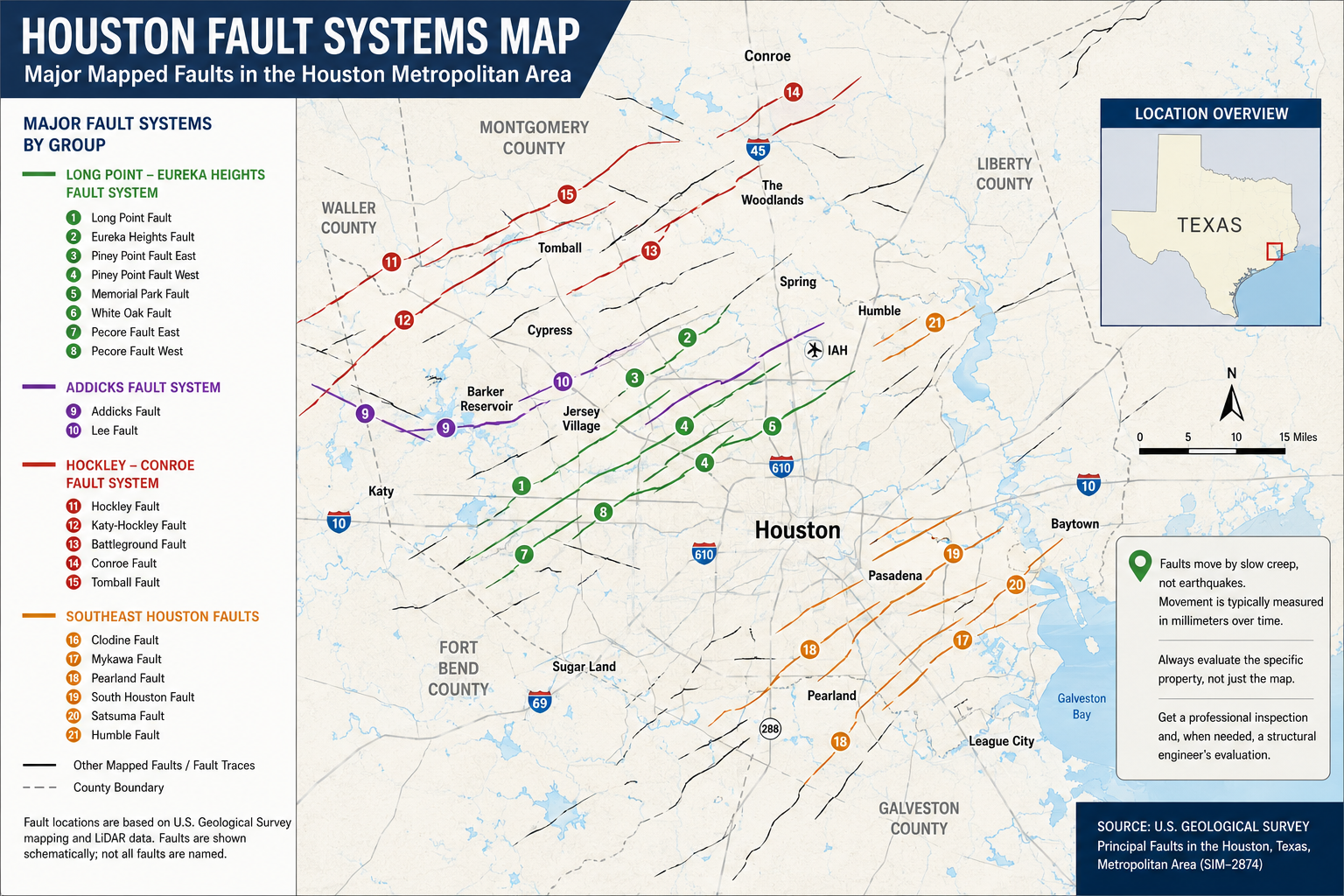
Major mapped fault systems across the Houston metropolitan area. Fault locations are approximate for consumer research and should not serve as property surveys or site-specific engineering determinations.
The map provides useful regional context, but don’t use it alone to decide whether a particular house sits directly on a fault.
Think of it as a screening tool.
If you see a mapped fault close to a property you’re considering, investigate further. You don’t necessarily need to eliminate the house.
Houston Fault Lines by Area
It helps to connect the geology with Houston neighborhoods buyers actually recognize.
Spring Branch and Memorial contain portions of the Long Point, Eureka Heights, Piney Point, and related fault systems. These established neighborhoods also provide decades of visible street and property history.
The Heights and inner northwest Houston intersect the broader Eureka Heights, White Oak, Pecore, and related fault network. The location and condition of an individual property matter more than the neighborhood name.
West Houston and the Energy Corridor sit within the broader geological environment that includes the Addicks system. Buyers should consider fault information along with flood history, drainage, reservoir proximity, and foundation history.
Cypress and Hockley move farther into Houston’s northwestern fault systems. Tomball, Magnolia, The Woodlands, and Conroe bring the northern fault network and modern subsidence monitoring into the conversation.
Pasadena, Deer Park, Baytown, Pearland, and South Houston have their own mapped faults. These areas also include salt-dome geology and some of Houston’s most significant historical subsidence.
None of this means you should avoid these communities.
Houston is geologically complicated. A statement such as “Spring Branch has faults” isn’t detailed enough to evaluate a particular house.
Ask a better question:
What is happening at this specific property?
What Can a Houston Fault Line Actually Do to a House?
A fault crossing a neighborhood doesn’t damage every home.
The concern increases when a structure sits directly across or very close to a fault experiencing differential movement.
Imagine one portion of the ground moving differently from the soil only a short distance away. The slab above those areas can experience continuing stress.
Possible warning signs include:
- Stair-step cracks through exterior brick
- Interior cracks that repeatedly return after repair
- Noticeably uneven or sloping floors
- Doors and windows that consistently bind
- Separation between the driveway and house slab
- Offsets in sidewalks or curbs
- Repeated pavement repairs
- Similar movement across several neighboring properties
One of the smartest things a buyer can do is stop looking only at the house.
Look at the Entire Street
If a driveway has an unusual offset, look at the neighboring driveway. Then check across the street.
Examine sidewalks, curbs, fences, retaining walls, and pavement.
A fault doesn’t stop at a property line.
Similar displacement across several properties along a consistent path deserves further investigation.
Don’t Blame Every Houston Foundation Crack on a Fault
This distinction matters because Houston has another major foundation challenge: expansive clay soil.
Clay absorbs moisture and expands during wet periods. It loses moisture and contracts during dry periods.
Those changes don’t always happen evenly around a house.
Poor drainage can make the problem worse. So can plumbing leaks, large trees, improper grading, prolonged drought, and inconsistent soil moisture.
As a result, Houston has plenty of houses with foundation movement that sit nowhere near a mapped fault.
The opposite can also happen. A home may sit relatively close to a mapped fault without showing meaningful structural distress.
That’s why looking at a crack and saying, “This house is on a fault line,” isn’t a diagnosis.
A qualified home inspector can identify warning signs and recommend further evaluation. A licensed structural engineer can then provide a more specialized assessment when necessary.
Does Homeowners Insurance Cover Foundation Damage?
Foundation problems can become expensive, so buyers need to understand their insurance before closing.
Typical Texas homeowners policies contain exclusions related to earth movement. Don’t assume your policy will automatically cover gradual foundation movement caused by settling, soil conditions, subsidence, or fault movement.
The cause of the damage matters.
For example, damage connected to a covered plumbing event can create a different insurance situation from gradual soil movement beneath a slab.
Discuss the specific property with your insurance professional before closing. Ask about exclusions, deductibles, water damage, available endorsements, and foundation-related coverage.
You should also include potential foundation expenses in your overall housing budget.
Property taxes, insurance, HOA dues, maintenance, drainage work, plumbing repairs, and structural repairs can all change the true cost of owning a house.
That’s why I encourage buyers to work the numbers on what they can actually afford instead of focusing only on a lender’s maximum approval.
You should also understand the hidden costs of buying a home in Texas before setting your final budget.
If you’re considering a Houston property and aren’t sure whether its foundation history deserves a closer look, schedule a free 15-minute consultation. We can talk through the property and identify the questions you should answer before moving forward.
How to Check a Houston Address Before You Buy
You don’t need to become a geologist to perform good due diligence.
You need to know where to look and when to call a professional.
Start With the USGS Houston Fault Line Map
The U.S. Geological Survey’s Principal Faults in the Houston, Texas, Metropolitan Area provides regional context for mapped Houston faults.
Remember that a geological map isn’t a property survey.
It can show that a mapped fault is near a property. It can’t reliably tell you that the fault runs beneath a specific bedroom, garage, or swimming pool.
Use the map to decide whether additional research makes sense.
Compare the Map With Current Subsidence Data
The Harris-Galveston Subsidence District maintains monitoring information that helps show where measurable land movement continues.
Combining historical fault maps with modern subsidence information gives you more context than either resource provides alone.
Walk the Property and Surrounding Block
Online research only takes you so far.
Look closely at the exterior brick, slab edges, garage floor, driveway, sidewalks, curbs, fences, grading, and drainage.
Then look at nearby properties.
You’re trying to determine whether you’re seeing an isolated cosmetic issue or a broader pattern of movement.
Read the Seller’s Disclosure Carefully
Previous foundation work doesn’t automatically make a house undesirable.
What matters is understanding what happened, what the owner repaired, who performed the work, and how the repair has performed since completion.
If the seller discloses foundation work, request the supporting documentation. Ask for invoices, engineering reports, repair diagrams, plumbing tests, warranties, and warranty transfer requirements.
Sometimes a house with professionally documented repairs is easier to evaluate than a house showing obvious movement with no repair history.
Get a Thorough Home Inspection
A general home inspection remains an important part of the buying process.
The inspector evaluates much more than the foundation. The inspection can identify structural warning signs, drainage concerns, plumbing problems, moisture issues, roof defects, electrical concerns, and other conditions.
These findings help you decide whether you need another specialist.
Bring in a Structural Engineer When Necessary
If the inspection reveals significant movement, don’t guess about the cause.
The same applies when a house sits very close to a mapped fault, previous foundation repairs raise questions, or visible conditions simply don’t make sense.
A licensed structural engineer can provide a more specialized assessment.
The engineer can evaluate the structure, measurements, repair history, and current conditions. That information can help you decide what to do next.
Decide Whether the House Still Makes Financial Sense
Finding foundation movement doesn’t automatically mean you should walk away.
It means you need more information.
Understand the condition and previous repairs. Review warranties. Estimate future expenses. Then decide whether the purchase price reflects the property’s condition and risk.
Having your mortgage pre-approval completed beforehand also gives you clearer financial boundaries when repairs or negotiations enter the conversation.
Do Houston Fault Lines Affect Property Values?
They can, but the effect isn’t as simple as drawing a fault on a map and discounting every nearby property.
Buyers usually react more strongly to visible movement, documented structural problems, incomplete repairs, and uncertainty than they do to geological maps.
Consider 2 nearby houses.
One has severely uneven floors, recurring wall cracks, exterior displacement, and no documentation explaining the problem.
The other has no major symptoms and a well-documented repair history.
Those houses present very different risks, even if they sit in the same general fault area.
This distinction matters in Houston because foundation repairs aren’t unusual. Buyers regularly encounter homes with piers or other structural repairs.
Good documentation makes those conversations much easier.
If you’re selling a property with previous foundation work, gather your records before listing. Keep the engineering reports, repair invoices, pier diagrams, plumbing tests, warranties, and later inspections together.
Give buyers enough information to evaluate a known condition instead of leaving them to imagine the worst.
If you’re selling a Houston home with previous foundation repairs, schedule a free 15-minute consultation. We can discuss how to present the home’s repair history clearly and responsibly.
What Houston Buyers Should Remember
Houston’s faults are real. Some have produced measurable surface movement and damaged infrastructure over time.
Subsidence is also real.
However, groundwater regulation and Houston’s shift toward surface water have improved conditions in many parts of the metropolitan area.
Neither fact means Houston is unsafe for home buyers.
Millions of people live throughout Greater Houston, including neighborhoods near mapped fault systems. Most don’t experience significant fault-related structural problems.
The mistake is treating regional geology as either irrelevant or catastrophic.
Neither approach helps you make a good real estate decision.
Instead, evaluate the individual property. Use the maps for context, inspect the street, read the seller’s disclosure, research previous repairs, and complete a thorough home inspection.
When the evidence calls for more investigation, bring in a structural engineer.
After closing, remember another important financial step. If the property is your primary residence in Harris County, review my Harris County homestead exemption guide.
The Bottom Line on Houston Fault Lines
Houston’s geology is complicated, but buying a house doesn’t have to be.
A fault appearing near a neighborhood shouldn’t automatically scare you away. At the same time, fresh paint shouldn’t convince you that a house has never experienced movement.
Look at the evidence.
Understand where mapped faults sit in relation to the property. Pay attention to the house and surrounding street. Review disclosures and previous repairs. Bring in qualified professionals when something deserves a closer look.
The goal isn’t to find a Houston house sitting on perfectly motionless soil.
Instead, understand the house you’re actually buying. Learn what has happened to it, what risks remain, what those risks could cost, and whether the price makes sense.
That’s the type of due diligence that protects you long after closing.
If you’re comparing Houston neighborhoods or have found a property that raises questions about foundation movement, fault proximity, flooding, or resale value, schedule a free 15-minute consultation. We’ll look at the property in context and help you identify the questions you should answer before making the commitment.
Frequently Asked Questions About Houston Fault Lines
Does Houston have earthquakes?
Houston’s main fault-related real estate concern isn’t the type of major earthquake activity people associate with California. The region contains many growth faults that have shown slow surface movement over time.
For homeowners, gradual ground movement and its possible effect on structures deserve more attention than earthquake shaking.
How can I tell whether a house is near a Houston fault line?
Start with the USGS Principal Faults in the Houston, Texas, Metropolitan Area map. Then compare it with current monitoring information from the Harris-Galveston Subsidence District.
These resources provide regional context rather than exact property boundaries. If a property appears close to a mapped fault or shows structural movement, consider professional evaluation.
Is buying a house near a Houston fault line a bad idea?
Not automatically.
Some of Houston’s most established neighborhoods contain mapped faults. The condition of the individual house matters much more than the neighborhood name alone.
Consider its location, foundation performance, drainage, repair history, and any signs of ongoing movement.
Will homeowners insurance cover foundation damage caused by a Houston fault?
Don’t assume it will.
Typical homeowners policies contain exclusions related to earth movement and gradual foundation conditions. Coverage depends on the policy and the cause of the damage.
Discuss the property and your coverage with an insurance professional before closing.
What’s the difference between fault movement and Houston clay-soil movement?
Expansive clay changes volume as moisture levels change. It can affect foundations throughout Greater Houston, including homes nowhere near a mapped fault.
Fault movement involves displacement along a geological fault.
Because both can produce similar symptoms, significant movement deserves professional evaluation.
Does a Houston seller have to disclose previous foundation problems?
Texas sellers who must provide a Seller’s Disclosure Notice answer questions about known conditions covered by the disclosure.
Buyers should review the disclosure carefully and request documents for previous structural or foundation work.
Sellers should keep repair records organized and disclose required information accurately.
Is subsidence still happening in Houston?
Yes, but conditions vary by location.
Groundwater regulation and Houston’s transition toward surface water have reduced subsidence in many areas. Places that still rely more heavily on groundwater can continue to experience measurable movement.
Current monitoring information can provide additional regional context.
Should I hire a structural engineer or a home inspector?
For most purchases, start with a thorough general home inspection.
If the inspector identifies meaningful structural concerns, previous repairs raise questions, or the property sits close to a mapped fault, consider a structural engineer.
The engineer can provide a more specialized assessment of the structure and observed movement.
About Kory White Real Estate Group
Kory White Real Estate Group helps buyers and sellers throughout Texas, including Greater Houston, Dallas-Fort Worth, Austin, San Antonio, and the communities in between.
Our approach goes beyond finding a house and negotiating a price. A smart purchase also requires understanding the property’s foundation, drainage, insurance, taxes, maintenance needs, repair history, neighborhood conditions, and future resale potential.
Whether you’re relocating to Houston, buying your first home in Harris County, moving farther into the suburbs, or selling a property with previous foundation repairs, we’ll help you gather the information needed to make a confident decision.



Join The Discussion