
 by
by 
A post blew up on my feed this week claiming that families on H-1B visas in Celina and Melissa lost their jobs, flew home and left their houses, cars and furniture behind. It says values dropped almost $100,000, homes are sliding into foreclosure and the whole market north of Dallas is “getting gutted.”
Some of that is real. Some of it is not supported by the data. And the part that matters most for you, whether you own a home up there, live next to one of these houses or want to buy, is what happens next.
So here is my straight take on North Texas foreclosures, the H-1B story, and a plan you can actually use.
The Short Answer
There is no verified wave of abandoned homes in North Texas. The viral claim refers to “more than 10” families, and news outlets that repeated it noted it was unverified and small in number. What is verified: Celina prices are down about 9% from last year, the area has a large supply of finished lots, and foreclosure filings in Collin and Denton counties are climbing faster than the rest of DFW.
Here is how the claims stack up against the record:
| What the post said | What the data shows |
|---|---|
| 10+ H-1B families in Celina and Melissa left homes behind | Anecdotal. Outlets that carried it called it unverified and small. No public data confirms an exodus. |
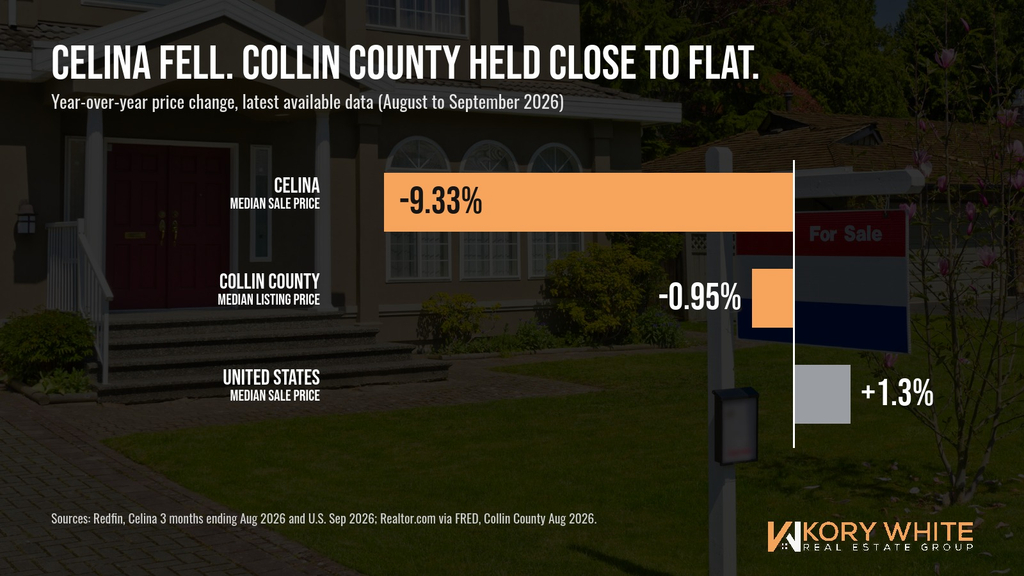
| Values dropped almost $100,000 | Plausible for some homes bought at the 2022 to 2023 peak. Celina’s median sale price was $498,665 for the 3 months ending August 2026, down 9.33% year over year (Redfin). |
| Collin County is down 9% | Not supported countywide. Collin County’s median listing price was down 0.95% year over year in August 2026, and active listings were down 1.37% (Realtor.com data via FRED). |
| Celina has 50 months of lot supply | Supported. Ted Wilson of Residential Strategies told HousingWire Celina ended Q1 2026 with 7,000+ finished lots against roughly 1,700 annual starts, about 50 months. |
| One builder fell from 70% of sales to under 30% | Reported by Bloomberg about a specific builder. It is one builder, not the whole market. |
| H-1B workers have 60 days after a layoff | Currently true. DHS has proposed eliminating that grace period, but it has not taken effect. |
Why Did H-1B Layoffs Hit Celina Harder Than the Rest of DFW?
Celina was built on fast new-construction demand, and a big share of that demand came from one buyer pool tied to tech jobs and work visas. When layoffs, visa costs and return-to-office rules hit that pool at the same time, the builders who planned phases around it were left holding lots.
According to Wilson in the same HousingWire report, 70% to 75% of new home sales in Celina from 2021 to 2025 went to international buyers, many of them H-1B holders. A balanced market usually carries about 2 years of lot supply. Celina is sitting near 4.
Three policy pressures stacked up on that buyer pool:
- The $100,000 H-1B fee. A September 2025 proclamation added it to certain new petitions. A Massachusetts federal court vacated it in June 2026, and the First Circuit refused to reinstate it on July 24, 2026, so it is currently not enforceable while the appeal continues (Ogletree).
- The 60-day grace period proposal. On September 11, 2026, DHS published a proposed rule to eliminate the up to 60-day grace period after a job ends (Federal Register). Comments are open through November 10, 2026. Until a final rule takes effect, the current 60 days still apply.
- Return-to-office and commutes. Bloomberg reported that some remote workers who bought far north were pushed into long commutes, relocations or a move back home.
I wrote about how fast Celina was growing in my breakdown of Celina’s 30,000 planned homes. That growth is still coming. The difference now is that builders, not buyers, are the ones under pressure.
One more thing needs to be said plainly. A slowdown tied to a visa program is a policy and economic story. It is not a reason to blame a community, and it is never a reason to treat buyers, sellers or neighbors differently based on national origin. That is a Fair Housing line, and it is also just the right way to do business.
What Actually Happens When a Texas Homeowner Stops Paying?
Texas is a fast foreclosure state. Most home loans here use non-judicial foreclosure, which means no lawsuit is needed. Once a loan is in default, the process can move from first notice to auction in weeks, not years.
Here is the basic sequence under Texas Property Code § 51.002:
- Missed payments. Federal servicing rules generally keep the first foreclosure notice from going out until a loan is more than 120 days delinquent.
- Notice of default. The servicer must send written notice by certified mail giving at least 20 days to cure.
- Notice of sale. If the default isn’t cured, notice of the sale must be posted, filed and mailed at least 21 days before the auction.
- Auction. Sales happen on the first Tuesday of the month at the county’s designated location. In Collin County, you can look up filed notices on the County Clerk’s foreclosure notices page.
- Deficiency risk. If the sale price is less than what is owed, the lender can sue for the difference within 2 years. Under § 51.003, the borrower can ask the court to use the home’s fair market value instead of the auction price, which can shrink or wipe out that balance.
In other words, leaving the country does not make the loan go away. It just takes away your ability to manage the outcome.
How Fast Are North Texas Foreclosures Rising?
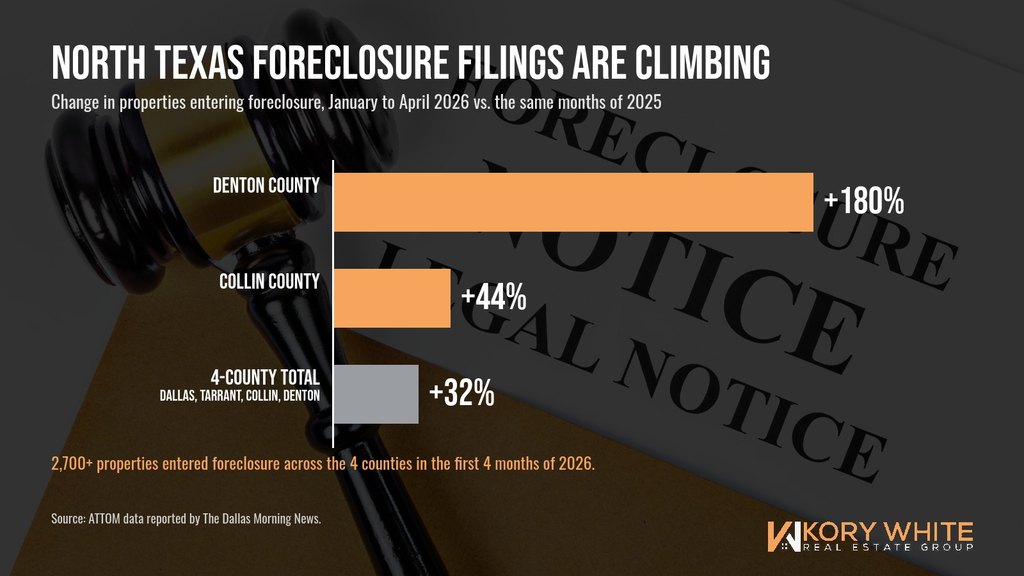
More than 2,700 properties in Dallas, Tarrant, Collin and Denton counties entered foreclosure in the first 4 months of 2026, about 32% more than the same stretch in 2025, according to ATTOM data reported by The Dallas Morning News. Collin County filings rose 44% and Denton County jumped 180%.
That sounds scary, so here is the context. Percent changes from a low base move fast. Dallas and Tarrant still account for most of the volume. And plenty of foreclosure starts get cured, sold or modified before auction day.
What Happens Next in Celina, Melissa and Nearby Areas
Expect more supply, more builder incentives and more price negotiation in new-construction-heavy subdivisions, not a market-wide collapse. Countywide numbers are much calmer than Celina’s, and that gap tells you where the pressure is.
Here is what I’m watching for 2027:
- Builders competing with resale. When a builder has standing inventory, it can offer rate buydowns or closing cost help that a regular seller can’t. That pulls buyers away from resale homes in the same price range.
- Appraisals and comps. Lower closed sales, and any foreclosure sales, become comparable sales. That can pressure appraised values on nearby homes for a while.
- Rents. Some owners who can’t sell will lease instead, which adds rental supply in the same subdivisions.
- HOA budgets. Vacant homes still owe HOA dues. When owners stop paying, the HOA covers the gap and pursues collection.
- Policy swings. If the 60-day grace period is removed, job loss could turn into a forced departure faster. If the H-1B fee stays blocked, some hiring and buyer demand could come back. Market conditions can change quickly in either direction.
Celina
Celina has the deepest exposure: heavy new construction, a large lot pipeline and prices down about 9% year over year. Sales volume is actually up (287 homes sold in August 2026 versus 197 a year earlier per Redfin), which tells you buyers are still showing up. They’re just negotiating harder. Also confirm school district boundaries for any address, since some Celina-address communities sit in Prosper ISD.
👉 Search Homes in Celina and Nearby Communities
Melissa
Melissa sits along US 75 north of McKinney and Anna, with a mix of newer subdivisions and established neighborhoods. It was named in the viral post, but I have not seen verified data showing abandoned homes there. Treat it like any growing suburb right now: compare builder incentives against resale, and look closely at the tax rate for each subdivision.
👉 Search Homes in Melissa and Nearby Communities
Anna, Prosper and Princeton
These neighbors share the same commuter corridors and a lot of the same builders. Prosper sits at a higher price point. Anna and Princeton have shown up on recent Collin County trustee sale notices, which is normal for fast-growing areas with lots of newer loans. The takeaway is the same across all three: price is set subdivision by subdivision, not city by city.
👉 Search Homes in Anna, Prosper, Princeton and Nearby Communities
How North Texas Homeowners Can Come Back From This
If you’re the owner who is behind, already moved or about to lose a job, you have more options than the viral post suggests. The worst outcome is the one where nobody calls the servicer and the house goes to auction by default.
Step 1: Call Your Servicer Before the Notice of Sale
Ask about a repayment plan, forbearance, loan modification, short sale approval or a deed in lieu of foreclosure. Get every answer in writing.
Step 2: Talk to a HUD-Approved Housing Counselor
These counselors are free or low cost and can talk to your servicer with you. Find one through the CFPB’s housing counselor search.
Step 3: Sell It the Right Way, Even From Overseas
You can list and sell a Texas home while living abroad. Most of the work can be handled with a properly drafted power of attorney accepted by the title company, remote signing where available and a local agent you trust. Two things people miss:
- FIRPTA. If you are a foreign person for tax purposes when you sell, the buyer generally must withhold 15% of the sale price for the IRS, with reduced or no withholding in some home-sale situations (IRS). Talk to a tax professional early.
- Your homestead exemption. If the home is no longer your primary residence, let the appraisal district know. Leaving the exemption on can create back taxes later.
If you owe more than the home is worth, a short sale is usually better for your credit and your future than a foreclosure. Your lender has to approve it.
Step 4: Consider Leasing, but Run the Real Numbers
Leasing can buy time if the rent covers the payment, taxes, insurance, HOA and management. In a lot of newer North Texas subdivisions, it doesn’t fully cover it right now. I walk through that math in my guide on whether to sell or rent your house.
Step 5: Protect the House While It Sits
A vacant home is a target for leaks, break-ins and squatters. Keep utilities and the HVAC running, have someone check it weekly and call your insurance company. Many homeowners policies limit coverage once a home sits vacant for an extended period, so ask what yours says. A monitored camera and sensor system, like the Vivint setups I recommend to Texas homeowners, can alert you before a small problem becomes a big one.
Texas also gave owners stronger tools against squatters. SB 1333 (effective September 1, 2025) created a law enforcement path to remove unauthorized occupants, and SB 38 (effective January 1, 2026) sped up eviction court timelines.
Step 6: Rebuild and Plan to Buy Again
How you exit matters for how soon you can buy again. General waiting periods look like this, though lenders and circumstances vary:
| Loan type | After foreclosure | After short sale or deed in lieu |
|---|---|---|
| Conventional (Fannie Mae) | 7 years | 4 years (2 with documented extenuating circumstances) |
| FHA | 3 years | 3 years |
| VA | 2 years | Varies by lender |
That’s why I push owners to act before the auction. A short sale today can mean buying again years sooner. If you want to understand which loan fits your comeback, here’s my rundown of the main types of mortgage loans in Texas.
A Worked Example: Sell, Short Sale or Walk Away?
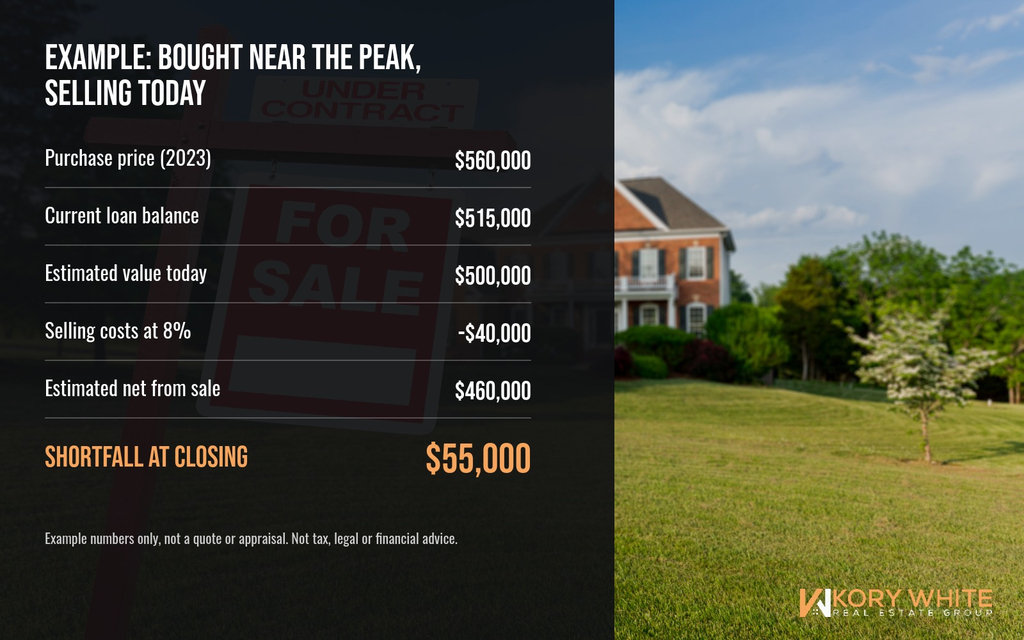
Here’s a simplified example of an owner who bought near the peak. These numbers are examples only, not quotes, appraisals or advice for your situation.
| Example assumption | Amount |
|---|---|
| Purchase price (2023) | $560,000 |
| Current loan balance | $515,000 |
| Estimated value today (about 11% below purchase) | $500,000 |
| Example selling costs at 8% (commissions, title, concessions) | $40,000 |
| Estimated net from a sale | $460,000 |
| Shortfall at closing | $55,000 |
What that owner could do:
- Bring cash to close and sell normally. Clean credit, but it takes $55,000.
- Short sale. The lender agrees to accept less. Credit takes a hit, but the waiting period to buy again is generally shorter than after a foreclosure. Ask in writing whether the lender waives the remaining balance.
- Lease and wait. Works only if the rent covers the full monthly cost and the owner can manage it from wherever they live.
- Let it go to foreclosure. The worst credit result, and the lender may still pursue a deficiency within 2 years, subject to the fair market value offset.
If you want to see where each dollar goes on a Texas closing, here’s who gets paid when you buy or sell. I also break down numbers like these on The Kory White Show, where I walk through real scenarios on camera.
This example is not tax, legal or financial advice. Talk to your lender, a tax professional and a Texas real estate attorney about your situation.
What This Means for Neighbors Who Are Staying
If you’re not selling, a softer market mostly matters for your property taxes and your patience. One vacant house on your street doesn’t set your value. Closed sales do.
- Protest your appraisal. If Collin CAD’s 2027 value is higher than what similar homes are selling for, file a protest by the deadline on your notice. Start with my Collin County homestead exemption guide to make sure your exemption is in place.
- Report vacant property issues. Overgrown yards, open doors or signs of squatting go to the HOA, city code enforcement or police, not social media.
- Don’t panic sell. If you don’t need to move, selling into a builder-heavy market often means competing with incentives you can’t match.
Where Investors Fit: Pros and Cons
Yes, there are opportunities for investors in North Texas right now, but the best ones are usually not the “abandoned house” deals people imagine. Builder inventory, bank-owned homes and properly negotiated short sales tend to be safer than chasing auction properties or approaching distressed owners directly.
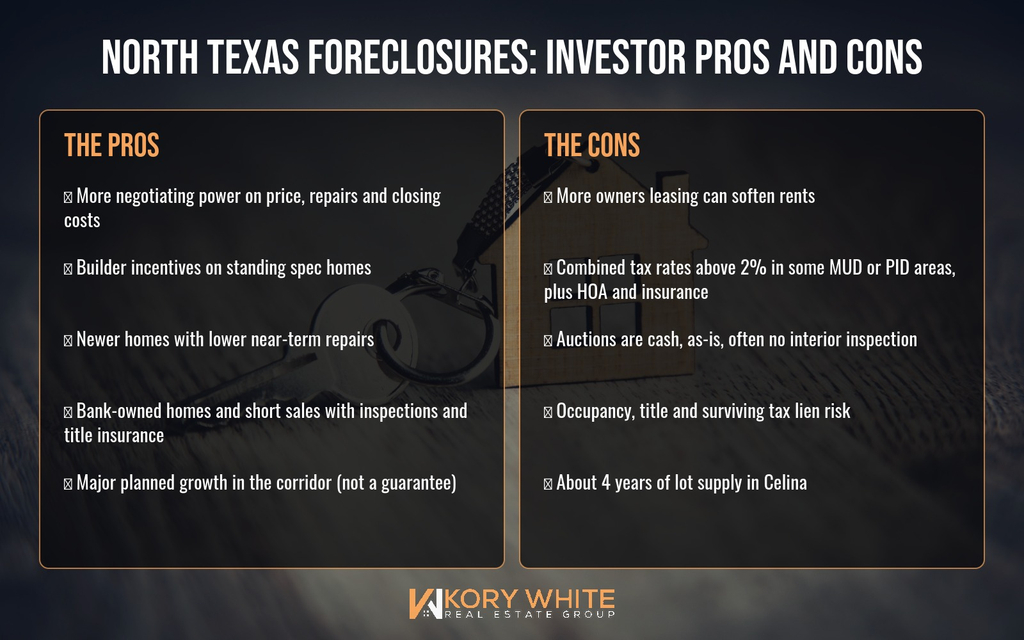
The Pros
- Negotiating power. More inventory and longer days on market give buyers leverage on price, repairs and closing costs.
- Builder incentives. Standing spec homes can come with rate buydowns or closing cost help that improve cash flow from day one.
- Newer housing stock. Many homes in this area are only a few years old, which can mean lower near-term repair costs.
- Long-term growth. The corridor still has major planned development. That is not a guarantee of appreciation, but it is a real factor.
- Short sales and REOs. Lender-approved short sales and bank-owned listings on the MLS let you buy with inspections and title insurance.
The Cons
- Rental competition. If more owners lease instead of sell, rents in the same subdivisions can soften.
- High carrying costs. Combined property tax rates in some newer subdivisions run above 2% once MUD or PID taxes are included, plus HOA dues and rising insurance.
- Auction risk. Trustee sales are usually cash, as-is and often without an interior inspection. Some liens, including property taxes, can survive the sale.
- Occupancy and title issues. A “vacant” home may not be legally vacant, and personal property left behind has to be handled correctly.
- More supply coming. With roughly 4 years of lots in Celina, prices may stay under pressure longer than expected.
Rules Every Investor Needs to Respect
- Texas regulates foreclosure “help.” Under Chapter 21 of the Texas Business and Commerce Code, anyone offering services to a homeowner in foreclosure, especially services designed to transfer title to themselves, has to follow specific contract and disclosure rules.
- Subject-to and wrap deals carry real risk. Most loans have a due-on-sale clause, and Texas has added notice and licensing requirements for these structures. Get a Texas real estate attorney involved before you sign anything.
- Fair Housing applies to investors too. Don’t target, steer or advertise based on national origin, race or any other protected class.
- Vet your money partners. If someone is raising money to “buy up abandoned Celina homes,” read what happened in the Dallas investment fraud case I covered first.
What Buyers Should Do Right Now
If you’ve been priced out of Collin County for years, this is a better time to negotiate than you’ve had in a while. Just do it with your eyes open.
- Compare new construction and resale side by side. Neither one is automatically better. Here’s how I think about new construction vs resale homes.
- Bring your own agent to the builder. The sales rep works for the builder. Read my do’s and don’ts for visiting a builder community before your first model home tour.
- Price the full payment. Tax rate, MUD or PID, HOA and insurance can swing a payment by hundreds of dollars a month on the same list price.
- Watch rates and incentives together. A builder buydown can beat a price cut depending on how long you’ll keep the loan. My take on Texas mortgage rates explains how the Fed fits in.
Price. Location. Build Type.
Most buyers in this corridor get 2 of the 3. Location plus new construction usually costs more. Price plus new construction may mean going farther north. Price plus location may mean a resale home. Pick your 2 first, and the search gets a lot easier.
👉 Search Homes for Sale or Lease
📘 Download the Texas Home Buyer’s Guide
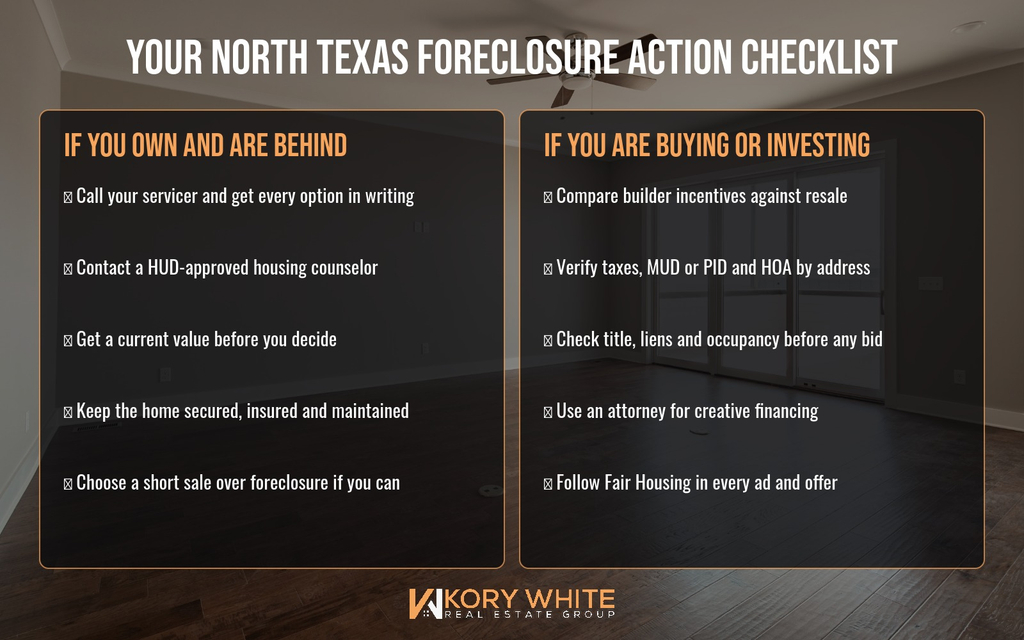
Your North Texas Foreclosure Action Checklist
If you own and you’re behind or leaving:
- Call your servicer and ask about every option in writing
- Contact a HUD-approved housing counselor
- Get a current value estimate before you decide anything
- Keep the house secured, insured and maintained
- Talk to a tax professional about FIRPTA and your homestead status
- Choose a short sale over foreclosure if you can’t cover the gap
If you’re buying or investing:
- Get pre-approved and compare builder incentives against resale
- Verify taxes, MUD or PID and HOA for each address
- Check title, liens and occupancy before any auction bid
- Use an attorney for any creative financing
- Follow Fair Housing in every ad, offer and conversation
🏡 See What Your Home Could Be Worth
My Take
The viral post gets the pain right. Some families really did lose jobs, and some homes in Celina really are worth less than their owners paid. But “our market is getting gutted” isn’t what the countywide numbers show. Celina is a builder-heavy suburb working through too many lots and a buyer pool that shrank fast. That’s a correction in specific subdivisions, and corrections create both risk and opportunity.
If you own up there, the move is to get real numbers and make a plan before the calendar makes it for you. If you’re buying or investing, the move is to negotiate hard, verify everything and treat people fairly. If you’re not ready to talk yet, I’ll keep covering what’s happening in Celina, Collin County and the rest of DFW on The Kory White Show.
📅 Schedule a Free 15-Minute Consultation
Frequently Asked Questions
Are H-1B families really abandoning homes in Celina and Melissa?
A viral post claimed more than 10 families did, but that number has not been independently verified. News outlets that repeated it described it as anecdotal. There is no public data showing a large-scale wave of abandoned homes in North Texas.
Are home prices dropping in Celina, Texas?
Yes. Celina’s median sale price was $498,665 for the 3 months ending August 2026, down 9.33% from a year earlier, according to Redfin. Countywide, Collin County’s median listing price was down less than 1% in August 2026.
How long does foreclosure take in Texas?
It can be fast. After a loan is seriously delinquent, Texas law requires a 20-day notice to cure and a 21-day notice of sale. Auctions happen on the first Tuesday of the month, so the formal process can wrap up in about 6 weeks once it starts.
Can I still owe money after a Texas foreclosure?
Possibly. The lender can sue for a deficiency within 2 years of the sale. You can ask the court to credit the home’s fair market value instead of the auction price, which may reduce or eliminate what you owe.
Can I sell my Texas home if I’ve already moved out of the country?
Yes. You can usually sell with a properly drafted power of attorney, remote signing where the title company allows it and a local agent. If you’re a foreign person for tax purposes, FIRPTA withholding may apply, so involve a tax professional early.
What is the H-1B 60-day grace period, and is it changing?
It currently gives many laid-off H-1B workers up to 60 days to find a new sponsor or change status. DHS proposed eliminating it on September 11, 2026, with comments due November 10, 2026. The grace period remains in effect until a final rule says otherwise.
Is now a good time to invest in North Texas foreclosures?
It can be, depending on the property and your plan. Bank-owned homes, approved short sales and builder inventory are generally lower risk than trustee auctions. Factor in high property taxes, rental competition and more supply coming.
How soon can I buy a home again after a foreclosure or short sale?
Generally, conventional loans require 7 years after a foreclosure and 4 years after a short sale or deed in lieu. FHA is usually 3 years and VA is usually 2. Rules vary by lender and circumstance, so talk to a loan officer about your timeline.
About Kory White Real Estate Group
Kory White Real Estate Group helps buyers, sellers, investors and relocating clients throughout Texas, including Dallas-Fort Worth, Greater Houston, Austin, San Antonio and surrounding communities. Services include buying, selling, relocation, new construction, first-time buyers, luxury, investments and leasing.
We help clients understand the home, the numbers, the market, and the deal.
From Sugar Land to Sherman. From Manvel to Mansfield.
Dallas: 469-336-3027 Houston: 281-738-4446 Website: https://korywhiterealestategroup.com/
For agents: If you’re fielding calls from owners in situations like these, I talk through the conversations, follow-up and business side on Mentors + Masterminds = Escrows. And if you want coaching, systems and VA support behind your own brand, see what we’re building with CoFounders.
This article is for general information and is not legal, tax, immigration or financial advice. Market data changes often; figures reflect sources available as of October 2026.
Information About Brokerage Services (IABS) | TREC Consumer Protection Notice



Join The Discussion