
 by
by 
If you’re shopping new construction in Texas, you’ve probably seen headlines about Lennar Millrose in the last 2 weeks. The short version: Millrose Properties, the land company Lennar spun off in 2025, bought hundreds of finished Lennar homes in about a month and started listing many of them for rent. A shareholder lawsuit followed.
Some of those homes are here in Texas. A reporter visited 39 of them in Princeton, in Collin County.
I’m not here to tell you Lennar is good or bad. I sell new construction from multiple builders across DFW and Greater Houston, and Lennar builds a lot of homes in both metros. What I want you to understand is what happened, what’s proven versus alleged, and what it changes about how you should buy a new home right now.
What Is the Lennar Millrose Controversy?
The Lennar Millrose controversy is about Lennar selling finished homes to Millrose Properties, a company it created and spun off in February 2025, and Millrose renting those homes out. Critics say the sales helped Lennar hit a quarterly target and may hide weaker buyer demand. Neither company has been found to have done anything illegal, and the claims are still allegations.
Here’s the timeline in plain English:
| Date | What happened |
|---|---|
| Feb. 7, 2025 | Lennar completes the spinoff of Millrose Properties (NYSE: MRP) as a land bank |
| 2025 filings | Millrose tells investors it will not have tenants or lease its properties |
| Aug. 27, 2026 | Millrose and 3 Lennar subsidiaries amend their agreement to add “completed single family homes” as an asset Millrose can buy and rent |
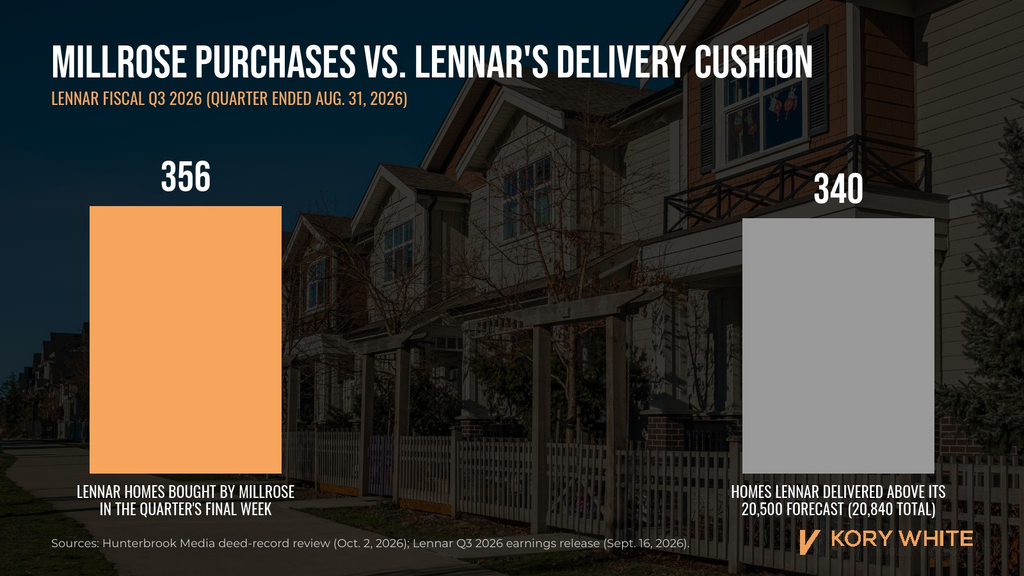
| Late Aug. 2026 | Millrose buys at least 356 Lennar homes in the last week of Lennar’s fiscal quarter, per a review of deed records |
| Sept. 16, 2026 | Lennar reports Q3 results: 20,840 deliveries vs. a forecast of at least 20,500 |
| Oct. 2, 2026 | Hunterbrook Media publishes its report: 700+ homes, roughly $200 million, 51+ counties, 15 states |
| Oct. 5, 2026 | Millrose stock closes at $22.51, down $2.10 (8.5%) |
| Oct. 9, 2026 | Shareholders file a class action against Millrose and 2 executives in federal court in South Florida |
Sources for the table are linked in each section below.
What Is a Land Bank, and Why Did Lennar Create Millrose?
A land bank is a company that owns lots so a homebuilder doesn’t have to carry all that land on its own balance sheet. The builder pays option fees for the right to buy each lot back when it’s ready to build.
Lennar moved about $5.5 billion of land, roughly 87,000 homesites, into Millrose when it launched. According to >Hunterbrook’s reporting, Lennar pays Millrose about $43 million a month in option fees to hold that land. Millrose then sells the lots back to Lennar one at a time.
That model isn’t unusual. Most large builders now control land through third parties instead of owning it outright. In its own >Q3 2026 filing, Lennar says it owns about 2% of its homesites and controls the rest through third parties, with about 86% of quarterly deliveries sourced through land banking.
The issue isn’t land banking. The issue is that the land bank started buying the finished houses too.
Did Lennar Sell Homes to Itself?
Not technically, but that’s the heart of the debate. Millrose is a separate public company with its own board. However, the ties are close:
- Lennar supplied 72% of Millrose’s revenue last quarter, per Hunterbrook’s review of Millrose filings.
- Lennar CEO Stuart Miller holds about 43% of Millrose’s voting power.
- Millrose has no employees of its own and is run by an outside manager Lennar selected.
- Millrose’s own SEC filings warned its agreements with Lennar weren’t negotiated at arm’s length.
Accounting experts quoted in the >original report argue that if Lennar effectively controls Millrose, the sales shouldn’t count as outside revenue. Lennar has said it lacks the power to direct Millrose. That question isn’t settled, and it may end up in front of a court or regulators.
Why Do These Sales Matter to Lennar’s Numbers?
Timing is the core concern. Lennar forecast at least 20,500 deliveries for its third quarter and delivered 20,840, a cushion of 340 homes. Meanwhile, deed records show Millrose bought at least 356 Lennar homes in the final week of that quarter.
In other words, without those sales, Lennar likely would have missed its delivery target.
Here’s the rest of the backdrop from Lennar’s >Q3 2026 earnings release:
| Lennar metric | Q3 2025 | Q3 2026 |
|---|---|---|
| Net earnings | $591 million | $284 million |
| Gross margin on home sales | 17.5% | 15.8% |
| Homes delivered | 21,584 | 20,840 |
| Average incentives | n/a | About 12% of price |
Lennar also lowered its full-year 2026 delivery target to 80,000 to 81,000 homes. Translation: demand is softer, and the builder is leaning hard on incentives to keep homes moving.
Is Millrose Losing Money on These Rentals?
Possibly, based on the reporting. The rent looks fine on the surface. The math after expenses and borrowing is where it gets thin.
Hunterbrook compared deed prices with Zillow rent listings and estimated:
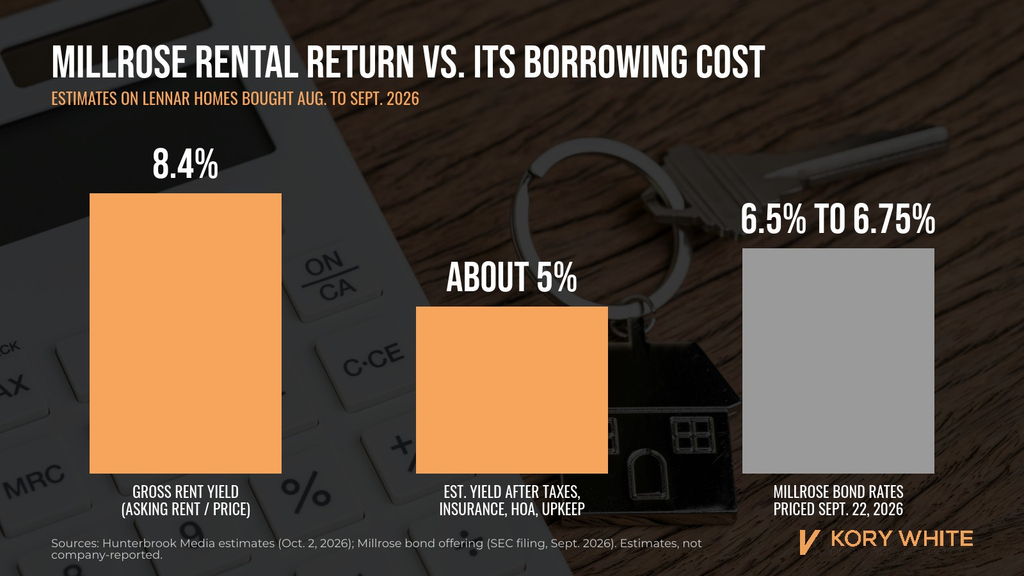
- Gross rent yield: about 8.4% of the purchase price per year
- After taxes, insurance, HOA, repairs and management: about 5%
- Millrose’s latest bond rates: 6.5% to 6.75%
Borrowing at 6.5% to buy something that earns about 5% is a negative spread. The same report estimated Millrose paid about 13% more than individual buyers in the same communities once you factor in the incentives those buyers received, though it noted that differences between homes and unrecorded incentives could affect that comparison.
A Worked Example: Why Gross Rent Isn’t Profit
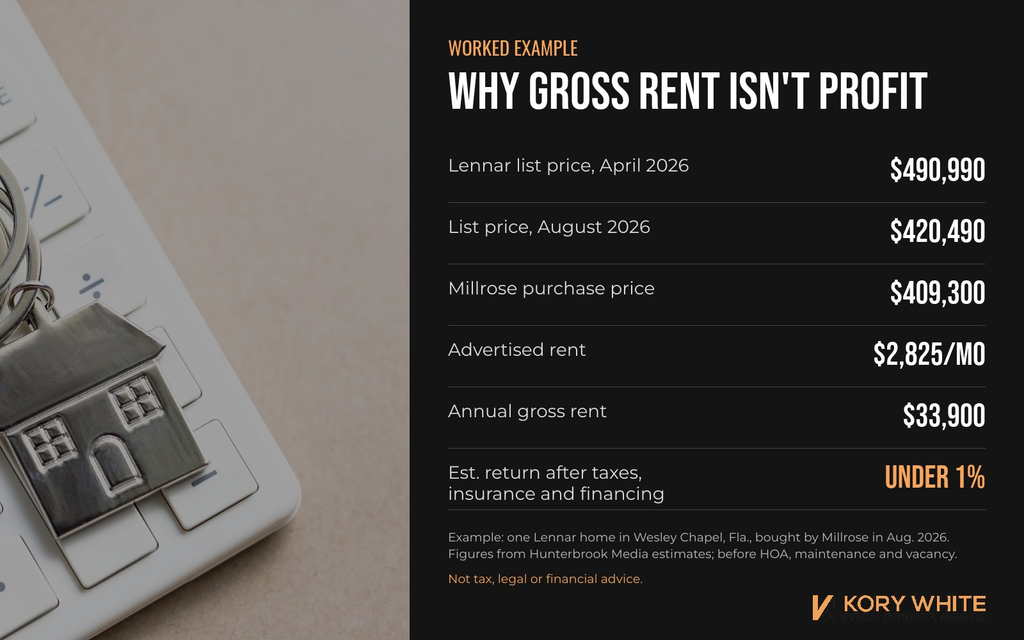
Investors, this part is for you. One home in the report, in Wesley Chapel, Florida, shows the math clearly.
| Item | Example amount |
|---|---|
| Lennar list price in April | $490,990 |
| List price in August | $420,490 |
| Millrose purchase price | $409,300 |
| Advertised rent | $2,825/month |
| Annual gross rent | About $33,900 |
| Estimated return after taxes, insurance and financing | Under 1%, before HOA, maintenance and vacancy |
Figures are from Hunterbrook’s published estimate and are shown as an example only. This is not tax, legal or financial advice.
That’s the same trap I see Texas investors fall into all the time. A rent that looks like 8% on paper can shrink to almost nothing once Texas property taxes, insurance and your interest rate show up. I walk through rental math like this on The Kory White Show, because the gap between gross and net is where most bad deals hide.
What About the Rent-to-Own Explanation?
Millrose management described the purchases to Goldman Sachs as a small rent-to-own pilot for buyers who can’t yet qualify for a mortgage, with tenants often lined up before purchase, according to a >follow-up report.
Hunterbrook says it couldn’t verify that. It found more than 95% of roughly 1,000 analyzed purchases advertised for rent to the public, and representatives of Millrose’s property manager said they didn’t offer rent-to-own. Millrose did not provide a comment to the outlet.
If Millrose rolls out a true rent-to-own program, that would change the picture. For now, buyers should treat these homes as rentals.
The Lawsuit: What It Claims and What It Doesn’t
On October 9, 2026, shareholders filed a securities class action in the U.S. District Court for the Southern District of Florida against Millrose, its CEO and its CFO, according to >The Real Deal and >Courthouse News.
The complaint alleges Millrose misled investors by saying it wouldn’t lease properties, then buying about $200 million of Lennar homes and renting them at a loss. The class period runs from February 7, 2025 to October 2, 2026, and the lead plaintiff deadline is December 8, 2026.
A few things worth keeping straight:
- Lennar is not named as a defendant in that suit, based on the reporting.
- Nothing has been proven. A lawsuit is a set of claims, not a ruling.
- The reporting comes with a conflict. Hunterbrook’s affiliated fund disclosed it was short both Lennar and Millrose stock, meaning it profits if the shares fall.
- There’s another side. A KBW analyst noted that build-to-rent sales have historically been a mid-single-digit share of Lennar’s quarterly deliveries, at margins similar to its regular home sales. Berkshire Hathaway also kept buying Lennar shares after the earnings report.
Both things can be true: the deal structure deserves scrutiny, and the final story isn’t written yet.
What Happened in Princeton, Texas?
Princeton is ground zero for the Texas side of this story. According to deed records reviewed by Hunterbrook, Millrose bought more than 1 in 4 homes Lennar sold in Princeton from late August through late September 2026.
On September 30, a reporter visited 39 Millrose-owned homes there. None appeared to be lived in, and only 4 of the 39 had a rental listing on Zillow as of October 1. That’s normal for brand-new purchases, but it tells you supply in that pocket of Collin County just shifted.
Princeton sits along the US 380 corridor east of McKinney, a fast-growing stretch of North Texas. If you’re buying there, or in nearby areas like Farmersville, Melissa, Anna and Celina, the number of rentals in a new section is a real factor for your future resale. Our Celina growth breakdown shows how quickly new supply can stack up in this part of Collin County.
Also, if you close in Princeton, don’t forget your Collin County homestead exemption. On a new home, your first tax bill is often based on a partial value, and the second one can jump.
👉 Search Homes in Princeton and Nearby Communities
What This Means for New Construction Buyers in DFW and Houston
Lennar builds across Dallas-Fort Worth and Greater Houston, so this matters well beyond one Collin County suburb. Hunterbrook’s count covered at least 51 counties in 15 states and noted the search was still ongoing, so more Texas counties could show up.
Here’s my honest read for buyers. It doesn’t mean Lennar homes are bad homes. It does mean builders are under pressure, and pressure creates leverage for prepared buyers.
Price. Location. Build Type.
Most buyers can get 2 of these 3:
- Location + new construction usually costs more.
- Price + new construction often means moving farther out, like the US 380 corridor or the outer ring around Houston.
- Price + location may mean looking at resale.
New construction isn’t automatically better or worse. Right now, though, builder incentives are large, and a new construction vs. resale comparison is worth running on the exact homes you’re considering.
👉 Search Homes in DFW, Houston and Nearby Communities
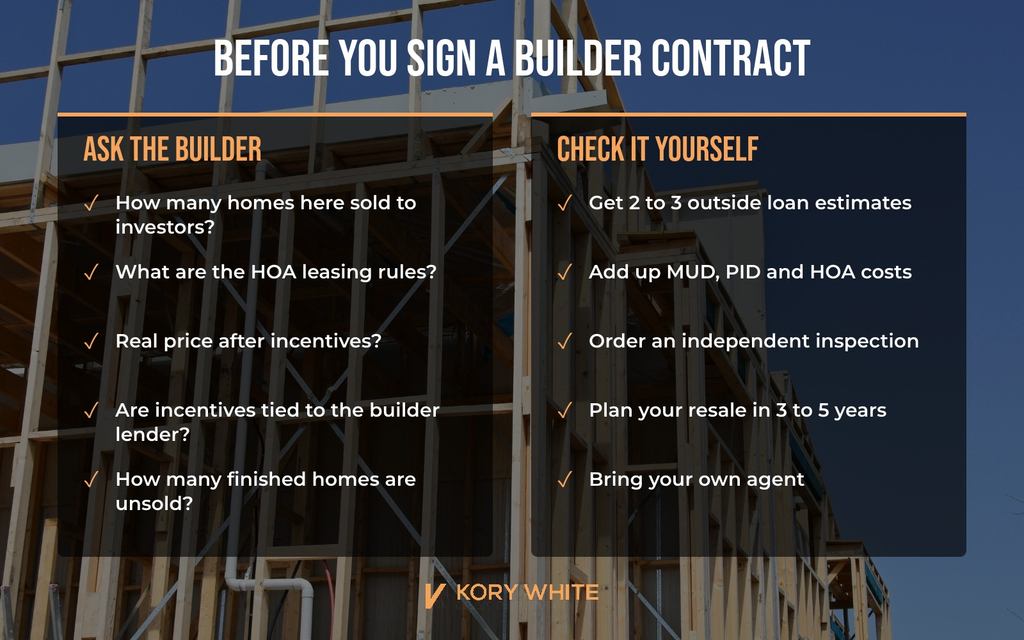
9 Questions to Ask Before You Sign a Builder Contract
This is the checklist I’d want any client to run through in any builder community right now, Lennar or not.
- How many homes in this section were sold to investors or rental companies? Ask the sales office directly. You can also see who bought a home in county deed records.
- What are the HOA rules on leasing? Look for lease minimums and rental caps in the deed restrictions. Remember, the builder usually controls the HOA board during the build-out.
- What’s the real price after incentives? Lennar’s incentives averaged about 12% last quarter. On a $372,000 home, that’s about $44,640 in value on the table. Get it itemized in writing.
- Are the incentives tied to the builder’s lender? Compare at least 2 or 3 loan estimates. Here’s why applying with multiple lenders can save real money.
- What are the MUD, PID and HOA costs? These change your monthly payment as much as the rate does. Our guide to hidden costs of buying in Texas breaks them down.
- How many finished, unsold homes are on the ground? Standing inventory means more negotiating room.
- Will you get an independent inspection? Always, including a pre-drywall inspection. In Dallas, our clients often use Nations Best Inspections.
- What’s the plan if you need to sell in 3 to 5 years? You may compete with the builder’s new phases and with rental homes in your own section.
- Who represents you? The builder’s sales rep works for the builder. Read the do’s and don’ts of visiting a builder community before you walk in.
A Texas-Specific Catch: Sale Prices Aren’t Public
Texas is a non-disclosure state. Deeds here generally show who bought a home, but not the price. That’s why the price comparisons in the national reporting relied on counties that record sale prices.
For you, it means two things. First, you need an agent with MLS access and builder relationships to know what homes actually sold for. Second, don’t assume a builder’s price sheet reflects what your neighbors paid.
Will More Rentals Hurt Home Values in These Communities?
The research is mixed, so nobody can promise you an answer either way. A 2025 study of institutional purchases around Charlotte found nearby home values fell about 2% within 5 years, but only around homes owned by publicly traded REITs. A Federal Reserve Bank of Philadelphia working paper from the same year found single-family REITs modestly raised prices.
What I tell clients is simple. A section with a high share of rentals often has more turnover and more homes competing when you list. That doesn’t make it a bad buy, but it should factor into your price and how long you plan to stay. If you’re already a homeowner in one of these communities, see what your home could be worth now, so you know where you stand against builder pricing.
And if you’re an owner thinking about renting instead of selling, our breakdown on whether to sell or rent your Texas house runs the same net-versus-gross math Millrose is facing.
What I’d Do Right Now If I Were Buying New Construction
- Don’t panic, and don’t rush. This story is about corporate accounting and investor disclosures. It isn’t about the quality of a specific house.
- Use the pressure. Builders are working hard to hit volume. That can mean better rate buydowns, closing cost help or upgrades.
- Check the rental mix before you pick a section or a lot.
- Run your own numbers at today’s rates. Our recent post on Texas mortgage rates after the Fed hike shows what the rate environment looks like.
- Watch the case. I’ll update this post as the lawsuit and any company response develop.
📘 Download the Texas Home Buyer’s Guide
📅 Schedule a Free 15-Minute Consultation
Frequently Asked Questions
What is the Lennar Millrose controversy?
It’s a dispute over Lennar selling more than 700 finished homes, worth an estimated $200 million, to Millrose Properties, the land bank it spun off in 2025. Millrose then listed many for rent despite earlier filings saying it wouldn’t lease properties. A shareholder lawsuit against Millrose followed in October 2026.
Did Lennar sell homes to itself?
Not legally. Millrose is a separate public company. However, Lennar supplies most of Millrose’s revenue and Lennar’s CEO holds about 43% of Millrose’s voting power, which is why critics argue the sales weren’t truly arm’s length.
Is Lennar being sued over Millrose?
The class action filed October 9, 2026 names Millrose, its CEO and its CFO, not Lennar, based on published reports. The claims are allegations, and no court has ruled on them.
Did Millrose buy Lennar homes in Texas?
Yes. Deed records reviewed by Hunterbrook show Millrose bought more than 1 in 4 homes Lennar sold in Princeton, Texas, from late August through late September 2026. Other Texas purchases may exist, since the national search was ongoing.
Should I still buy a Lennar home in Texas?
You can, as long as you buy with your eyes open. Get an independent inspection, compare outside lenders, ask about investor ownership in the section and review HOA leasing rules. The controversy is about corporate disclosures, not about any specific home’s construction.
How can I find out if investors are buying homes in a new community?
Ask the builder’s sales office, and check the county clerk’s deed records for buyers that are LLCs or institutional names. In Texas, deeds usually don’t show prices, so an agent with MLS and builder access helps fill the gap.
What is a land bank in homebuilding?
A land bank buys and holds lots so a builder doesn’t carry them on its balance sheet. The builder pays monthly option fees and buys lots back as it’s ready to build. I explain how builder finance affects your price and incentives on The Kory White Show.
Will rental homes in my neighborhood lower my home value?
Research is mixed. One 2025 study found about a 2% drop near REIT-owned homes over 5 years, while a Philadelphia Fed paper found modest price increases. Local supply, turnover and how long you plan to stay matter more than any single study.
About Kory White Real Estate Group
Kory White Real Estate Group helps buyers, sellers, investors and relocating clients throughout Texas, including Dallas-Fort Worth, Greater Houston, Austin, San Antonio and surrounding communities. We work with buyers on new construction, resale, first-time purchases, luxury, investments and leasing.
We help clients understand the home, the numbers, the market, and the deal.
From Sugar Land to Sherman. From Manvel to Mansfield.
Dallas: 469-336-3027 Houston: 281-738-4446 Website: korywhiterealestategroup.com
👉 Search Homes for Sale or Lease
For agents: Builder deals like this are where your buyer consultation and your numbers have to be sharp. I talk through that side of the business on >Mentors + Masterminds = Escrows, and if you want coaching, systems and VA support behind your business, take a look at what we’re building with CoFounders.
Sources: Hunterbrook Media (Oct. 2 and Oct. 8, 2026), Lennar Q3 2026 earnings release and 10-Q, Millrose SEC filings, The Real Deal, Courthouse News. Hunterbrook’s affiliated fund disclosed short positions in Lennar and Millrose. This article is for general information and isn’t legal, tax or investment advice.
Texas law requires all license holders to provide the Information About Brokerage Services and the TREC Consumer Protection Notice.




Join The Discussion