
 by
by 
When most people talk about affordability in Texas, they talk about two things: mortgage rates and property taxes. That makes sense. Those are the biggest lines on the payment.
But there is a third line that has quietly become a much bigger part of the story. Texas homeowners insurance costs have climbed faster than the national average, and they are not rising evenly across the state.
The Summer 2026 issue of Tierra Grande, published by the Texas Real Estate Research Center at Texas A&M University, took a close look at this. The researchers concluded that insurance “should be treated as a core part of the story, not a footnote.” I agree, and I see it in real transactions across Dallas-Fort Worth and Greater Houston.
Here is what the data shows, why it matters for your payment, and what buyers and sellers can actually do about it.
How Much Is Homeowners Insurance in Texas?
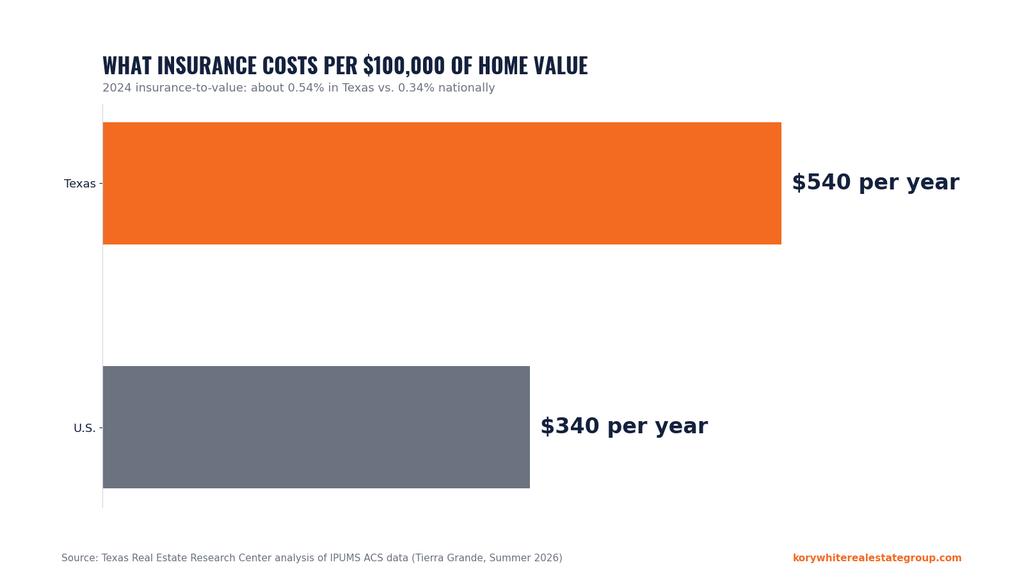
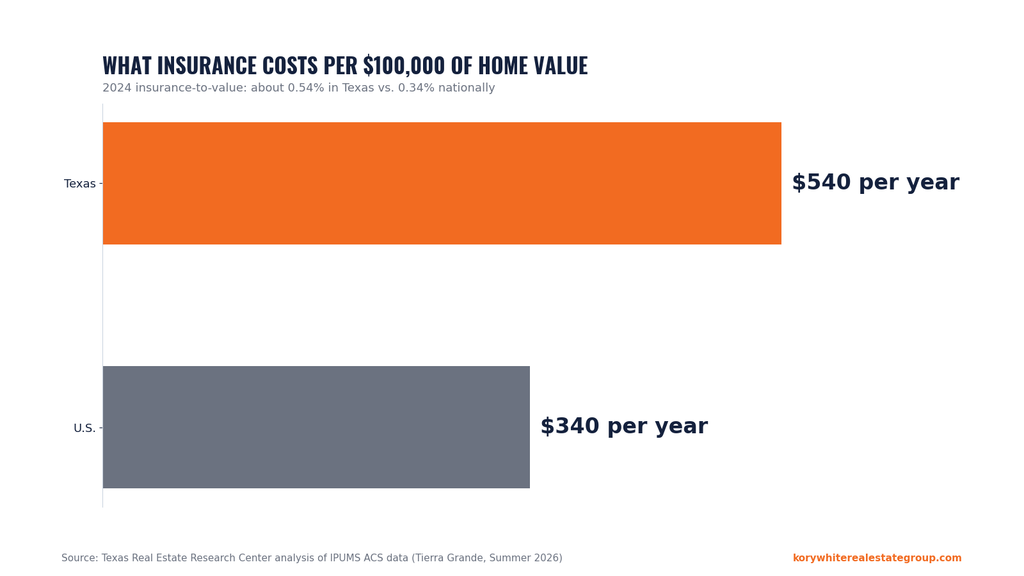
In 2024, Texas homeowners paid roughly $540 per year for every $100,000 of home value, compared with about $340 per $100,000 nationally, according to the Texas Real Estate Research Center’s analysis of Census survey data. That works out to an insurance-to-value ratio of about 0.54% in Texas versus 0.34% across the U.S.
In other words, even after you adjust for home prices, Texans carry a heavier insurance burden than most of the country.
Insurance has also become a larger share of what it costs to own a home here. Homeowners insurance made up about 8.2% of owner costs in Texas in 2024, up from 7.0% in 2017. Nationally, the share was 6.3%.
Which Texas Metros Pay the Most for Homeowners Insurance?
Dallas-Fort Worth and Houston pay the most. In 2024, owners in DFW averaged about $238 per month for homeowners insurance and Houston owners averaged about $225 per month. Austin came in at $181, and San Antonio at $157. <!– IMAGE: texas-homeowners-insurance-costs-by-metro.png | ALT: Bar chart of average monthly homeowners insurance cost in 2024 for Dallas-Fort Worth, Houston, Austin and San Antonio –>
The gap is getting wider, too. The spread between the highest and lowest cost metro grew from $47 per month in 2017 to $81 per month in 2024. Two buyers purchasing similar homes in different Texas metros can end up with noticeably different monthly payments for that reason alone.
Texas Department of Insurance (TDI) data tells a similar story from a different angle. Measured as average premium per policy, the Research Center found 2024 averages of roughly:
| Market | Avg. Premium per Policy (2024) |
|---|---|
| Dallas-Fort Worth | about $3,900 |
| Houston | about $3,600 |
| Austin | about $2,800 |
| San Antonio | about $2,600 |
| Coastal counties group | about $2,100 |
Source: Texas Real Estate Research Center analysis of TDI data, Tierra Grande, Summer 2026.
Why are these numbers higher than the monthly figures above? They come from different data sets. The TDI numbers reflect average premium per policy in force, while the monthly figures reflect what owners reported paying in the Census survey. Both point in the same direction: DFW and Houston are the high-cost insurance markets in Texas.
The coastal number looks low, and that surprises people. The researchers note that a large share of coastal wind risk is written separately through the Texas Windstorm Insurance Association (TWIA) and the Texas FAIR Plan, so the standard homeowners data may not capture the full cost of insuring a coastal home.
Why Are Texas Homeowners Insurance Costs Going Up So Fast?
The short answer is that insurers are paying more claims, those claims cost more to fix, and Texas weather keeps producing losses. Premiums followed.
The jump was sharp. In 2023, Texas property insurance costs rose 21.9% year over year, compared with 15.4% nationally. Every major metro saw a similar spike:
- Houston: +20.6%
- Dallas-Fort Worth: +20.0%
- Austin: +16.9%
- San Antonio: +22.6%
Growth stayed elevated in 2024, with DFW up 16.7% and Texas overall up 14.7%.
The drivers are not the same everywhere, though.
Dallas-Fort Worth: More Claims and Bigger Claims
DFW stands out as the clearest high-cost market. According to the Research Center, premiums there reflect persistently higher claim frequency plus a meaningful rise in claim severity. North Texas hail is a big part of that conversation, and roofs are expensive to replace.
Houston: More Claims Being Filed
Houston is also a high-cost market. Its recent increases appear to be driven mainly by a rise in claim counts, which the researchers say could support continued premium growth.
Austin and San Antonio: Event-Driven Losses
Austin and San Antonio remain lower-premium markets, but both saw substantial repricing after 2022. Their loss experience tends to spike around specific events, such as Winter Storm Uri in 2021, while repair and replacement costs have trended up.
The Price of Coverage Itself Is Rising
Here is the part I want readers to understand. The increase is not just because homes are worth more. When the Research Center standardized premiums per $1,000 of coverage, the price varied roughly 3 times from the lowest-cost counties to the highest-cost counties. The most expensive cluster sits along the coast, with elevated pricing in parts of the Panhandle and West Texas where wind, tornado and hail exposure runs high.
So you are not only insuring a more expensive house. In many areas, each dollar of coverage simply costs more than it used to.
How Much Does Insurance Change Your Monthly Payment?
Insurance is still a smaller piece of the payment than principal, interest and property taxes. However, it has become a much bigger piece of what is changing.
From 2022 to 2024, homeowners insurance accounted for about 15% of the increase in Texas owner costs, and it hit a record of about 25% in 2024. Mortgage payments still drove more than 80% of the increase over that period, while property taxes fell below 13%.
Let’s put that in real dollars. On a $400,000 home:
| Insurance Rate | Annual Premium | Monthly |
|---|---|---|
| Texas average (about 0.54%) | about $2,160 | about $180 |
| U.S. average (about 0.34%) | about $1,360 | about $113 |
These are averages, not quotes. Your actual premium depends on the home, the roof, the location, the deductible and your claims history.
Now think about how that affects buying power. At a rate around 6.75%, every extra $100 per month in insurance takes away roughly $15,000 of loan amount you could otherwise qualify for. That is why I want buyers to get real insurance quotes early, not after they fall in love with a house.
If you want to see how rates are affecting payments right now, read The Fed Just Raised Rates. What Does That Mean for Texas Homebuyers and Sellers?
📅 Schedule a Free 15-Minute Consultation and we can run the full payment, insurance included, before you write an offer.
What Texas Home Buyers Should Do Before Closing

Get Insurance Quotes During Your Option Period
In Texas, the option period is your window to investigate the property and walk away if something doesn’t work. Insurance belongs in that investigation. If a quote comes back far higher than you budgeted, you want to know while you still have choices.
Ask for a CLUE Report
A CLUE report shows the insurance claims history on a property for roughly the past 7 years. Sellers can request a free copy from LexisNexis. Prior roof, water or foundation claims can affect pricing and, in some cases, whether a carrier will write the policy.
Know the Roof
Roof age, material and condition are among the biggest pricing factors in Texas. Older roofs can lead to higher premiums, actual cash value roof coverage instead of replacement cost, or a declined application. Ask for the roof’s age and any permits or receipts.
Read the Wind and Hail Deductible
Many Texas policies use a separate wind and hail deductible written as a percentage of dwelling coverage, such as 1% or 2%. On $400,000 of dwelling coverage, a 2% deductible means you pay the first $8,000 of a hail or wind claim. A lower premium sometimes comes with a much higher deductible.
Confirm Replacement Cost vs. Actual Cash Value
Replacement cost coverage pays to repair or rebuild without deducting for age. Actual cash value subtracts depreciation. The Texas Department of Insurance notes that most mortgage companies require a replacement cost policy.
Shop More Than One Carrier
Use HelpInsure.com, the comparison site from TDI and the Office of Public Insurance Counsel, to see sample rates, complaint indexes and coverage comparisons. TDI also notes that consumers often get the best rates when they are willing to switch companies.
📘 Download the Texas Home Buyer’s Guide
Do You Need Separate Flood or Windstorm Insurance in Texas?
Flood is not covered by a standard homeowners policy. That applies whether you are in Katy, Kingwood or Keller. You can look up a property’s flood zone on the FEMA Flood Map Service Center.
Plan ahead. FEMA says there is typically a 30-day waiting period before a National Flood Insurance Program (NFIP) policy takes effect, unless the coverage is required by a lender as part of a loan or tied to a flood map change. Congress has extended NFIP authority through December 11, 2026, according to the National Association of Home Builders. If you are buying in a flood-prone area this winter, keep an eye on that date.
Windstorm coverage is a separate conversation on the coast. TWIA writes wind and hail coverage in the 14 first-tier coastal counties, including Galveston, Brazoria and Chambers, plus certain parts of Harris County. In Harris County, eligibility is limited to properties inside the city limits of La Porte, Morgan’s Point, Pasadena, Seabrook and Shore Acres and east of Highway 146. TWIA also requires a denial from at least one private insurer and a windstorm certification showing the home meets building code.
If you cannot find coverage at all, TDI points homeowners to the Texas FAIR Plan at 800-979-6440.
👉 Search Homes for Sale or Lease
What Current Homeowners Can Do About Rising Premiums
You do not have to accept every renewal notice as final. A few practical moves:
- Shop your policy at renewal. Compare at least 2 or 3 carriers using the same coverage limits and deductibles.
- Watch your escrow. When your premium rises, your lender’s escrow analysis can create a shortage and raise your monthly payment. Knowing your renewal number early helps you plan.
- Ask about discounts. Bundling, impact-resistant roofing, security systems and a clean claims history can all affect pricing. Ask your agent which ones apply.
- Review your deductible. A higher deductible may lower your premium, but only if you can comfortably cover it after a storm.
- Protest your property taxes too. Insurance is not the only line you can work on. Here is how to file a property tax protest in Harris County.
What Sellers Should Know About Insurance in Today’s Market
Buyers are paying closer attention to the full monthly payment. If a buyer’s insurance quote comes back high during the option period, that can turn into a renegotiation or a terminated contract.
Sellers can get ahead of it:
- Pull your CLUE report before listing.
- Gather roof age, permits, invoices and any impact-resistant shingle documentation.
- Share flood zone and any windstorm certification upfront if you are near the coast.
- Price with today’s buyer math in mind, not 2021’s.
🏡 See What Your Home Could Be Worth
Does New Construction Cost Less to Insure?
It can, depending on the home and the carrier. Newer roofs, current building codes and updated systems are factors insurers commonly weigh. Still, I never tell buyers new construction is automatically the better deal. Location, property taxes, MUD or PID assessments and HOA dues all matter.
Most buyers can get 2 of these 3: price, location and build type. Insurance is one more number to compare when you weigh a resale home against a new build. If you plan to tour builder communities, read The Do’s & Don’ts of Visiting a Builder Community Without Your REALTOR® first.
My Take
Insurance is not a reason to stop buying in Texas. It is a reason to stop guessing.
I would much rather a buyer find out during the option period that a home’s roof will cost an extra $90 a month to insure than find out at closing. I would rather a seller hand over a clean CLUE report and roof receipts than lose a buyer on day 9.
The buyers who do well right now are the ones who look at the whole payment. That means rate, taxes, HOA, MUD or PID, and insurance, all together.
We help clients understand the home, the numbers, the market, and the deal.
📅 Schedule a Free 15-Minute Consultation
Frequently Asked Questions About Texas Homeowners Insurance Costs
How much is homeowners insurance in Texas per month?
In 2024, owners averaged about $238 per month in Dallas-Fort Worth, $225 in Houston, $181 in Austin and $157 in San Antonio, according to the Texas Real Estate Research Center. Your premium will depend on the home, roof, location, deductible and claims history.
Why is homeowners insurance so expensive in Texas?
Texas sees frequent hail, wind, tornado, freeze and flood events, and repair costs have climbed. Research Center analysis of TDI data shows higher claim frequency and rising claim severity in markets like DFW, which pushed premiums up statewide.
Is homeowners insurance higher in Dallas or Houston?
Dallas-Fort Worth was slightly higher in 2024, at about $238 per month versus $225 in Houston. TDI premium-per-policy data also showed DFW as the highest-cost metro, at roughly $3,900 per policy compared with about $3,600 in Houston.
How much did Texas home insurance go up in 2023?
Texas property insurance costs rose about 21.9% year over year in 2023, compared with 15.4% nationally. Growth stayed elevated in 2024, with Texas up about 14.7%.
Does homeowners insurance in Texas cover flooding?
No. Standard homeowners policies do not cover flood. You need a separate flood policy through the NFIP or a private flood insurer, and NFIP policies typically have a 30-day waiting period unless purchased as part of a loan closing.
When should I get homeowners insurance quotes when buying a house in Texas?
Get quotes as soon as you are under contract, and ideally during your option period. That gives you time to adjust your budget, renegotiate or walk away if the quote changes the deal.
Who qualifies for TWIA windstorm insurance?
TWIA covers properties in the 14 first-tier coastal counties and certain parts of Harris County east of Highway 146. Applicants generally need a denial from at least one private insurer and a windstorm certification showing the property meets building code.
Can I lower my homeowners insurance premium in Texas?
Often, yes. Shopping multiple carriers, adjusting your deductible, bundling policies and documenting roof upgrades can all help. Compare options on HelpInsure.com and make sure you compare the same coverage, not just the price.
About Kory White Real Estate Group
Kory White Real Estate Group helps buyers, sellers, investors and relocating clients throughout Texas, including Dallas-Fort Worth, Greater Houston, Austin, San Antonio and surrounding communities. We work with first-time buyers, move-up buyers, new construction, luxury, investment properties and leasing.
From Sugar Land to Sherman. From Manvel to Mansfield.
- Dallas: 469-336-3027
- Houston: 281-738-4446
- Email: realtor@korywhite.com
- Website: korywhiterealestategroup.com
👉 Search Homes for Sale or Lease
📘 Download the Texas Home Buyer’s Guide
📅 Schedule a Free 15-Minute Consultation
🏡 See What Your Home Could Be Worth
Data in this article comes from “Texas homeowners insurance” research by Tian Su, Ph.D., and Mallika Natarajan of the Texas Real Estate Research Center at Texas A&M University, published in Tierra Grande, Summer 2026, using IPUMS ACS and Texas Department of Insurance data. Figures are averages and are not insurance quotes. Insurance terms vary by carrier and policy.
Join The Discussion