 by
by 
You compare homes before you choose one. Your mortgage deserves the same attention.
When you apply with multiple lenders, you can compare real costs, explore different loan programs and choose a lender who can actually close on your timeline. In my experience, the lowest advertised rate is rarely the whole story. The Consumer Financial Protection Bureau agrees: its guide to choosing a loan offer tells buyers to request, review and compare Loan Estimates from multiple lenders before deciding.
For Texas buyers in Dallas-Fort Worth, Greater Houston and everywhere in between, that comparison should answer 3 practical questions:
- What will I really pay each month?
- How much cash will I need at closing?
- Can this lender finish my financing before my contract deadlines?
Why Should You Apply With Multiple Lenders?
Applying with multiple lenders shows you the full range of financing available to you, and it exposes differences a quick rate quote can hide. That is the short answer.
One lender might offer a lower rate with higher upfront costs. Another could require less cash to close. A third may have a loan program that fits your income, credit or property better than the others.
Those differences matter because your mortgage has to fit your situation, not just look good in an ad. As a licensed Mortgage Loan Originator and a REALTOR®, I see both sides of this. Buyers who compare usually ask better questions, and better questions lead to fewer surprises at the closing table.
If you haven’t started the financing process yet, begin with why mortgage pre-approval matters so much in Texas.
Look at the Cost Behind the Rate
A lower interest rate may come with discount points, which you pay upfront in exchange for that reduced rate. On the other hand, lender credits can help cover closing costs, often in exchange for a slightly higher rate.
Neither is automatically good or bad. So ask every lender for a comparable option with no points, then review the alternatives side by side. The CFPB Loan Estimate explainer shows exactly where points, lender credits and other costs appear on the form.
Find a Lender Who Understands Your File
During your first conversation, mention anything that could affect your financing:
- Self-employment or 1099 income
- Commission, overtime or bonus income
- A recent job change
- A condo, duplex or other less typical property
- A new construction home with a moving completion date
- Interest in comparing FHA, VA, USDA and conventional programs
Then ask one question: “What would you need to verify before you can confidently move forward with my loan?”
A strong answer explains the next steps, the documents required and any potential issues. A vague answer tells you something too. If you are still sorting out which program fits, my breakdown of FHA vs. conventional loans in Texas is a good place to start.
Give Yourself Room to Negotiate
Competing Loan Estimates give you leverage to ask your preferred lender for a better offer. However, no lender is required to match another lender’s pricing.
Try something simple and respectful:
“I’d prefer to work with you. This other offer has lower upfront lender costs. Can you take another look at yours?”
That approach keeps the relationship intact while giving the lender a clear reason to sharpen its pencil.
Does Applying With Multiple Mortgage Lenders Hurt Your Credit?
Usually not much, as long as you shop within a short window. Mortgage applications create hard inquiries, but credit scoring models treat mortgage rate shopping differently from other credit applications.
According to myFICO, older FICO® Score versions group mortgage inquiries made within any 14-day span, while newer versions use a 45-day span. FICO scores also ignore mortgage inquiries less than 30 days old. The CFPB explains that multiple mortgage credit checks within the shopping window generally count as a single inquiry for scoring, and that any one inquiry typically has only a small effect.
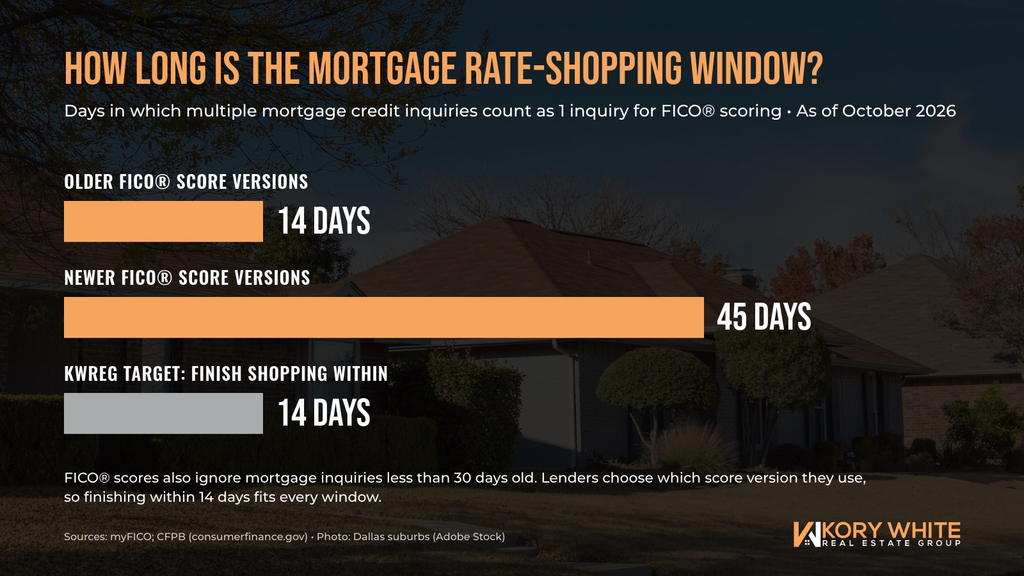
Because you can’t control which scoring version each lender uses, my practical advice is to finish your initial lender shopping within 14 days whenever you can. That fits even the shortest window. Keep in mind that each inquiry can still appear on your credit report individually, even when the score treats them as one.
Before you authorize a credit check, ask each lender:
- Is this a soft pull or a hard pull?
- When exactly will you pull my credit?
- Will you need to pull it again before closing?
Also, hold off on new credit until after closing. The CFPB specifically advises against applying for other credit, such as a car loan or new credit card, during the mortgage process.
How Many Mortgage Lenders Should You Compare?
Start with 3. That is a manageable comparison, not a legal or lending requirement.
A balanced mix could include your bank or credit union, an independent mortgage lender and a mortgage broker. If you are buying new construction, add the builder’s preferred lender so you can evaluate that incentive package honestly.
Once you have solid comparisons, stop shopping and choose. Endless applications create extra paperwork without making the decision any clearer.
How Do You Compare Loan Estimates Fairly?
Give every lender the exact same scenario. Otherwise, a “better” quote may simply reflect different assumptions.
Keep these details identical:
- Purchase price and property address
- Down payment and loan amount
- Loan program and term
- Fixed-rate or adjustable-rate structure
- Points and lender-credit assumptions
- Expected closing date and rate-lock period
Request pricing on the same day if possible, because mortgage rates can change daily.

Mortgage Offer Comparison Checklist
| Compare | What to Check |
|---|---|
| Interest rate | Is the quote locked, and for how long? |
| Principal and interest | Are both offers based on the same loan amount and term? |
| Mortgage insurance | What does it cost, and when can it come off? |
| Origination charges | Review the Section A total, including any points. |
| Services you cannot shop for | Compare Section B and ask about differences. |
| Lender credits | Find credits in Section J and the rate tradeoff behind them. |
| Cash to close | Confirm deposits, credits and down payment match across offers. |
| Taxes and insurance | Make sure low estimates aren’t creating an artificially low payment. |
| Closing timeline | Confirm the lender can meet your contract deadlines. |
For a full walkthrough of who gets paid at closing, read where the money goes when you buy or sell a home in Texas.
When Should You Receive a Loan Estimate?
A lender must send your Loan Estimate within 3 business days after receiving 6 pieces of information. According to the CFPB, those are:
- Your name
- Your income
- Your Social Security number
- The property address
- An estimate of the property’s value
- The loan amount you want
You do not need a signed purchase contract or income documents to request one. Still, a Loan Estimate is not a loan approval. It describes the terms the lender expects to offer if you move forward and meet its requirements.
Pay attention to the clock after that. The CFPB notes that a lender only has to honor a Loan Estimate for 10 business days unless you tell it you intend to proceed.
Is the Lowest Mortgage Payment Always the Best Offer?
No. Before you celebrate a lower payment, find out why it is lower.
A quote might use a longer term, different mortgage insurance or lighter estimates for property taxes and homeowners insurance. In Texas, those last 2 items can move a payment by hundreds of dollars a month. Insurance in particular has climbed fast, as I covered in why Texas homeowners insurance costs are rising.
For any Texas property, build a complete budget that includes:
- Property taxes
- Homeowners insurance, plus separate flood coverage if applicable
- Mortgage insurance
- HOA dues
- MUD taxes or PID assessments, where they apply
- Utilities and maintenance
For new construction, specifically ask whether the tax estimate reflects the finished home’s expected value rather than the lot value. A lower estimate does not make the real expense disappear. My guide to the hidden costs of buying a home in Texas covers the items buyers most often miss.
Should You Pay More Upfront for a Lower Rate?
It depends on 3 things: the added upfront cost, the monthly savings and how long you expect to keep the loan.
Here is a hypothetical example:
| Item | Example Amount |
|---|---|
| Additional upfront cost for a lower rate | $3,000 |
| Monthly principal-and-interest savings | $75 |
| Simple break-even point | 40 months |
The math is $3,000 ÷ $75 = 40 months.
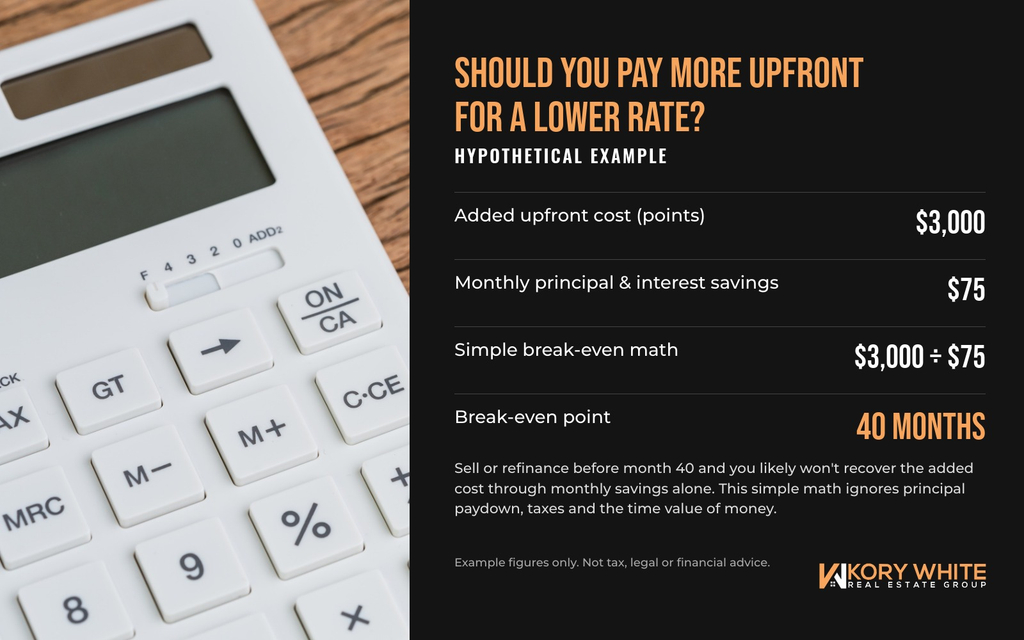
If you sell or refinance before month 40, you likely won’t recover that upfront cost through monthly savings alone. Keep in mind this simple calculation ignores differences in principal paydown, taxes and the time value of money. Also, avoid building your budget around a refinance that may never happen. Nobody can promise where rates go next.
I walk through tradeoffs like this, with real Texas numbers, on The Kory White Show.
How Should You Compare a Builder’s Preferred Lender?
Include the builder’s offer in your comparison, then get every condition in writing.
Ask the builder and its lender:
- Does the incentive require a specific lender or loan program?
- Does it apply to this exact home and closing date?
- Is the lower payment temporary, such as a 2-1 buydown?
- What will my payment be after any temporary buydown ends?
- How much cash will I need to close?
- Which incentives would I lose by using outside financing?
Builder offers vary widely. Compare the complete purchase and financing package before assuming the biggest advertised incentive is the best value. If you plan to tour model homes first, read the do’s and don’ts of visiting a builder community without your REALTOR® before you sign anything.
Price. Location. Build Type.
Most buyers can prioritize 2 of 3. Location plus new construction may cost more. Price plus new construction may mean moving farther out. Price plus location may mean considering resale. Financing is part of that equation, so compare it with the same care.
Can Another Lender Help If Your First Lender Says No?
Possibly, but a second application does not guarantee approval.
Ask the first lender to explain the issue clearly. Then give the next lender the same accurate information so it can tell you whether it has a workable option. Lenders use different overlays and programs, so a second opinion can be worth it. However, an unresolved income, credit, asset or property issue will usually follow you to the next application.
Multiple preapprovals are not insurance against a denial. If you’ve heard no once, read my take on first-time buyers being priced out in Texas. One no from one lender is not always the end of the road.
What Should You Ask Before Switching Lenders Under Contract?
Before switching mid-contract, confirm the new lender can meet every deadline.
Ask:
- What documents do you still need from me?
- How much underwriting review remains?
- Will I need a new appraisal?
- Could I pay duplicate or nonrefundable fees?
- Will your rate lock cover my closing date?
- Can you realistically close on time?
Coordinate any change with your real estate agent. A better rate does not help if it costs you the house or your option period strategy.
Prepare Once, Then Compare With Confidence
Keep a secure folder with the documents lenders commonly request: pay stubs, W-2s or 1099s, bank statements, tax returns and ID. Share sensitive files only through secure lender portals, never by regular email. And keep your purchase details consistent across every application.
Want help setting a realistic price range before you shop? Start with how much house you can afford in Texas.
📘 Download the Texas Home Buyer’s Guide
Frequently Asked Questions
Can I apply for a mortgage with more than one lender?
Yes. You can apply with multiple lenders to compare financing options. Keep your information consistent across applications and finish your initial shopping within about 14 days to limit credit impact.
Does getting preapproved mean I have to use that lender?
No. A preapproval does not obligate you to use that lender. Ask about any fees before you authorize an appraisal or further processing.
Do multiple mortgage inquiries count separately on my credit score?
Usually not for scoring. FICO groups qualifying mortgage inquiries within a 14-day or 45-day window, depending on the version, and the CFPB says they generally count as a single inquiry. They can still show individually on your credit report.
How many lenders should I compare when buying a home in Texas?
Three is a practical starting point. A bank or credit union, an independent mortgage lender and a mortgage broker gives you a useful spread without drowning you in paperwork.
Can I get a Loan Estimate before I have a contract on a house?
Yes. Lenders must issue a Loan Estimate within 3 business days once they have your name, income, Social Security number, property address, estimated value and desired loan amount. A signed purchase contract is not required.
Is a Loan Estimate the same as a mortgage approval?
No. A Loan Estimate shows anticipated terms and costs. The lender still has to review your full application before final approval.
Should I just choose the lender with the lowest rate?
Not automatically. Compare the rate alongside points, lender credits, mortgage insurance, cash to close and the lender’s ability to close on time. If you’d rather see this explained on video, I break down rate-versus-cost decisions on The Kory White Show.
Can I change lenders after my offer is accepted?
Often, yes. Before changing, confirm the new lender’s timeline, remaining requirements, appraisal needs and any duplicate costs with both your agent and the lender.
Choose Financing That Fits Your Home, Not Just the Ad
Your first offer might be a great one. Comparing it is how you find out.
If you want a second set of eyes on your Loan Estimates, or help lining up a home search with your financing, let’s talk.
📅 Schedule a Free 15-Minute Consultation
👉 Search Homes for Sale or Lease
About Kory White Real Estate Group
Kory White Real Estate Group helps buyers, sellers, investors and relocating clients throughout Texas, including Dallas-Fort Worth, Greater Houston, Austin, San Antonio and surrounding communities. We help with buying, selling, relocation, new construction, first-time buyers, luxury, investments and leasing.
We help clients understand the home, the numbers, the market, and the deal.
Kory White is a Texas REALTOR®, investor, coach and licensed Mortgage Loan Originator (NMLS #2527042) who began his real estate career in 2003.
From Sugar Land to Sherman. From Manvel to Mansfield.
Dallas: 469-336-3027
Houston: 281-738-4446
Website: korywhiterealestategroup.com
Agents: Lender relationships are a big part of keeping deals on schedule. I talk business building, conversion and leverage on Mentors + Masterminds = Escrows. If you want coaching, VA support and systems behind your business, see what I’m building with CoFounders.
This article is for general education and is not tax, legal or financial advice. Loan approval, pricing and program availability depend on lender review and individual qualifications. Market conditions can change.