 by
by 
Texas distilleries are not just making whiskey. They are buying old golf courses, moving into former grocery stores, filling rice silos with grain and turning dead industrial blocks into places people drive across town to visit.
That matters if you buy, sell, lease or invest in Texas real estate. A distillery can be the anchor that pulls restaurants and foot traffic into a district. It can also bring parking pressure, noise, zoning questions and insurance conversations you did not see coming.
I’m Kory White, and I help clients across Dallas-Fort Worth and Greater Houston. Here’s the real estate side of the Texas spirits boom: who’s distilling where, the deals behind the buildings, and what it means for your next move.
How Big Is the Texas Distillery Industry?
Texas went from 8 distilleries in 2008 to about 190 by 2020, according to a University of Texas at San Antonio study prepared for the Distilled Spirits Council. That same study credited Texas distillers with nearly $2 billion in total economic output and close to 4,900 supported jobs.
Tourism is a big piece of it. A study for the Texas Distilled Spirits Association estimated that the state’s 188 distillers produced about $831.7 million in total economic impact from distillery tourism in 2022, plus $42.5 million in state and local tax revenue.
For real estate, those numbers translate into one thing: distilleries need space, and increasingly they want space the public can visit.
Texas Drinks Out: The Numbers Cities Track
Distilleries are only one part of a much bigger alcohol economy. Bars, restaurants and venues in the City of Houston sold more than $1.5 billion in alcoholic beverages in 2025, according to Houston First’s review of Texas Comptroller data. Dallas came in at $1.2 billion, Austin at $1.1 billion, San Antonio at $843 million and Fort Worth at $476 million. Statewide, sales reached $10.4 billion.
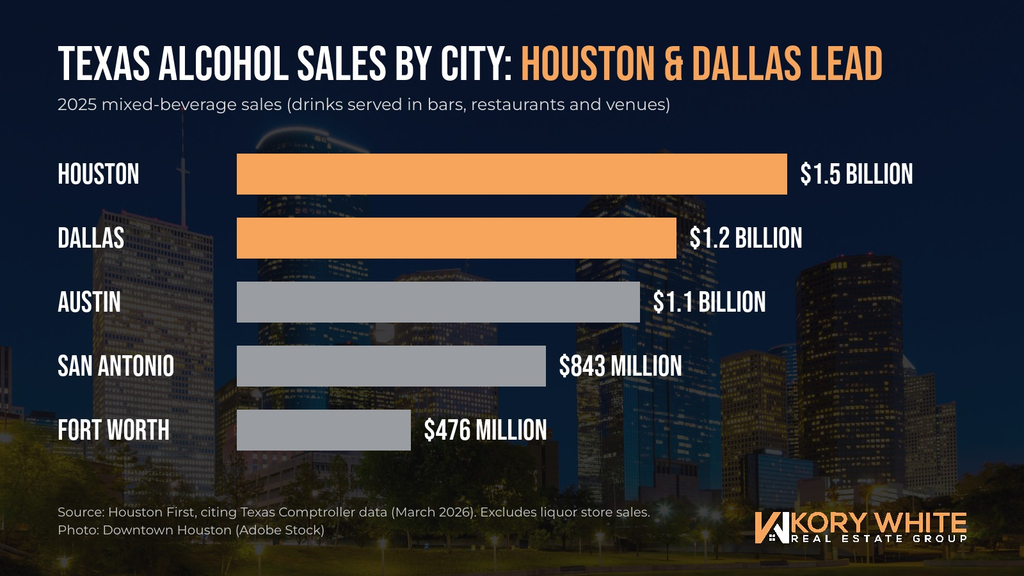
Source: Houston First, citing Texas Comptroller data, March 2026. Figures cover drinks served in bars and restaurants, not liquor store sales.
Why should a homeowner care? Because cities receive a share of that tax money. The Texas Comptroller allocates 10.7143% of mixed beverage tax receipts from businesses inside a city back to that city, and counties receive a share as well.
Worked Example: What Drink Sales Can Mean for a City Budget
Here’s a rough, simplified illustration using Houston’s 2025 figure. Treat it as an example, not an official city number.
- Mixed beverage gross receipts tax: 6.7%
- Mixed beverage sales tax: 8.25%
- Example sales base: $1.5 billion
- Combined state taxes: about $224 million
- City share at 10.7143%: roughly $24 million
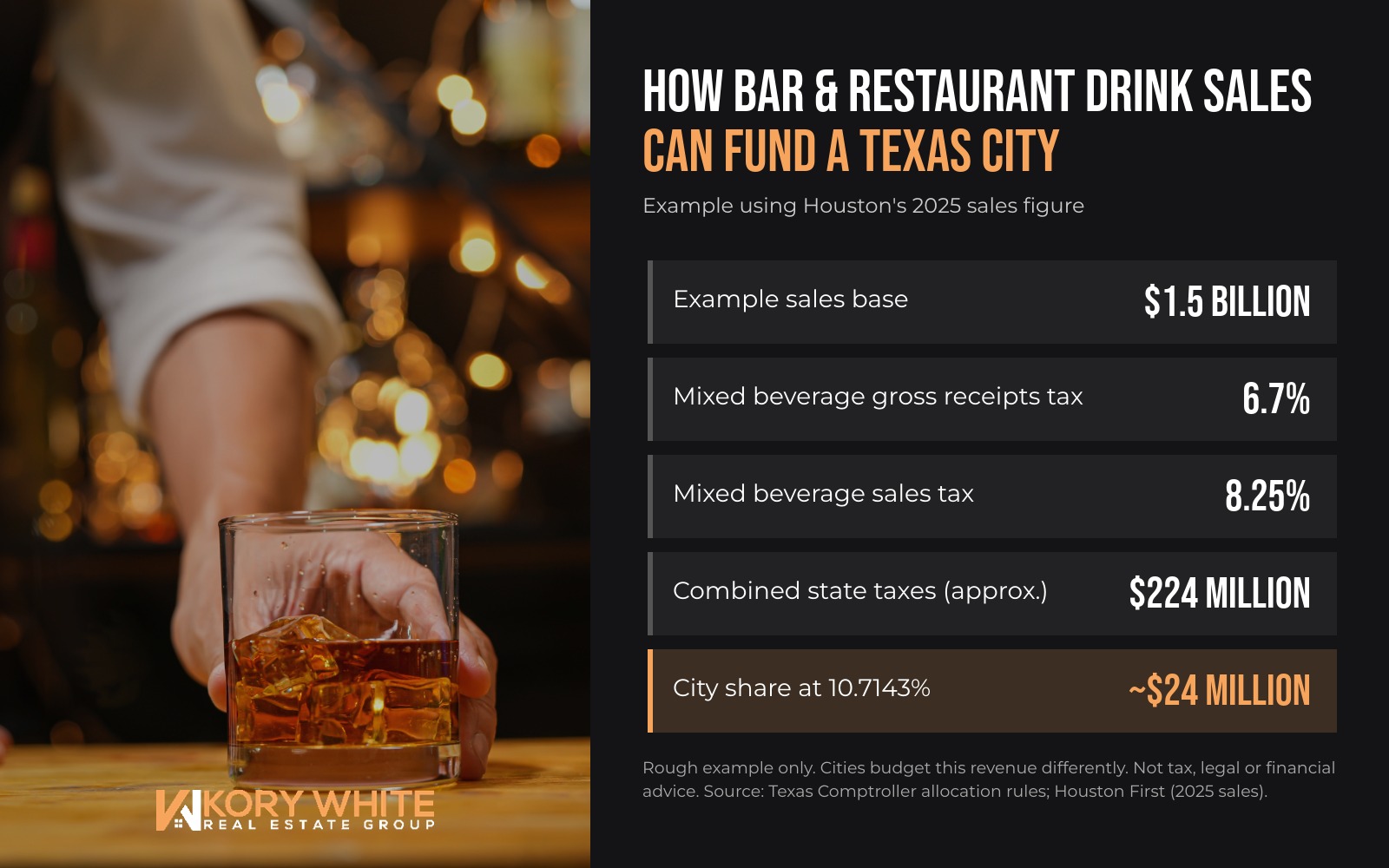
That money does not lower anyone’s property tax bill directly, and every city budgets it differently. Still, it shows why many Texas cities court restaurants, tasting rooms and entertainment districts. I walk through local numbers like this on The Kory White Show.
The Big Crossover Stories: When Whiskey Bought the Real Estate
Whiskey Ranch: A Fort Worth Golf Course Turned Distillery
This is the best whiskey-meets-real-estate story in Texas. Firestone & Robertson Distilling Co., the maker of TX Whiskey, bought 112 acres of the former Glen Garden Country Club in southeast Fort Worth in 2014. Ben Hogan and Byron Nelson learned the game on that course.
The club had closed and the course had declined before it went up for sale. Instead of a subdivision or a vacant tract, the site became Whiskey Ranch, which opened in November 2017 with a column still, visitor center, tavern, event space, barrel warehouse and a lake. The owners kept the 18 holes for private and charity events.
Capacity jumped from about 3 barrels a day at the original Vickery Boulevard warehouse to roughly 40 barrels a day at the Ranch. Then in 2019, French spirits giant Pernod Ricard bought the company, and the deal included Whiskey Ranch.
The real estate lesson: a closed golf course is a hard asset to reuse. Housing often gets proposed first. Here, a destination business found a use that kept the open space and added a tourism anchor for Fort Worth’s east side.
👉 Search Homes in Fort Worth and Nearby Communities
Houston’s Uncle Ben’s Rice Plant Becomes a Whiskey Plant
On Clinton Drive in Houston’s East End, the de Aldecoa family bought the old Uncle Ben’s Rice facility in the 1990s and turned it into a coffee processing operation. Later they carved out a distillery: Gulf Coast Distillers, which also markets itself as Giant Texas Distillers.
The silos that once held rice now store Texas-grown corn, rye and barley. The tasting room sits in a 1940s building. In 2024 the company also leased the former Buffalo Bayou Brewing Company venue at 2101 Summer St. in Sawyer Yards for its Tejas Beer brand, backfilling a high-profile space soon after the prior brewery left.
The real estate lesson: industrial buildings with heavy power, water and floor loads are hard to replace. Beverage makers often value exactly what office or retail users can’t use.
👉 Search Homes in the East End, Sawyer Yards and Nearby Communities
Balcones: From Under a Bridge to a 1923 Waco Landmark
Balcones started in an old welding shop under a bridge in downtown Waco. In 2011, the company bought the Texas Fireproof Storage Building, a 65,000-square-foot structure built in 1923 that survived the 1953 tornado. It opened as the new Balcones distillery in 2016 with 4 times the still capacity, and the company projected nearly $300,000 in property taxes over 5 years.
The real estate lesson: a vacant historic building on a busy downtown corner went back on the tax rolls with an active use.
A Former Piggly Wiggly in Old Town Lewisville
Bendt Distilling Co. operates out of a former Piggly Wiggly grocery store near Main Street in Lewisville. More recently, the owners opened Ethel Janes, a whiskey kitchen inside a 1920s-era building on West Main Street.
Local coverage credits Bendt’s tasting room and live music with helping turn Old Town Lewisville into a nightlife stop before its broader retail revival.
👉 Search Homes in Lewisville and Nearby Communities
Garland Changed Zoning to Land a Distillery
Lockwood Distilling Co. started in Richardson in 2019, added McKinney, then closed its Fort Worth Magnolia Avenue location in 2025. The next move was downtown Garland, where it opened a 5,000-square-foot tasting room and dining room at 532 Main St. in February 2026.
The founder said Garland’s City Council courted the business, and the deal included changing local zoning. That is a city using a distillery brand to strengthen a downtown square.
👉 Search Homes in Garland, Richardson, McKinney and Nearby Communities
Dallas-Fort Worth Distilleries Worth Knowing
DFW’s spirits scene runs from industrial edges of Dallas to historic downtown squares in the suburbs. Here are distilleries tied to real places and real buildings.
Dallas: Design District Area
New Artisan Distillery sits at 8202 Chancellor Row, just north of the Design District, in an industrial pocket. Chef Robert Del Grande and Don Short founded it in 2021. Industrial-to-hospitality conversions like this are a big reason areas around the Design District keep changing.
👉 Search Homes in the Design District, Oak Lawn and Nearby Communities
Wylie and Garland
Herman Marshall Whiskey was the first legal distillery in Dallas County since Prohibition when it opened in Garland in 2010. After Dry County Distilleries bought the brand in 2021, operations moved to Historic Downtown Wylie, where the brand now runs a tasting room at 121 N. Ballard Ave.
👉 Search Homes in Wylie and Nearby Communities
Fort Worth: Foundry District and Southeast Fort Worth
Blackland Distillery opened in 2019 at 2616 Weisenberger St. in the Foundry District and later expanded into an adjacent warehouse to add a second rickhouse and event space. Along with Whiskey Ranch, it shows two very different Fort Worth models: an urban warehouse and a 112-acre campus.
👉 Search Homes in Fort Worth’s Near Southside, Cultural District and Nearby Communities
Denison
Ironroot Republic in Denison was founded in 2013 by brothers Robert and Jonathan Likarish. In 2020, its Harbinger 115 became the first bourbon from outside Kentucky to win World’s Best Bourbon at the World Whiskies Awards. It pulls whiskey tourists to the Texoma area, near Sherman and Lake Texoma.
👉 Search Homes in Denison, Sherman and Nearby Communities
If you’re relocating and want the full DFW food and drink picture, start with my 10 favorite DFW restaurants.
Houston Distilleries Worth Knowing
Houston’s distilling scene got a slower start than its brewery scene, but it now includes some of the largest and most distinctive operations in Texas.
Galleria and Uptown Area
Yellow Rose Distilling launched in 2010 as Houston’s first legal whiskey distillery and opened a 10,000-square-foot facility at 1224 N. Post Oak Rd., near Uptown and Memorial Park. The founders noted that city inspectors and the fire marshal weren’t sure at first how to handle a distillery permit. That’s a useful reminder for any commercial landlord.
👉 Search Homes in Uptown, Memorial and Nearby Communities
East End and EaDo
Gulf Coast Distillers anchors the East End on Clinton Drive. Nearby in EaDo, 8th Wonder opened a distillery at 2201 Dallas St. in 2019, across the street from its brewery, taking over space and equipment from a short-lived rum distillery. The expansion came with a 10-year lease extension and a one-acre parking lot.
👉 Search Homes in EaDo, the East End and Nearby Communities
Houston-Area Independents
Highway Vodka, founded by Ben Williams and Wendell Robbins, is known as the first Black-owned distillery in Texas and makes hemp seed vodka. Whitmeyer’s Distilling Co., founded by brothers Travis and Chris Whitmeyer in 2012, also helped build the city’s early craft spirits scene.
If food and drink matter in your relocation decision, read my Dallas vs. Houston food breakdown.
Outside the Big Metros: Hill Country, Austin and Waco
Some of the best-known Texas distilleries sit on ranch land, and they have helped make rural road trips part of Texas tourism.
Hye: Garrison Brothers
Garrison Brothers Distillery in Hye calls itself the first and oldest legal whiskey distillery in Texas. It sits on a 68-acre working ranch along the U.S. 290 corridor between Johnson City and Fredericksburg, a stretch already known for wineries.
Dripping Springs: Treaty Oak Ranch
Treaty Oak Distilling opened its 27-acre Treaty Oak Ranch in Dripping Springs in 2015, adding a tasting room, restaurant, live music and family areas to a working distillery. It is a clear example of a distillery acting more like a destination venue than a factory.
Austin: Still Austin in St. Elmo
Still Austin Whiskey Co. opened in September 2017 as the first whiskey distillery inside Austin city limits since Prohibition. It sits in The Yard, a mixed maker development on St. Elmo Road in South Austin, alongside a brewery, coffee roaster and other local businesses.
Waco: Balcones
As covered above, Balcones turned a 1923 storage building into a working distillery and visitor stop in downtown Waco.
👉 Search Homes in Austin, the Hill Country and Nearby Communities
Do Distilleries Raise Nearby Home Values?
There’s no Texas study that proves a distillery raises home values. The closest research looks at craft breweries. A study of Charlotte, North Carolina, published in Growth and Change by researchers at the University of Toledo and UNC Charlotte, found that craft breweries had a positive effect on nearby residential property values and no significant effect on commercial property values.
There are important limits. The researchers noted that many brewery areas already carried a price premium before the brewery opened. They also said the effect may be smaller in places with higher vacancy, slower growth or very established cities.
So here’s my honest take. A distillery is usually a sign that a neighborhood is already changing, not a guarantee that values will rise. Market conditions can change, and every street is different.
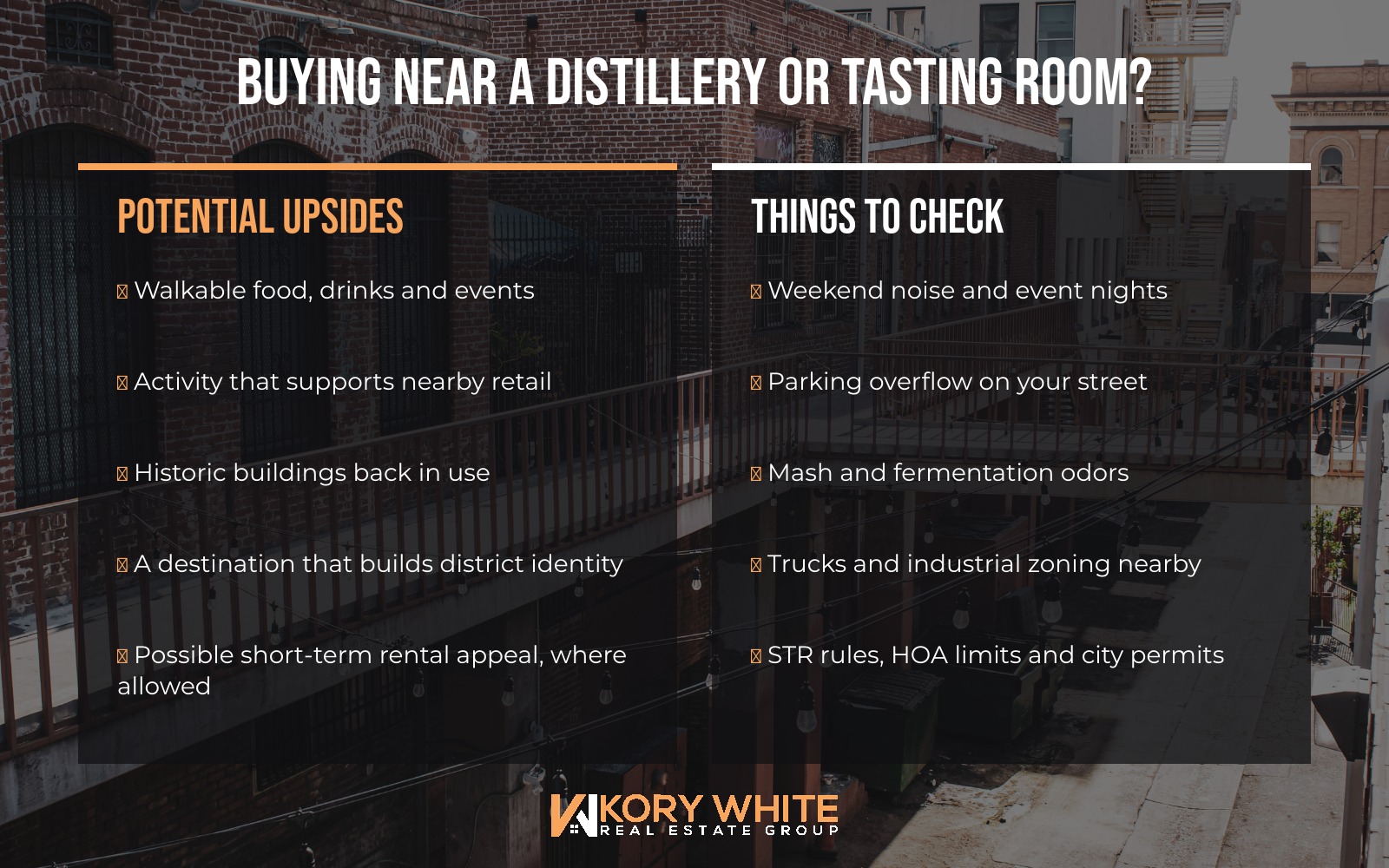
Pros and Cons of Buying a Home Near a Distillery or Tasting Room
Potential UpsidesThings to CheckWalkable food, drinks and eventsWeekend noise, live music and event nightsActivity that can support nearby restaurants and retailParking overflow on residential streetsHistoric buildings put back into useOdors from mashing and fermentation on some daysA destination that can help a district’s identityTruck deliveries and industrial zoning next doorPossible appeal for short-term rental guests, where allowedRules on short-term rentals, HOA limits and city permits
Before you buy near any entertainment district, visit on a Friday night and a Tuesday morning. Read the zoning map around the block, not just the lot. Also check flood risk with FEMA’s Flood Map Service Center, and look up school information directly from the Texas Education Agency.
Insurance can shift near commercial uses too, so get quotes early. My Texas homeowners insurance guide explains what to ask before closing.
Price. Location. Build Type.
Most buyers get 2 of 3. Walkable districts near tasting rooms and restaurants tend to be infill areas, so price and location there often mean resale homes, townhomes or condos instead of new construction. If you want new construction and a lower price, you may be looking farther out, near places like Wylie, Denison or the Hill Country corridor. Neither path is automatically better. My new construction vs. resale guide breaks down the tradeoffs.
📘 Download the Texas Home Buyer’s Guide
Commercial Real Estate: What Distilleries Need From a Building
If you own an industrial or flex building, a distillery tenant can be attractive. It can also be one of the more complicated tenants you’ll ever sign. Here’s what typically comes up.
Zoning and Permits
Distilleries hold a federal permit plus a Texas distiller’s permit, and cities still control the land use. Lockwood’s founder put it simply when talking about Garland: they had to be zoned as a distillery. Expect a zoning check, possibly a specific use permit, and a longer timeline than a typical restaurant.
Fire Code and Building Inspections
High-proof spirits and barrel storage raise fire and building code questions. Yellow Rose’s founders said even Houston’s fire marshal and building inspectors weren’t sure how to handle the city’s first distillery. Plan for extra review, sprinklers, egress and storage limits, and budget time for them.
Utilities, Floors and Drainage
Mashing and distilling use heavy water, power and often natural gas. Barrel storage is heavy. Balcones specifically cited natural gas, electrical and parking upgrades as reasons for its move. Buildings that already have this infrastructure have an advantage.
Parking and Neighbors
Tasting rooms bring evening and weekend crowds. 8th Wonder’s EaDo deal included a one-acre parking lot, which tells you how seriously operators take parking.
The 300-Foot Rule
Under Texas Alcoholic Beverage Code Section 109.33, cities and counties can prohibit alcohol sales within 300 feet of a church, public or private school, or public hospital, and up to 1,000 feet of certain schools on request. If you’re marketing a site to a tasting room or bar, check those distances first. Local ordinances vary, so confirm with the city.
What Research Says About Commercial Values
That Charlotte study found no significant effect on commercial property values near breweries. The value for a commercial owner usually shows up in occupancy, lease terms and how unique the space is, not in an automatic bump in nearby rents. Market conditions can change.
🏡 See What Your Home Could Be Worth
Wet, Dry and the Grocery Store Effect
Alcohol laws have shaped Texas real estate for decades. In November 2010, Dallas voters approved citywide beer and wine sales in grocery and convenience stores, 65% to 35%, ending a patchwork of wet and dry areas. A second measure removed the private club requirement for restaurants in dry areas.
Supporters, including grocers and restaurants, argued the change would make more parts of Dallas attractive to grocery stores and other development. Opponents, including some South Dallas pastors and liquor store owners, raised concerns about crime and impaired driving. Both views shaped the debate, and the vote split heavily by geography.
The takeaway for buyers: what you can buy, and where, still affects which businesses open nearby.
A Warning for Investors: Whiskey Barrel “Investments”
Here’s where alcohol and real estate investing cross in a bad way. Cask and barrel investment pitches often look like real estate pitches: buy an asset, let it age, sell for a profit.
In 2021, the Texas State Securities Board entered an emergency cease and desist order against an international whiskey investment scheme that, according to the order, advertised 12% to 20% annual returns while having existed for less than 3 years. In the U.K., the BBC documented investors who lost life savings on overpriced casks, casks sold to more than one buyer and casks that didn’t exist.
The due diligence rules are the same ones I use for private real estate lending: verify title and ownership, verify the storage facility, and be skeptical of promised returns. Read my breakdown of real estate investment fraud in Texas for the full checklist, and check any offering with the Texas State Securities Board.
Dallas or Houston: Where Does the Distillery Scene Fit Your Move?
Houston leads Texas in mixed-beverage sales and has some of the largest distilling operations, like Gulf Coast Distillers in the East End. DFW spreads its distilleries across suburban downtown squares, from Wylie to Lewisville to Garland, plus Fort Worth’s 112-acre Whiskey Ranch.
Neither metro wins on whiskey alone. Housing costs, commute, taxes and insurance matter more. Start with my Dallas vs. Houston cost of living and real estate guide, then look at the best small cities in DFW if a walkable downtown square appeals to you. For Houston, my look at Houston’s record inventory shows where buyers have leverage.
👉 Search Homes for Sale or Lease
Frequently Asked Questions
What is the largest distillery in Texas?
Two operations make “largest” claims. Gulf Coast Distillers in Houston’s East End calls itself the largest distillery west of the Mississippi and the largest in Texas, operating inside a roughly 300,000-square-foot plant. TX Whiskey describes Whiskey Ranch in Fort Worth as the largest whiskey distillery west of the Mississippi.
What is the oldest legal whiskey distillery in Texas?
Garrison Brothers in Hye calls itself the first and oldest legal whiskey distillery in Texas. It was founded in 2006 and received its distilling license in the late 2000s.
How many distilleries are in Texas?
A UTSA study counted about 190 Texas distilleries in 2020, up from 8 in 2008. A 2022 tourism study for the Texas Distilled Spirits Association referenced 188 distillers. The number changes as distilleries open and close.
Do distilleries increase home values?
Not automatically. Research on craft breweries in Charlotte found a positive effect on nearby home values, but many of those areas already had higher prices before the brewery opened. A distillery is often a sign of change, not a guarantee.
Can a bar or distillery tasting room open next to a school or church in Texas?
Often not within 300 feet, if the city or county has adopted that rule under Alcoholic Beverage Code Section 109.33. Some schools can request a 1,000-foot buffer. Exact rules vary by city, so check the local ordinance.
Where can I tour a distillery near Dallas?
Options include Herman Marshall in Wylie, Bendt in Lewisville, Lockwood in Richardson, McKinney and Garland, New Artisan near the Design District, and Whiskey Ranch and Blackland in Fort Worth. Check each distillery’s site for current tour hours.
Where can I tour a distillery in Houston?
Gulf Coast Distillers on Clinton Drive, 8th Wonder Distillery in EaDo and Yellow Rose near Uptown are popular starting points. Hours and tours change, so confirm before you go. I talk about Houston neighborhoods like the East End and EaDo regularly on The Kory White Show.
Is investing in whiskey barrels like investing in real estate?
No. Barrel and cask investments are often lightly regulated, hard to verify and hard to sell. Texas regulators have shut down at least one whiskey scheme that promised high returns. Always verify ownership and storage, and check offerings with the Texas State Securities Board.
The Bottom Line
Texas distilleries are doing what good real estate does: taking a building or piece of land nobody else could use well and turning it into a destination. A golf course became a whiskey ranch. A rice plant became a bourbon plant. A grocery store became a tasting hall.
If you’re buying near one of these districts, selling a home close to one, or leasing a building to a beverage maker, the details matter: zoning, parking, insurance, noise and how the neighborhood is changing. That’s where I come in.
📅 Schedule a Free 15-Minute Consultation
About Kory White Real Estate Group
Kory White Real Estate Group helps buyers, sellers, investors and relocating clients throughout Texas, including Dallas-Fort Worth, Greater Houston, Austin, San Antonio and surrounding communities. Services include buying, selling, relocation, new construction, first-time buyers, luxury, investments and leasing.
We help clients understand the home, the numbers, the market, and the deal.
From Sugar Land to Sherman. From Manvel to Mansfield.
Dallas: 469-336-3027 Houston: 281-738-4446 Website: https://korywhiterealestategroup.com/
For agents: Commercial and lifestyle deals like these take relationships and systems. I talk about building that kind of business on Mentors + Masterminds = Escrows, and if you want coaching, a real graphic designer and follow-up systems behind your brand, see what I’m building with CoFounders.
Please drink responsibly. This article is for general information only and is not legal, tax or financial advice. Market conditions can change.
Information About Brokerage Services | TREC Consumer Protection Notice