

The Fed Just Raised Rates. What Does That Mean for Texas Homebuyers and Sellers?
The Federal Reserve just did something it hasn’t done in more than three years, and Texas mortgage rates are already feeling it.
On September 16, 2026, the Federal Open Market Committee voted 12–0 to raise the federal funds target range by 0.25 percentage points to 3.75%–4.00%. This was the Fed’s first rate increase since July 2023. According to the committee, inflation remains elevated, and the move supports a quicker return to its 2% goal.
In addition, the Fed signaled it may not be finished. The median projection from policymakers points to one more quarter-point hike before the end of 2026.
If you’re thinking about buying or selling a home in Dallas-Fort Worth, Houston or anywhere else in Texas, your first question is probably simple:
Does this Fed rate hike push Texas mortgage rates higher?
Possibly. However, the answer isn’t as direct as the headline suggests, and understanding why can save you real money.
Want to know what today’s rates mean for your budget? Schedule a free 15-minute call and we’ll walk through your numbers.
The Fed Doesn’t Set Your Mortgage Rate
This is one of the most common misconceptions I hear from buyers.
The Federal Reserve controls the federal funds rate, a short-term rate banks use to lend to each other overnight. It directly affects things like credit cards, home equity lines of credit and savings account yields.
However, your 30-year fixed mortgage works differently. Long-term mortgage rates are driven mainly by the bond market, especially the 10-year Treasury yield. Investor expectations about inflation, economic growth and risk matter too.
As a result, you can see some counterintuitive outcomes:
- Mortgage rates often move before the Fed acts, because markets price in the decision ahead of time.
- The Fed can raise rates while mortgage rates eventually fall.
- Or the Fed can hold rates steady while mortgage rates climb.
This time, markets had already priced in better than a 90% chance of a hike before the announcement. Consequently, much of the rise in mortgage rates happened in the weeks leading up to the decision, not after it.
In other words, watching the Fed alone won’t tell you where mortgage rates are headed.
Where Texas Mortgage Rates Stand Right Now
According to Freddie Mac, the average 30-year fixed mortgage rate was 6.95% as of September 17, 2026, up from 6.76% the week before. A year earlier, it was 6.26%.
Meanwhile, the average 15-year fixed rate was 6.26%, up from 5.41% a year ago.
The 30-year rate is up 69 basis points in twelve months. Here’s what that looks like in real dollars:
| Loan amount | Rate | Monthly principal & interest |
|---|---|---|
| $400,000 | 6.26% (Sept. 2025) | $2,465 |
| $400,000 | 6.95% (Sept. 2026) | $2,648 |
| Difference | +$182/month |
That’s roughly $2,200 more per year on the same loan, before property taxes and insurance. Those can be substantial on their own in Texas.
Keep in mind that these are national averages. Freddie Mac’s survey is based on conventional loans for borrowers putting 20% down with excellent credit. Your rate could be higher or lower depending on your:
- credit profile
- loan program (conventional, FHA, VA, USDA)
- down payment
- loan amount
- property type and occupancy
- debt-to-income ratio
- discount points
- lender
- market conditions on the day you lock
For that reason, I encourage buyers not to fixate on the rate in a headline. The better question is: what does the entire deal look like for me?
The best starting point is getting a real number from a lender. If you haven’t done that yet, read Why Mortgage Pre-Approval Is One of the Most Important Steps in Buying a Home.
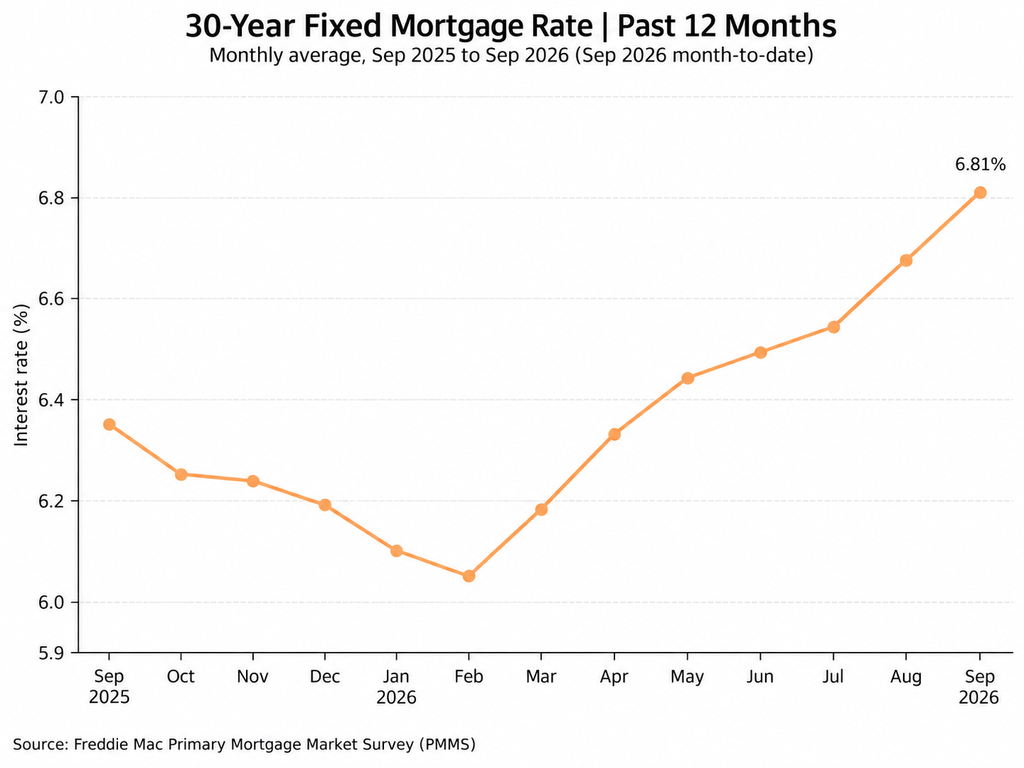
Why the 10-Year Treasury Matters More Than the Fed
If you want one number to watch, make it the 10-year Treasury yield.
On the day of the Fed’s decision, the 10-year closed at roughly 5.02%. Mortgage rates and the 10-year don’t move in perfect lockstep, but lenders use it as a pricing anchor for 30-year loans. So when investors demand higher yields on long-term government debt, mortgage-backed securities have to offer competitive returns too, which pushes mortgage rates up.
That’s why the mortgage market reacts every day to inflation reports, jobs data and bond-market activity. It doesn’t wait for the next Fed meeting.
Don’t wait for the Fed to tell you what mortgage rates are doing. The market is moving every day.
What Higher Texas Mortgage Rates Mean for Homebuyers
First, higher rates reduce buying power. That’s the honest math.
Take a buyer who was comfortable with a $500,000 home a year ago, putting 10% down. At 6.26%, the monthly principal and interest payment was about $2,774.
Today, at 6.95%, that same payment only supports roughly a $465,600 home.
It’s the same budget, but it buys about $34,000 less house.
Still, higher rates don’t mean buying should stop. Instead, the purchase has to be structured more carefully. In today’s market, buyers may be able to negotiate:
- Seller concessions toward allowable closing costs or a mortgage-rate buydown
- A lower purchase price, depending on the property and competition
- Builder incentives, including closing-cost help or below-market rate programs on inventory homes
- A different loan structure, since conventional, FHA, VA and USDA programs can produce very different payments
- Discount points, which sometimes make sense and sometimes don’t, depending on how long you’ll keep the loan
That leverage is real right now, especially in Houston. Greater Houston hit 40,750 active single-family listings in July 2026, the highest level HAR has ever recorded. More inventory means more room to negotiate. I broke that down in Houston Just Broke a Real Estate Record: What 40,750 Homes for Sale Means for Buyers and Sellers.
Here’s how I put it to my buyers: Don’t shop for a mortgage rate. Shop for the right combination of house, price, financing and payment.
Not sure how much house makes sense at today’s rates? Book a 15-minute strategy call and we’ll run the payment scenarios together.
Your Payment Matters More Than the Headline Rate
Imagine two buyers purchasing similar homes.
Buyer A gets a slightly lower rate but pays full asking price with no concessions.
Buyer B, on the other hand, negotiates the price down, gets seller-paid closing costs and uses part of that concession to lower the rate.
In the end, Buyer B could easily have the stronger deal, even though the rate on paper looked worse at first.
Price is one part of the deal, and rate is another. Ultimately, the entire structure is what you live with every month. That’s why it matters so much in a rising-rate environment to have your REALTOR® and mortgage professional working together.
It also helps to know everything you’ll pay beyond the rate. Our guide to The Hidden Costs of Buying a Home in Texas covers the expenses buyers most often overlook.
What the Fed Rate Hike Means for Texas Home Sellers
Sellers need to pay close attention too.
When rates rise, the same monthly payment buys less house. For example, a buyer who was shopping at $500,000 may now be shopping closer to $465,000, even though nothing about their income or savings changed.
As a result, the pool of buyers who can comfortably afford your price point shrinks. That’s also why pricing based on what your neighbor sold for six months ago can be dangerous.
Your buyer isn’t choosing between your house and the one that sold six months ago. They’re choosing between your house and everything else they can buy today.
When several comparable homes compete at the same price, buyers compare:
- price and monthly payment
- condition and updates
- location
- property taxes and HOA fees
- seller concessions
- available financing and builder incentives
- days on market
In a higher-rate environment, sellers often need to compete on more than price alone. Exposure also matters more than ever. If you’re weighing a private or pre-market strategy, read Selling Off the MLS in Texas: What Houston and DFW Sellers Should Know before you sign anything.

Why Seller Concessions Can Beat a Price Cut
A seller doesn’t always need a dramatic price reduction to improve a buyer’s affordability.
Consider a $450,000 home with a buyer putting 10% down at 6.95%. The monthly principal and interest payment is about $2,681.
| Seller offers | Buyer’s monthly savings |
|---|---|
| $10,000 price reduction | about $60/month |
| $10,000 toward a rate buydown (illustrative 0.50% reduction) | about $134/month |
In this example, the same $10,000 from the seller delivers more than twice the monthly benefit when it goes toward the rate instead of the price.
Buydown pricing varies by lender, loan program and market conditions on the day of the lock. Concession limits also depend on the loan type, so the numbers have to be run for each transaction. Even so, for many sellers a targeted concession works better than an across-the-board price cut, and it can protect the recorded sale price.
Selling in Houston or DFW? Schedule a free 15-minute seller consultation and we’ll compare price-cut and concession strategies for your home.
Should Buyers Wait for Mortgage Rates to Fall?
Frankly, nobody knows where rates will be in three, six or twelve months. Right now, the Fed is signaling it may raise again, not cut.
Trying to time the bottom perfectly also creates a problem that often gets overlooked. If rates fall meaningfully, more buyers come back into the market at once. That typically means:
- more competition
- fewer seller concessions
- more multiple-offer situations
- less negotiating leverage
- upward pressure on prices
In other words, buyers who wait for lower rates can end up paying more for the house and losing concessions they could have negotiated today.
That doesn’t mean you should rush. Rather, your decision should rest on your finances and your goals, not a prediction about the Fed.
If the numbers work today, we evaluate the opportunity today. Otherwise, we build a plan.
Already Own a Home With a Low Rate?
Higher rates create a different challenge for current homeowners.
If your mortgage rate is in the 2%, 3% or 4% range, it’s understandable to hesitate before selling. After all, replacing that loan could mean financing your next home at a much higher rate.
Still, your mortgage rate is only one part of the decision. Job changes, a growing family, equity, relocation, downsizing, investment opportunities and lifestyle needs can all matter more than holding onto a particular rate.
The right question isn’t just “Why would I give up my current rate?”
It’s “What would selling this home allow me to accomplish?”
Then we look at the numbers. If you’re considering a move between Texas metros, our Dallas vs. Houston cost of living and real estate guide is a good place to compare.
Frequently Asked Questions
Did the Fed raise interest rates in September 2026?
Yes. On September 16, 2026, the FOMC voted unanimously to raise the federal funds target range by 0.25 percentage points to 3.75%–4.00%. It was the Fed’s first increase since July 2023.
Does a Fed rate hike raise mortgage rates immediately?
Not necessarily. The Fed sets short-term rates, while 30-year mortgage rates follow the bond market, especially the 10-year Treasury yield. Because markets often price in a Fed decision before it happens, mortgage rates may move ahead of the announcement.
What are Texas mortgage rates right now?
Freddie Mac reported the national average 30-year fixed rate at 6.95% and the 15-year fixed rate at 6.26% as of September 17, 2026. Your actual rate in Texas depends on your credit, loan program, down payment and lender.
Will the Fed raise rates again in 2026?
The Fed’s September projections showed the median policymaker expecting one more quarter-point increase before year-end. That’s a projection, not a commitment, and it depends on upcoming inflation and jobs data.
Is it a good time to buy a home in Texas?
It depends on your finances and goals. Higher rates reduce buying power, but elevated inventory gives buyers more negotiating leverage on price and concessions than they’ve had in years. That’s especially true in Houston.
Can a seller pay to lower my mortgage rate?
Often, yes. Depending on the loan program, seller concessions can go toward allowable closing costs or a rate buydown. Limits vary by loan type, so confirm with your lender.
Should I wait for rates to drop before buying?
Timing the bottom is difficult. When rates fall, buyer competition usually increases, which can reduce concessions and push prices up. Base the decision on whether the numbers work for you today.
How much house can I afford at 7% mortgage rates?
It depends on your income, debts, down payment, property taxes and insurance. As a rough guide, say your payment supported a $500,000 home at 6.26% with 10% down. At 6.95%, that same payment covers roughly a $465,600 home. Schedule a 15-minute call to run your exact numbers.
The Bottom Line
The Fed’s September rate hike matters, but it doesn’t give a simple answer about where Texas mortgage rates go next.
Right now, the federal funds rate sits at 3.75%–4.00%, and the average 30-year fixed mortgage is 6.95%. Meanwhile, the 10-year Treasury is hovering around 5%, and the Fed is signaling another hike may be coming.
For Texas buyers and sellers, the strategy is the same: focus on the numbers you can actually control.
If you’re buying, understand your full payment, your loan options and your negotiating leverage.
If you’re selling, understand your competition and what today’s financing costs mean for the buyers who can afford your home.
In both cases, evaluate the entire deal, not one headline.
Thinking About Buying or Selling in Texas?
🏠 Search homes for sale across Dallas-Fort Worth, Houston and Texas
📘 Download the KWREG Seller’s Guide
📅 Schedule a free 15-minute strategy call
About Kory White Real Estate Group
Kory White Real Estate Group helps buyers, sellers and relocating families across Dallas-Fort Worth, Houston, Austin, San Antonio and communities throughout Texas. We focus on the numbers behind every decision, from payment structure and seller concessions to pricing strategy and market exposure, so our clients can move forward with clarity. Whether you’re buying your first home, selling in a shifting market or relocating across the state, schedule a 15-minute conversation and let’s build your plan.
Sources
HAR: Monthly Housing Update and MLS Sales Activity
Advisor Perspectives: Fed’s interest rate decision, September 16, 2026
CNBC: Fed rate decision September 2026
Chase: Fed raises rates, officials signal one more hike in 2026
U.S. Bank: Fed raises rates to 3.75%–4.00%
Freddie Mac: Primary Mortgage Market Survey



Join The Discussion