
 by
by 
If your home has been sitting on the market and you’re asking, “Should I sell or rent my house?”, you’re in good company. In fact, Texas is one of the epicenters of this trend right now.
Zillow found that 2.3% of homes listed for rent on its site were recently listed for sale, a level topped only once in its nearly 6-year record. Even more telling, 4 of the 10 metros with the highest share are in Texas: Houston, Austin, San Antonio and Dallas-Fort Worth.
The industry calls these owners “accidental landlords.” Most of them didn’t plan to become landlords. Instead, they listed, waited, didn’t get the number they wanted and pivoted.
Renting can be a smart move. However, it can also turn a slow sale into a slow drain on your bank account. This guide walks through the real numbers, the Texas-specific rules most owners miss and how to decide which path fits you.
📅 Schedule a Free 15-Minute Consultation
Quick Answer: Should I Sell or Rent My House?
Rent your house if the rent covers your full payment plus vacancy, repairs and management, you have cash reserves and you plan to hold for years. Sell if you need the equity, the real cash flow is negative or you’re close to losing your capital gains exclusion.
In other words, the decision isn’t “rent vs. price cut.” It’s “Do I want to own a rental property for the next 3 to 5 years?” If the honest answer is no, renting often just delays the same decision.
What Is an Accidental Landlord?
An accidental landlord is a homeowner who tried to sell, couldn’t get an acceptable offer and leased the home out instead. Zillow’s definition is specific: the home was listed for sale for at least 2 weeks, was delisted without selling, then showed up as a rental within 3 months.
Other names for the same situation include “reluctant landlord,” “renting out your house instead of selling” and “turning your home into a rental.” Whatever you call it, the money questions are identical.
Why This Is Happening in 2026
The 2022 wave of accidental landlords was driven by a mortgage rate shock. This time, the cause is different. As Cotality economist Molly Boesel put it, the 2022 wave came from interest rates, while the 2026 wave is coming from prices.
Here’s what that looks like on the ground:
- Sellers have equity and low rates. Zillow notes that owners who bought or refinanced at or below 3% can often cover their payment with rent.
- Few sellers are in distress. As of October 2025, only 3.4% of new listings were priced below the home’s previous sale price, according to Zillow.
- Buyers have leverage. Homes take longer to sell, and price cuts are more common in the metros with the most accidental landlords.
So, many owners aren’t forced to sell. They’re choosing to wait. That’s a reasonable choice, as long as it’s made with the full numbers.
Texas Leads the Nation in Homes Turned Into Rentals
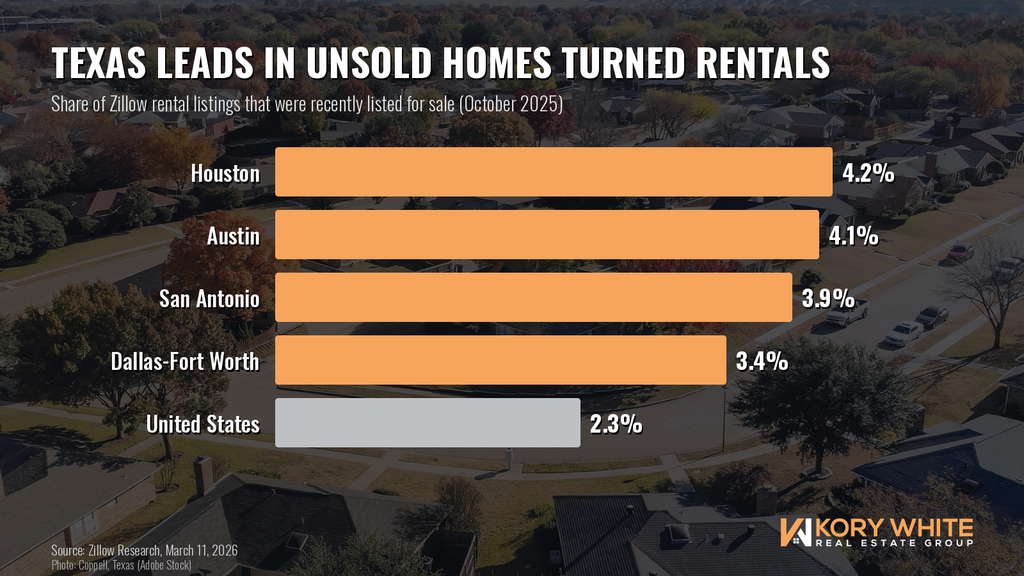
Zillow’s March 2026 analysis ranked the major metros with the highest share of rentals that were recently for sale. Texas took 4 of the top 10 spots.
| Metro | Rentals That Were Recently For Sale (Zillow, Oct 2025) | Listings Delisted (Redfin, Apr 2026) | Typical Rent (Zillow, Aug 2026) | Rent Change, Year Over Year |
|---|---|---|---|---|
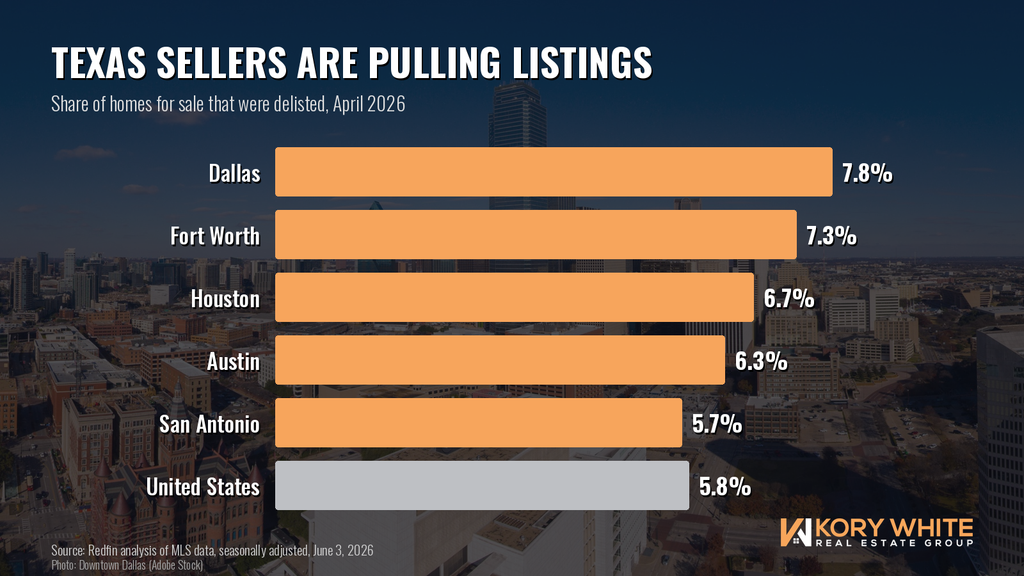
| Houston | 4.2% (#2 in U.S.) | 6.7% | $1,643 | 0.0% |
| Austin | 4.1% (#3) | 6.3% | $1,622 | 0.0% |
| San Antonio | 3.9% (#4) | 5.7% | $1,422 | -1.3% |
| Dallas-Fort Worth | 3.4% (#8) | Dallas 7.8%, Fort Worth 7.3% | $1,659 | 0.4% |
| United States | 2.3% | 5.8% | $1,948 | 2.5% |
Sources: Zillow Research, Redfin, Zillow August 2026 Rent Report. Zillow analyzes the accidental landlord metric with a lag, so October 2025 is its most recent published reading. Zillow’s “Dallas” metro covers the full Dallas-Fort Worth area.
Notice the pattern in the last 2 columns. Texas rents are flat or slightly down, while national rents are still rising. That matters because more former for-sale homes are now competing for the same tenants.
Houston
Greater Houston had 40,750 active single-family listings in July 2026 and a 5.5-month supply, compared with 4.6 months nationally, according to the Houston Association of Realtors. On the rental side, HAR reported 4,849 single-family leases in May 2026, up 5.2% from a year earlier. The average lease price was $2,346, virtually unchanged, and days on market rose from 39 to 42.
Translation: tenants are out there, but they have choices. Pricing and condition matter on the rental side just as much as they do on the sale side. For more on the for-sale picture, read our breakdown of Houston’s record inventory.
👉 Search Homes in Greater Houston and Nearby Communities
Dallas-Fort Worth
DFW sellers are pulling listings faster than almost anywhere. In April 2026, 7.8% of Dallas listings and 7.3% of Fort Worth listings were taken off the market, both above the 5.8% national rate, per Redfin. Only Atlanta, San Jose and Los Angeles were as high or higher than Dallas.
Meanwhile, Cotality has pointed to Dallas as a market where rental inventory is rising because would-be sellers are waiting for a better time to sell. Typical DFW rent grew just 0.4% over the past year, according to Zillow.
👉 Search Homes in Dallas-Fort Worth and Nearby Communities
Austin and San Antonio
Austin ranked #3 nationally for accidental landlords at 4.1%, and San Antonio ranked #4 at 3.9%. Rents in both markets were flat or falling as of August 2026, with San Antonio down 1.3% year over year. Owners in these markets should be especially careful about assuming rent will rise to fix a thin margin.
Rent vs. Sell Math: The Numbers Most Owners Skip
Most owners do “paper math”: rent minus mortgage payment. If rent is higher, renting looks like a win. Unfortunately, that leaves out several real costs.
Here’s a hypothetical Houston-area example. The rent comes from HAR’s May 2026 average. Everything else is an assumption for illustration only.
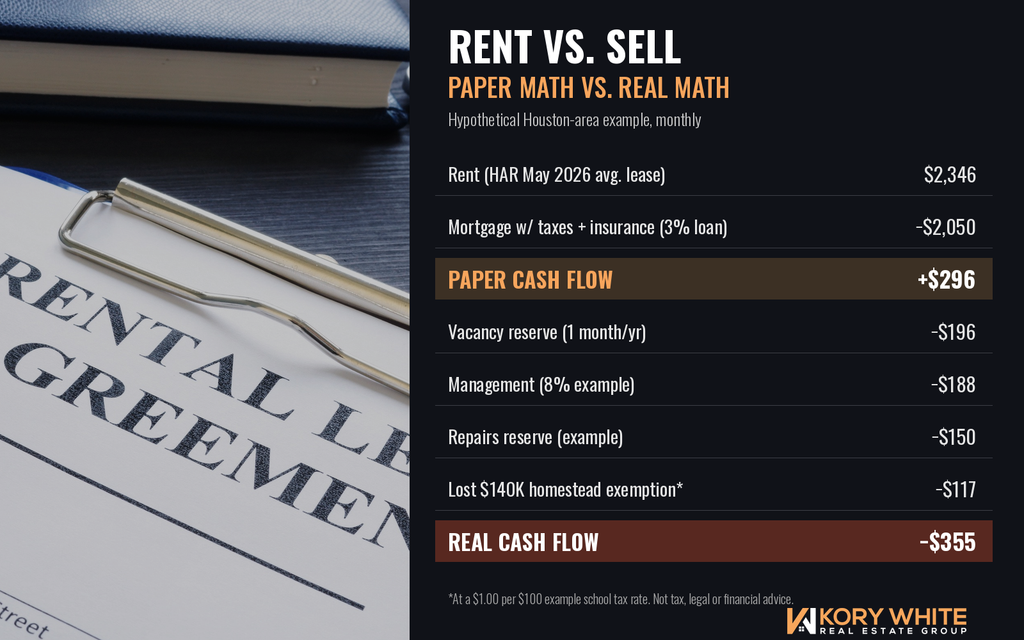
| Monthly Item | Amount |
|---|---|
| Rent collected (HAR May 2026 average single-family lease) | $2,346 |
| Mortgage payment with taxes and insurance (example 3% loan) | -$2,050 |
| “Paper” cash flow | +$296 |
| Vacancy reserve (1 month per year) | -$196 |
| Property management (example 8% of rent) | -$188 |
| Repairs and maintenance reserve (example) | -$150 |
| Lost $140,000 school homestead exemption (at a $1.00 per $100 example rate) | -$117 |
| Real cash flow | -$355 |
That’s a $651 monthly swing between what the owner expected and what actually happens. Over 2 years, a -$355 monthly gap adds up to $8,520. In that case, the home would need to sell later for at least that much more, plus any higher costs, just to break even with selling today.
Of course, this isn’t the whole picture. The tenant is also paying down your loan principal, and the home may appreciate. Still, those gains only show up when you sell or refinance. The monthly shortfall shows up every month.
Run your own version with these inputs:
- Realistic market rent from recent leases, not active listings
- Your full payment, including taxes and insurance
- The tax increase after your homestead exemption comes off
- A landlord insurance quote, not your current homeowners premium
- Vacancy, repairs, management, HOA dues and lawn care if you include it
🏡 See What Your Home Could Be Worth
What Changes When You Rent Out Your Texas Home
This is where most accidental landlords get surprised. Turning your homestead into a rental changes your taxes, insurance, loan obligations and legal responsibilities.
Your Homestead Exemption Goes Away
In Texas, a homestead exemption only applies to your principal residence. Once you move out and rent the home, you generally lose it, and you must notify your appraisal district. Since 2025, the school district homestead exemption is $140,000, so losing it can raise your tax bill noticeably. You also lose the 10% annual cap on homestead appraisal increases. Review the rules on the Texas Comptroller’s exemptions page.
There’s another Texas wrinkle. Non-homestead property valued at $5 million or less currently has a temporary 20% annual cap on appraisal increases, known as the circuit breaker. Under the 2023 law that created it, that cap is set to expire on December 31, 2026. Confirm the current status with your appraisal district before budgeting for 2027. If your new assessment looks high, you can protest your property taxes.
Your Capital Gains Clock Starts Ticking
Under IRS rules, you can generally exclude up to $250,000 of gain ($500,000 for married couples filing jointly) if you owned and lived in the home for at least 2 of the 5 years before the sale. Practically, that means you usually have about 3 years after moving out to sell and keep the exclusion. Depreciation you claim while it’s a rental can’t be excluded, though. See IRS Publication 523 and Publication 527, and talk with a tax professional before you sign a lease.
Your Insurance Needs to Change
A standard homeowners policy is written for an owner-occupied home. Once a tenant moves in, you’ll typically need a landlord or dwelling policy instead. Call your agent before move-in day, not after a claim. The Texas Department of Insurance has consumer guides on policy types.
Check Your Mortgage and HOA
Many owner-occupied loans, including conventional and FHA loans, require you to live in the home for at least 12 months after closing. If you’ve been there longer, renting is usually allowed, but read your deed of trust. Next, check your HOA’s deed restrictions, since some limit leasing or set minimum lease terms. If you’re weighing loan options for your next purchase, our guide to types of mortgage loans is a good starting point.
You Take On Texas Landlord Duties
Chapter 92 of the Texas Property Code spells out landlord obligations. Among other things, Texas landlords must:
- Make repairs to conditions that materially affect a tenant’s health or safety
- Rekey exterior door locks within 7 days after each tenant turnover
- Install required smoke alarms
- Refund the security deposit, or provide an itemized list of deductions, within 30 days after the tenant surrenders the home
Also, Texas eviction procedures changed on January 1, 2026, under Senate Bill 38. The Texas State Law Library tracks the current process.
Finally, you can lease your own home without a license. However, anyone who leases or manages property for you for a fee generally needs a real estate license through TREC.
When Renting Out Your House Makes Sense
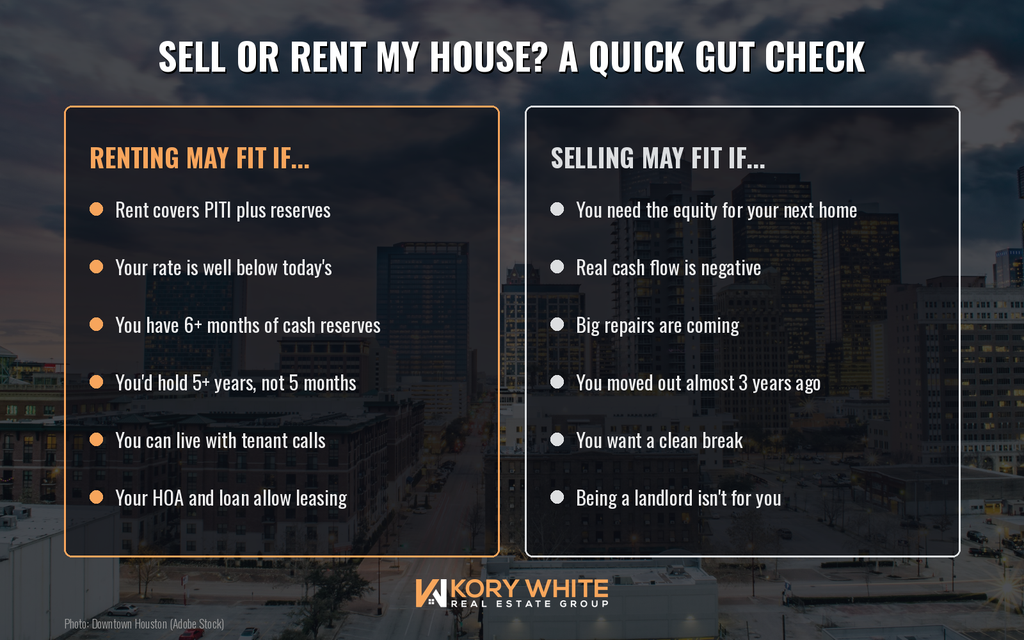
Renting tends to work best when most of these are true:
- Rent covers the real costs. Your rent covers the full payment plus vacancy, repairs and management.
- Your rate is a true asset. Zillow’s August 2026 rent report assumed a 6.67% rate for new buyers. If yours is near 3%, that gap is valuable.
- You have reserves. A single HVAC replacement or a 2-month vacancy shouldn’t put you in a bind.
- You’ll hold for years. Renting for 6 months to “wait out the market” rarely pencils after make-ready, leasing and turnover costs.
- You can handle the role. Either you’re comfortable dealing with tenants, or you’ll hire a licensed manager.
When Selling Is the Better Move
On the other hand, selling usually makes more sense when:
- You need the equity for your next down payment
- The real cash flow is negative and you don’t have a long-term plan for the property
- Major repairs are coming, such as a roof, foundation or HVAC
- You’re close to the 3-year mark after moving out and want to keep your capital gains exclusion
- You simply don’t want to be a landlord, which is a perfectly valid reason
Remember, if you’re buying again in the same market, a softer sale price often means a softer purchase price too.
Can’t Sell Your House but Need to Move? 5 Options Besides Renting
Before you sign a lease, it’s worth testing these:
- Reset the price based on fresh comps. Pricing to recent sales, not to last year’s peak, is often the fastest fix.
- Relaunch the listing. New photos, better staging and a clean relaunch can help. In April 2026, 2.5% of homes on the market were relistings, the highest share since 2020, according to Redfin.
- Offer concessions instead of a price cut. Closing cost help or a rate buydown can lower a buyer’s monthly payment more than a small price drop. Learn how much sellers should negotiate.
- Market an assumable loan. FHA and VA loans can often be assumed by a qualified buyer with lender approval. A low assumable rate can be a real selling point.
- Rent with a defined exit. If you do rent, set a sale date, a target price and a cash flow floor before you sign the first lease.
📘 Download the Texas Home Buyer’s Guide
When Should You Worry About Your House Not Selling?
Start asking questions when your home is getting showings but no offers, or when your days on market run well past the local average. In Greater Houston, for example, inventory sat at a 5.5-month supply in July 2026, so buyers can afford to be selective.
Typically, a home that isn’t selling has a price, condition or exposure problem. Showings without offers usually point to price or condition. Few showings usually point to price or marketing. Either way, the fix starts with an honest pricing conversation, not with a lease. If you’re also deciding whether to buy your next home now, read should you buy a home now or wait.
First-Time Landlord Checklist for Texas Homeowners
If you’ve run the numbers and renting still makes sense, use this checklist:
- ☐ Pull rental comps from recent leases, not just active listings
- ☐ Get a landlord insurance quote
- ☐ Notify your appraisal district that the homestead no longer applies
- ☐ Review your deed of trust and HOA leasing rules
- ☐ Use a current Texas residential lease form
- ☐ Screen every applicant the same way, following fair housing laws
- ☐ Rekey the locks and check smoke alarms before move-in
- ☐ Document the home’s condition with dated photos and a move-in inventory
- ☐ Set aside a repair and vacancy reserve
- ☐ Calendar your capital gains deadline and your planned sale date
👉 Search Homes for Sale or Lease
FAQ: Selling vs. Renting Your House in Texas
Should I sell or rent my house if it won’t sell?
Rent only if the real cash flow works and you’re comfortable holding the home for several years. Otherwise, adjusting price, condition or marketing is usually the better first step. A home that didn’t sell at one price may sell quickly at the right price with the right presentation.
What is an accidental landlord?
An accidental landlord is a homeowner who listed a home for sale, didn’t sell it and rented it out instead. Zillow found that 2.3% of its rental listings were recently for sale, with Houston (4.2%), Austin (4.1%), San Antonio (3.9%) and Dallas-Fort Worth (3.4%) among the top 10 metros.
Do I lose my homestead exemption if I rent out my house in Texas?
Generally, yes. The homestead exemption applies only to your principal residence, so once you move out and rent the home, you typically lose it and should notify your appraisal district. That means losing the $140,000 school district exemption and the 10% homestead appraisal cap.
Will I pay capital gains tax if I rent my house and sell later?
You can usually still exclude up to $250,000 of gain, or $500,000 if married filing jointly, if you lived in the home for at least 2 of the 5 years before the sale. That typically gives you about 3 years after moving out. However, depreciation taken during the rental period is taxable. Confirm your situation with a tax professional.
Can I rent out my house if I have an FHA or VA loan?
Usually, yes, once you’ve met your loan’s occupancy requirement. FHA loans generally require at least 12 months of owner occupancy. VA loans require that you intended to live in the home as your residence. Check your loan documents and talk with your lender if you’re unsure.
Do I need a license to rent out my own house in Texas?
No. You can lease your own property without a real estate license. However, if you pay someone else to lease or manage it for you, that person or company generally needs to be licensed by the Texas Real Estate Commission.
How much can I rent my house for in Houston or Dallas?
It depends on the home, but recent data gives a starting point. HAR reported a $2,346 average single-family lease in Greater Houston for May 2026. Zillow’s typical rent for all rentals was $1,643 in Houston and $1,659 in Dallas-Fort Worth in August 2026. Recent leases for homes like yours are the best guide.
Is it better to drop the price or rent the house out?
A price drop costs you once. Renting with negative cash flow costs you every month, plus the time, risk and tax changes that come with owning a rental. Compare the price cut to your realistic monthly shortfall over 1 to 3 years before choosing.
Talk Through Your Numbers Before You Sign a Lease
Every home and every owner is different. The right answer depends on your equity, your rate, your next move and how you feel about being a landlord.
If your home hasn’t sold and you’re weighing your options, we’ll help you compare an updated sale strategy against realistic rental numbers. No pressure, just the math and a straight answer.
📅 Schedule a Free 15-Minute Consultation
About Kory White Real Estate Group
Kory White Real Estate Group helps buyers, sellers, investors and relocating clients throughout Texas, including Dallas-Fort Worth, Greater Houston, Austin, San Antonio and surrounding communities. Our services include buying, selling, relocation, new construction, first-time buyers, luxury homes, investments and leasing.
We help clients understand the home, the numbers, the market and the deal.
From Sugar Land to Sherman. From Manvel to Mansfield.
Dallas: 469-336-3027
Houston: 281-738-4446
Website: korywhiterealestategroup.com
This article is for general information only and isn’t tax, legal or financial advice. Market data is from the sources linked above as of their publication dates, and market conditions can change.

Join The Discussion