
 by
by 
Dallas-Fort Worth fault lines are probably not the first thing most North Texas home buyers think about when touring a house. Foundation problems, however, usually enter the conversation pretty quickly.
Spend enough time looking at homes in Dallas, Fort Worth, Plano, Frisco, Arlington, Mansfield, Irving, McKinney, Denton, or the surrounding suburbs and you’ll eventually hear the same warning: pay attention to the foundation.
That advice makes sense, but North Texas geology is more complicated than simply saying DFW has bad soil.
The region contains ancient faults. Dallas-Fort Worth has also experienced real earthquakes, including earthquake sequences that researchers connected to oil and gas wastewater disposal.
For most homeowners, though, the larger day-to-day concern is the ground directly beneath the house.
Much of Dallas-Fort Worth contains clay-rich soil. It can expand when wet and shrink when dry. North Texas drought, heavy rain, trees, drainage problems, plumbing leaks, and poor grading can make those changes more severe.
Understanding Dallas-Fort Worth fault lines is therefore useful, but buyers should look at the complete geological and structural picture.
Should Dallas-Fort Worth Fault Lines Worry Home Buyers?
A mapped fault somewhere beneath North Texas does not automatically make a home unsafe or a poor investment.
In most DFW real estate transactions, the home’s actual foundation performance matters more than a regional fault map.
You want to know whether the house shows movement, how water drains around it, whether foundation repairs have occurred, and whether the soil has been managed properly.
That approach is much more useful than avoiding an entire city because faults exist beneath the region.
Does Dallas-Fort Worth Actually Have Fault Lines?
Yes.
North Texas contains many ancient geological faults. Some lie deep underground and don’t create a visible line at the surface.
Researchers have learned much more about these faults because of earthquake activity recorded across the Fort Worth Basin.
The U.S. Geological Survey’s research on induced earthquakes in the Dallas-Fort Worth area found that earthquakes occurred in the Fort Worth Basin from 2008 through 2020.
Researchers linked those events to increases in underground pore pressure caused by oilfield wastewater injection.
That doesn’t mean wastewater created the faults.
The faults already existed.
Instead, changes in underground pressure made some existing faults more likely to slip.
Dallas-Fort Worth Fault Lines Are Different From Houston Faults
Houston and Dallas-Fort Worth both have faults, but the geological stories are different.
Houston is known for shallow growth faults and a long history of land subsidence. Some Houston faults can produce gradual surface displacement.
North Texas contains older buried faults and has experienced earthquake activity on some fault systems.
For most DFW homeowners, expansive clay soil and changing moisture levels remain more common concerns than direct fault movement.
That difference matters if you’re comparing Texas metros.
You can read my Dallas vs. Houston Cost of Living & Real Estate Guide for a broader comparison of the 2 markets.
What About the Balcones Fault Zone?
Anyone researching Texas geology eventually comes across the Balcones Fault Zone.
It’s one of the state’s most recognizable geological systems and is most strongly associated with Central Texas.
Home buyers shouldn’t use it as a blanket explanation for DFW foundation problems.
North Texas has its own faults, rock formations, soil conditions, and underground structures.
The better question is not whether a famous fault system exists somewhere in Texas.
The better question is what is happening under the specific house you’re considering.
Why Has Dallas-Fort Worth Experienced Earthquakes?
North Texas experienced a noticeable increase in earthquake activity beginning in the late 2000s.
Researchers studied several earthquake sequences across the Fort Worth Basin.
They found that underground wastewater disposal could increase pressure inside deep rock formations. If enough pressure reaches a fault that is already under stress, the fault can slip.
That slip creates an earthquake.
The USGS found that faults near large wastewater disposal operations sometimes became unstable earlier than faults farther away. Researchers also found that faults responded differently to the same pressure changes.
This helps explain why one area can experience earthquakes while another nearby fault remains quiet.
The Azle Earthquakes Changed the North Texas Conversation
Azle, northwest of Fort Worth, became one of the best-known examples of North Texas earthquake activity.
A series of earthquakes began near Azle in 2013 along an ancient mapped fault system.
Researchers evaluated several possible explanations.
They found that normal changes in lake and groundwater levels didn’t explain the activity well enough.
Instead, models showed that brine production and wastewater injection produced underground pressure changes that could trigger earthquakes along faults that were already close to slipping.
The USGS research concluded that the combination of brine production and wastewater disposal represented the most likely cause of the Azle earthquake sequence.
That history doesn’t mean buyers should automatically avoid Azle.
It does show that some North Texas faults remain capable of movement.
What About the Irving and Dallas Earthquakes?
Irving also became closely associated with DFW earthquake discussions after a series of earthquakes occurred in and around the city.
Those events helped researchers better understand the underground fault network beneath the urban core.
They also reminded residents that North Texas isn’t completely free from seismic activity.
That said, earthquake history and foundation problems are not the same thing.
A home can experience foundation movement without experiencing an earthquake.
Likewise, an earthquake occurring somewhere in the region doesn’t mean every nearby home suddenly has structural damage.
For most DFW buyers, soil remains the bigger everyday concern.
Dallas-Fort Worth Fault Lines and Earthquake Map
The map below provides regional context for Dallas-Fort Worth fault lines, historical earthquake areas, and major geological features across North Texas.
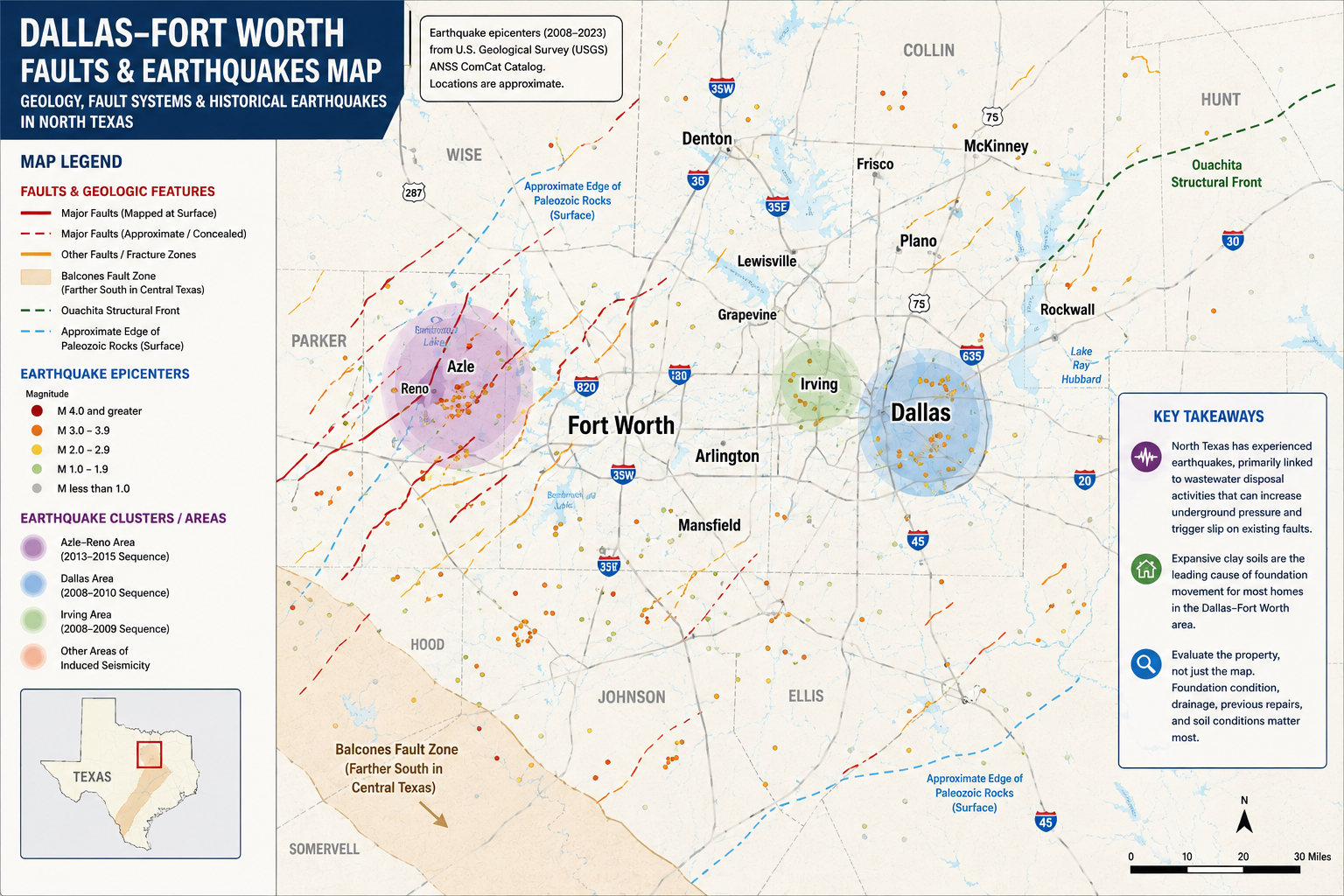
Dallas-Fort Worth fault lines, historical earthquake areas, and major geological features across North Texas. Locations are approximate and should not be interpreted as property surveys or predictions of future earthquake activity.
A regional map can help you identify areas worth researching.
It cannot determine the structural condition of a particular house.
Use it as a starting point rather than a final answer.
The Bigger DFW Foundation Issue Is Expansive Clay Soil
For most North Texas buyers, clay soil deserves more attention than earthquake activity.
Clay can absorb large amounts of moisture.
As moisture increases, the soil expands.
When the soil dries, it contracts.
The problem becomes more serious when different parts of the soil beneath a house contain different amounts of moisture.
Imagine the west side of a property baking in summer heat while the shaded east side stays relatively moist.
Now add a large tree pulling moisture from one corner.
A downspout could also dump water beside another section of the foundation.
If an under-slab plumbing leak develops, even more moisture can enter the soil beneath one portion of the house.
The foundation now rests on soil that isn’t behaving uniformly.
That’s when structural movement can become more noticeable.
Why DFW Droughts Can Be Hard on Foundations
North Texas weather creates major swings in soil moisture.
DFW can experience heavy rain followed by weeks of extreme heat and very little precipitation.
During long dry periods, clay soil shrinks.
You may even see soil pulling away from the edge of a foundation.
When rain returns, the soil absorbs water and expands again.
Repeated cycles can place additional stress on a slab.
That’s why consistent moisture and good drainage matter so much for North Texas homes.
The goal isn’t to soak the soil.
The goal is to avoid extreme moisture differences around the foundation.
Trees Can Affect a North Texas Foundation
Buyers love mature trees, especially in older Dallas-Fort Worth neighborhoods.
Large trees can also affect soil moisture.
Their roots draw water from the ground.
During hot and dry periods, a large tree close to a house can contribute to drier soil on one side of the structure.
That doesn’t mean every tree near a home needs to come down.
Instead, consider the tree together with the home’s drainage, irrigation, soil condition, foundation measurements, and repair history.
When measurable movement appears on the same side of a house as a large tree, it deserves additional attention.
What Foundation Warning Signs Should DFW Buyers Look For?
Foundation movement doesn’t always appear as one dramatic crack.
Buyers should look for a pattern of related symptoms.
Common warning signs include:
- Stair-step cracks through exterior brick
- Interior cracks that repeatedly return
- Doors that don’t close correctly
- Windows that bind
- Sloping or uneven floors
- Separation between walls and ceilings
- Cracked floor tile
- Significant garage floor cracks
- Chimney separation
- Exterior brick displacement
- Previous patches in the same areas
- Drainage that sends water toward the house
One crack alone may mean very little.
Several symptoms occurring together deserve more investigation.
Don’t Diagnose a Foundation From One Crack
A crack tells you that movement happened.
It doesn’t automatically tell you why.
The cause could involve normal cosmetic movement, expansive soil, drainage problems, a plumbing leak, tree roots, previous repairs, or more significant structural movement.
That’s why filling the crack before closing doesn’t solve the underlying question.
You need to understand why it appeared.
Walk Around the House Before You Blame Dallas-Fort Worth Fault Lines
The exterior of a property can tell you a great deal.
Check the grading.
Look at where rainwater goes.
See whether flower beds hold water against the slab.
Inspect the gutters and downspouts.
Look for soil pulling away from the foundation.
Pay attention to trees that sit close to the structure.
Examine driveways, patios, sidewalks, and retaining walls.
Then look at neighboring houses.
If several properties on one street show similar movement, that may provide useful information about local soil conditions or drainage.
The foundation and the land around it work together.
Slab Foundations vs. Pier-and-Beam Homes
DFW buyers encounter both slab-on-grade and pier-and-beam construction.
Most newer suburban homes use slab foundations.
Older neighborhoods in Dallas, Fort Worth, Oak Cliff, East Dallas, Arlington, and similar areas may have more pier-and-beam homes.
Neither type is automatically superior.
They simply create different maintenance and inspection issues.
Pier-and-beam homes can provide easier access beneath the structure. However, buyers may encounter moisture, damaged beams, shifting piers, inadequate ventilation, or previous modifications.
Slab foundations eliminate the crawlspace but can make under-slab plumbing repairs more complicated.
The goal isn’t to pick a foundation type by reputation.
It’s to understand the condition of the foundation attached to the home you’re buying.
Dallas-Fort Worth Foundation Concerns by Area
North Texas is too large to treat every city as though it has identical soil and foundation conditions.
Dallas and Dallas County
Dallas has a wide range of housing ages and foundation types.
A 1950s East Dallas house creates different questions from a newer home in Far North Dallas.
Older areas may have mature trees, pier-and-beam construction, previous plumbing work, and decades of foundation history.
Newer areas may have slab foundations and newer drainage systems.
Neither automatically eliminates the need for due diligence.
Plano, Frisco, McKinney, and Collin County
Collin County contains large amounts of modern slab-on-grade construction.
A newer home can still experience foundation movement.
Drainage, lot grading, soil conditions, plumbing leaks, construction quality, and moisture management all matter.
After purchasing a primary residence in Collin County, remember to file for your applicable homestead exemption.
Fort Worth and Tarrant County
Fort Worth covers a huge geographic area.
Housing age, geology, development patterns, and soil conditions can vary considerably across the city.
Western and northwestern parts of the region also sit closer to areas studied during North Texas earthquake research.
Again, that doesn’t make Fort Worth a poor place to buy.
It means the property deserves individual evaluation.
Azle and Northwest Tarrant County
Azle deserves special mention because of the earthquake sequence that began in 2013.
Researchers connected that activity to pressure changes associated with brine production and wastewater disposal.
For buyers, that information provides regional history.
It does not tell you whether a particular house has foundation problems.
Inspect the actual property.
Irving and the Mid-Cities
Irving is another recognizable name in DFW earthquake history.
Buyers considering Irving, Grand Prairie, Euless, Bedford, Hurst, Grapevine, or nearby communities should still focus primarily on property-specific conditions.
Look at drainage, foundation history, plumbing, previous repairs, trees, and inspection findings.
Arlington and Mansfield
Arlington and Mansfield contain enormous amounts of slab construction.
Buyers should pay close attention to grading, drainage, soil moisture, large trees, and previous foundation work.
Two homes in the same subdivision can behave differently because their individual lots manage water differently.
Denton and the Northern Growth Corridor
Denton and surrounding communities combine older housing with rapid new development.
For new construction, pay particular attention to grading and drainage.
A newly completed house still depends on proper site preparation and water management.
Rockwall and Eastern DFW
Rockwall and communities east of Dallas can have different elevation and drainage characteristics from flatter areas of the metroplex.
Sloped lots, retaining walls, drainage, and erosion can create additional questions.
A sloped property isn’t automatically a problem.
It simply deserves the appropriate evaluation.
What If the House Already Had Foundation Repair?
Don’t automatically reject it.
Foundation repairs are common enough in North Texas that many desirable houses have previous structural work.
Documentation matters more than the mere existence of repairs.
Ask for the engineering report, foundation company invoice, pier diagram, elevation measurements, plumbing tests, repair dates, warranty documents, and any later evaluations.
Also check whether the warranty transfers to the new owner.
A seller may call it a “lifetime warranty,” but you still need to read the actual terms.
Find out what it covers.
Learn what it excludes.
Verify whether the company still operates.
A professionally repaired foundation with strong documentation can be easier to evaluate than a house with obvious movement and no repair history.
Get a Home Inspection Before Making Assumptions
A thorough home inspection should remain an important part of your due diligence.
Your inspector can identify visible structural symptoms while evaluating the home’s other major systems.
The inspector may also identify drainage, plumbing, moisture, roof, electrical, and HVAC concerns.
If structural findings deserve additional investigation, bring in the appropriate specialist.
When Should You Call a Structural Engineer?
Not every home needs a structural engineer before closing.
Some situations justify one.
Consider an engineer when a house shows significant movement, has extensive previous repair history, contains unusual elevation differences, or presents conflicting information.
A structural engineer can evaluate the house without trying to sell you a pier installation.
That independent perspective can help determine whether repairs are necessary.
The engineer can also review measurements, repair records, visible symptoms, and current structural performance.
Does Homeowners Insurance Cover Foundation or Earthquake Damage?
Don’t assume it does.
The Texas Department of Insurance home insurance guide states that typical home policies don’t cover earthquakes or earth movement. TDI also notes that endorsements may be available for additional coverage, including certain foundation or slab damage and earthquake coverage.
The exact coverage depends on the policy and cause of damage.
TDI also explains that even all-risk policies usually exclude earthquakes and often don’t cover foundation repairs unless additional coverage applies.
Talk with your insurance agent before closing.
Ask about foundation coverage, slab coverage, earth movement, earthquakes, water leaks, endorsements, deductibles, and exclusions.
Insurance is part of the true cost of homeownership.
Before setting your budget, use my guide to How Much House Can I Afford in Texas?.
You should also understand the hidden costs of buying a home in Texas before deciding what monthly payment feels comfortable.
How to Check a House Near Dallas-Fort Worth Fault Lines
You don’t need to become a geologist.
You need a good due diligence process.
Research the property’s general location first.
Then look at the individual home.
Walk the exterior and study drainage, grading, trees, sidewalks, brick, windows, driveways, and patios.
Read the seller’s disclosure carefully.
If the seller reports previous foundation work, request supporting records.
Complete a thorough home inspection.
When significant structural concerns remain, consider a structural engineer.
Then decide whether the property still makes financial sense.
Foundation problems don’t automatically make a house a bad purchase.
Unanswered questions create the bigger risk.
Having your mortgage pre-approval completed before seriously shopping will also give you clearer financial boundaries if repairs or negotiations enter the conversation.
Do Dallas-Fort Worth Fault Lines Affect Property Values?
A regional fault map alone usually doesn’t determine a home’s value.
Buyers tend to react more strongly to visible structural movement, incomplete repairs, missing documentation, and uncertainty.
Consider 2 houses in the same neighborhood.
One shows substantial movement and has no records explaining what happened.
The other has previous foundation work supported by an engineering report, repair documentation, plumbing tests, and transferable warranty information.
Those houses tell very different stories.
Documentation builds confidence.
If you’re selling a DFW home with previous foundation repair, organize your records before listing.
Don’t wait for the buyer’s inspector to discover everything.
Provide enough information for buyers to evaluate the property instead of assuming the worst.
If you’re preparing to sell a North Texas home with structural repairs, schedule a free 15-minute consultation. We can discuss pricing, buyer expectations, repair documentation, and resale strategy.
Should You Avoid a Neighborhood Because of Dallas-Fort Worth Fault Lines?
I wouldn’t reject a DFW neighborhood solely because a regional geological map shows faults nearby.
The individual property tells you much more.
Ask how the foundation has performed.
Look at the drainage.
Review previous repairs.
Consider trees and plumbing history.
Study floor elevations when necessary.
Read engineering reports and warranty information.
Those details give you better information than a broad statement that faults exist beneath North Texas.
Dallas-Fort Worth Fault Lines: What Buyers Should Remember
Dallas-Fort Worth has faults and it has experienced earthquakes.
Research has also shown that some North Texas earthquake sequences resulted from underground pressure changes associated with oilfield wastewater disposal.
Those facts deserve attention.
For most DFW homeowners, however, expansive clay soil remains a much more common foundation consideration.
Water matters.
Drainage matters.
Trees matter.
Plumbing matters.
Previous repairs matter.
Construction quality matters.
Most importantly, the individual property matters.
Don’t reject a house because a fault exists somewhere in the region.
Don’t ignore visible structural problems because the house has fresh paint either.
Look at the evidence.
Read the disclosure, inspect the property, research previous repairs, understand the drainage, and bring in a structural engineer when necessary.
The goal isn’t to find a North Texas house that has never moved.
The goal is to understand the house you’re actually buying, how its foundation has performed, what repairs have occurred, what risks remain, and whether the price makes sense.
If you’re considering a home in Dallas, Fort Worth, Arlington, Mansfield, Irving, Plano, Frisco, McKinney, Denton, Rockwall, or another North Texas community, schedule a free 15-minute consultation.
We’ll help you look beyond the listing photos and identify the questions that should be answered before you make the commitment.
Frequently Asked Questions About Dallas-Fort Worth Fault Lines
Does Dallas-Fort Worth have fault lines?
Yes. North Texas contains ancient faults and geological structures. Many remain buried below the surface.
Does Dallas-Fort Worth get earthquakes?
Yes. DFW has experienced numerous earthquakes. Researchers have linked some North Texas earthquake sequences to pressure changes associated with oilfield wastewater disposal.
Did wastewater injection cause the Azle earthquakes?
USGS research concluded that a combination of brine production and wastewater disposal represented the most likely cause of the Azle earthquake sequence.
What causes most foundation problems in Dallas-Fort Worth?
Expansive clay soil is one of the biggest factors. Drainage, drought, trees, plumbing leaks, grading, and construction quality can also affect foundation performance.
Is a house with previous foundation repair a bad investment?
Not automatically. Review the quality of the repair, engineering reports, plumbing tests, warranty terms, and the home’s performance since the work occurred.
Should I hire a structural engineer?
Start with a thorough home inspection. If meaningful structural concerns remain, a licensed structural engineer can provide a more specialized evaluation.
Does homeowners insurance cover earthquake damage?
Typical Texas home insurance doesn’t cover earthquakes or earth movement. The Texas Department of Insurance says consumers can ask about additional coverage or separate earthquake protection.
Should I avoid Azle or Irving because earthquakes occurred there?
Earthquake history alone doesn’t determine whether a particular house is a good purchase. Evaluate the home’s foundation, drainage, soil, repair history, and inspection findings.
About Kory White Real Estate Group
Kory White Real Estate Group helps buyers and sellers throughout Texas, including Dallas-Fort Worth, Greater Houston, Austin, San Antonio, and the communities in between.
Our approach goes beyond finding a house and negotiating a price.
A smart purchase also means understanding the property’s foundation, drainage, insurance, taxes, maintenance needs, repair history, neighborhood conditions, and future resale potential.
Whether you’re relocating to North Texas, buying your first DFW home, moving into one of the area’s rapidly growing suburbs, or selling a property with previous foundation repairs, we’ll help you gather the information needed to make a confident decision.



Join The Discussion