
 by
A client asked me a simple question last week: “How do I transfer my VA loan to the person buying my house?” The honest answer is that it’s not hard, but it has a lot of moving parts. If one of them gets missed, the seller can stay on the hook for a loan they no longer control, or the buyer can lose the deal at the finish line.
So here is the full process to assume a VA loan in Texas, start to finish. I’m covering who qualifies, what the servicer checks, every fee VA allows, the Texas contract forms, how to cover the equity gap, the timeline, and what happens after closing. Nothing skipped.
Quick answer: Any buyer, veteran or not, can assume a VA loan if they qualify with the loan servicer. First, the loan must be current. Second, the buyer must agree in writing to take over the full debt. Third, they must meet VA credit and income standards. In return, the buyer pays a 0.5% VA funding fee, plus a capped processing fee and normal title and recording costs. The seller should request a release of liability, and only a veteran buyer can substitute their entitlement to free up the seller’s VA benefit.
What Is a VA Loan Assumption?
A VA loan assumption is when a buyer takes over the seller’s existing VA-guaranteed mortgage. The buyer keeps the same interest rate, the same remaining balance and the same remaining term. Nothing gets refinanced.
That’s exactly why assumptions are getting so much attention in Texas right now. Freddie Mac’s survey put the average 30-year fixed rate at 7.32% for the week of October 22, 2026. At the same time, many Texas veterans locked in VA loans in the 2% to 4% range a few years ago. When a buyer assumes one of those loans, that low rate goes with the house.
VA treats assumability as a core feature of the program. Every VA loan made on or after March 1, 1988 carries a notice that it can’t be assumed without approval from VA or its authorized agent. In plain English, the loan is assumable, but somebody has to sign off.
VA Loan Assumption vs. Unrestricted Transfer vs. Spousal Release
People mix these three up all the time.
| Situation | What it is | Approval needed? | VA funding fee? |
|---|---|---|---|
| Assumption | A buyer takes over ownership and full liability for the loan | Yes, servicer or VA | 0.5%, unless exempt |
| Unrestricted transfer | Ownership moves, but liability does not (certain transfers listed in the VA Lenders Handbook) | No, but the servicer must report it to VA | No |
| Spousal release | A divorce or legal separation awards the home to the veteran whose entitlement is on the loan | No full assumption; the servicer needs the decree and the recorded deed | No full assumption process |
Source: VA Circular 26-23-10. For unrestricted transfers, the servicer can charge up to $50 to update its records.
Who Can Assume a VA Loan in Texas?
Anyone can assume a VA loan if they qualify. You do not have to be a veteran, service member or surviving spouse.
Under 38 U.S.C. § 3714, the servicer has to approve the assumption when 3 things are true:
- The loan is current. If the seller is behind, they need to bring the loan current at or before closing. For example, cash at closing works. A loan modification at the time of the assumption generally does not, except in divorce or death situations.
- The buyer is contractually obligated to buy the home and take over full liability for the remaining balance and every obligation in the note and deed of trust.
- The buyer is creditworthy under VA’s credit standards, judged as if the buyer were a veteran applying for a VA loan in the amount of the unpaid balance.
What About Older VA Loans?
The approval rules above apply to VA loans with commitments made on or after March 1, 1988. Older loans follow different rules. They’re rare today, but if you have one, ask the servicer how it handles the transfer and the release before you list.
Can an Investor Assume a VA Loan?
VA’s guidance ties the occupancy requirement to substitution of entitlement. A veteran substituting entitlement has to intend to live in the home. For other assumptions, the statute focuses on credit and the loan being current. Servicers can still ask occupancy questions in the application, so get the answer from the servicer in writing before you write an offer as a non-occupant buyer.
What Are the Credit and Income Requirements to Assume a VA Loan?
The servicer underwrites the buyer the same way a lender would for a VA purchase loan, using Chapter 4 of the VA Lenders Handbook. Expect a full file: credit report, income, assets and debts.
Here is what the underwriter looks at:
- Credit history. VA doesn’t publish a minimum credit score. The underwriter looks at payment history, collections, judgments, bankruptcies and foreclosures.
- Debt-to-income ratio (DTI). VA uses 41% as a benchmark. A higher ratio can still work, but the file needs stronger compensating factors, and VA guidance looks for residual income at least 20% above the minimum.
- Residual income. This is money left each month after taxes, the house payment and major debts. It’s the number that sinks a lot of VA files.
- Stable income. Pay stubs, W-2s, tax returns and employment verification, the same as a purchase.
- Funds to close. You’ll need to document cash for the 0.5% funding fee, closing costs and the equity gap.
VA Residual Income Minimums for Texas
Texas is in VA’s South region. For loan amounts of $80,000 and up, these are the monthly minimums:
| Household size | South region minimum (Texas) |
|---|---|
| 1 | $441 |
| 2 | $738 |
| 3 | $889 |
| 4 | $1,003 |
| 5 | $1,039 |
| 6 to 7 | Add $80 per additional person |
Every person who depends on the household income counts toward household size, not just the people on the loan.
If you’re self-employed or paid on 1099s, your documentation looks different. This breakdown of mortgage documents for W-2 vs. 1099 earners shows what the servicer will likely ask for.
The 2 Types of VA Assumptions and Why the Seller Should Care
Servicers process every VA assumption one of 2 ways. For the seller, this is the most important decision in the whole transaction.
Assumption Without Substitution of Entitlement
This happens when a non-veteran buyer assumes the loan, or when a veteran buyer doesn’t substitute. The seller’s VA entitlement stays tied to the loan until the loan is paid in full. That could be years or decades.
Even so, the seller can still get a release from personal liability for the debt. However, release of liability and restoration of entitlement are 2 different things. A release protects the seller from the debt. It does not give the seller their VA benefit back.
Still, a seller in this position may have some remaining entitlement for a future VA purchase. How much depends on the county loan limit and the amount tied up in the old loan. A VA lender can calculate it from the seller’s Certificate of Eligibility (COE).
Assumption With Substitution of Entitlement
If the buyer is an eligible veteran who plans to live in the home and has enough entitlement, the buyer can substitute their entitlement for the seller’s. As a result, the seller gets their entitlement restored.
First, the servicer will pull the buyer’s COE to confirm there’s enough entitlement to cover the loan. In addition, the veteran buyer typically completes VA Form 26-8106, Statement of Veteran Assuming GI Loan.
VA Form 26-10291: The Seller’s Entitlement Acknowledgment
Since 2024, VA expects servicers to give the selling veteran VA Form 26-10291, Assumption Entitlement Acknowledgement, right after the assumption application comes in. The seller signs it no later than closing. It exists because VA found that many veterans didn’t understand how an assumption affects their entitlement.
My advice to veteran sellers: decide what you need before you accept an offer. If you plan to buy again with a VA loan soon, a veteran buyer who will substitute entitlement may be worth more to you than a slightly higher offer from a non-veteran.
How Much Does It Cost to Assume a VA Loan?
VA limits what a servicer can charge the buyer. Here’s the full list.
| Cost | Amount | Who usually pays |
|---|---|---|
| VA funding fee | 0.5% of the loan balance, paid in cash at closing (can’t be financed into the loan) | Buyer, unless exempt |
| Assumption processing fee | Up to $300 when the servicer has automatic authority; $250 when VA must give prior approval | Buyer |
| Assumption locality variance | VA’s published schedule lists $404 for the South region | Buyer, if the servicer charges it |
| Credit report | Actual cost | Buyer |
| Recording fees | County clerk charges | Negotiable |
| Taxes, hazard insurance, flood insurance, assessments | Prorated or prepaid | Per contract |
| Title examination, title insurance, endorsements | Varies by policy | Negotiable in Texas |
| Fees VA approved in advance as local deviations | Varies | Buyer |
Sources: VA Circular 26-23-10, Circular 26-23-10 Change 1, Circular 26-24-5 and VA’s funding fee page.
Fee Rules Worth Knowing
- The servicer can’t charge the buyer fees that aren’t on VA’s list. VA says so directly.
- The seller may pay real estate commissions.
- If the assumption is denied and still denied after 60 calendar days, the servicer has to refund $50 of the processing fee.
- The funding fee goes to VA within 15 calendar days of closing.
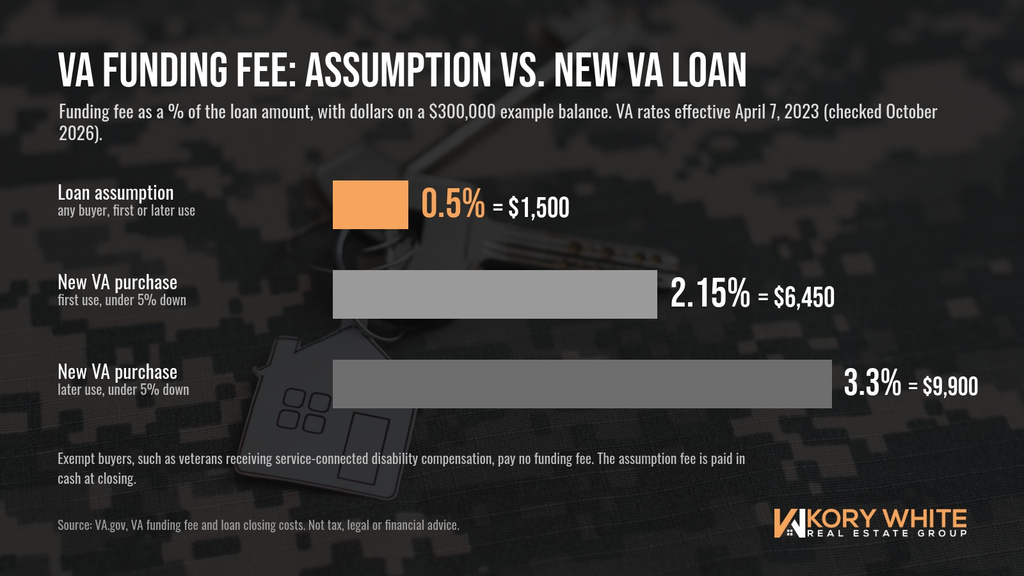
Chart comparing the 0.5% VA funding fee to assume a VA loan in Texas with 2.15% and 3.3% fees on new VA purchase loans
Who Is Exempt From the VA Funding Fee?
The buyer doesn’t pay the 0.5% fee if any of these apply, per VA.gov:
- Receiving VA compensation for a service-connected disability
- Eligible for that compensation but receiving retirement or active-duty pay instead
- A surviving spouse receiving Dependency and Indemnity Compensation (DIC)
- A service member with a proposed or memorandum rating before closing showing eligibility for compensation from a pre-discharge claim
- An active-duty service member who provides proof of a Purple Heart on or before closing
For comparison, a first-time VA purchase loan with less than 5% down carries a 2.15% funding fee, and subsequent use carries 3.3%. On a $300,000 balance, the assumption fee is $1,500. That’s one of the biggest cost advantages of assuming.
For a fuller picture of everything that shows up on a Texas settlement statement, here’s my Texas closing costs breakdown.
How Do You Cover the Equity Gap on a VA Assumption?
The equity gap is the difference between the sales price and the loan balance. In most cases, the buyer has to cover it, because the assumed loan doesn’t grow to match the price.
Example: a $400,000 sales price with a $300,000 loan balance leaves a $100,000 gap. Buyers usually cover it 1 of 3 ways:
- Cash. Simplest and fastest, but most buyers don’t have it.
- A second lien. VA allows a second loan behind the assumed VA loan. The rules are below.
- A mix. Some cash plus a smaller second lien.
VA’s Rules for a Second Loan on an Assumption
VA Circular 26-24-17 spells out what the servicer has to do when a buyer adds secondary financing:
- Lien position: the second loan must sit behind the VA loan, so the lender may need a subordination agreement.
- Documentation: the servicer records the second lender’s name, the amount and the repayment terms in the file.
- Allowed uses: closing costs needed to close the assumption, or money owed to the seller at closing.
- No cash back to the buyer from the second loan.
- Underwriting: the second loan’s monthly payment counts in the buyer’s debts.
- Rate: the second loan’s rate can be higher than the VA rate.
- Future sale: if the second loan isn’t assumable, it may limit the buyer’s ability to sell by assumption later.
- Grace period: the second loan must allow a reasonable grace period before late charges and before foreclosure.
Keep in mind that you still can’t roll the 0.5% funding fee into the assumed VA balance.
Worked Example: Assumption Plus a Second Lien
These numbers are an example only. Your rate, balance and terms will differ.
| Example assumption | Amount |
|---|---|
| Sales price | $400,000 |
| Seller’s VA loan balance | $300,000 at 2.75%, 300 months left |
| Buyer cash | $20,000 |
| Second lien | $80,000 at 8.99%, 30 years (example rate) |
| Assumed VA payment (principal and interest) | $1,383.93 |
| Second lien payment | $643.12 |
| Total principal and interest | $2,027.06 |
| New loan instead: $380,000 at 7.32%, 30 years | $2,610.34 |
| Monthly difference | About $583 |
| VA funding fee on the assumption (0.5% of $300,000) | $1,500 |
Principal and interest only. Taxes, insurance, HOA dues and any mortgage insurance on a new loan aren’t included. Not tax, legal or financial advice.
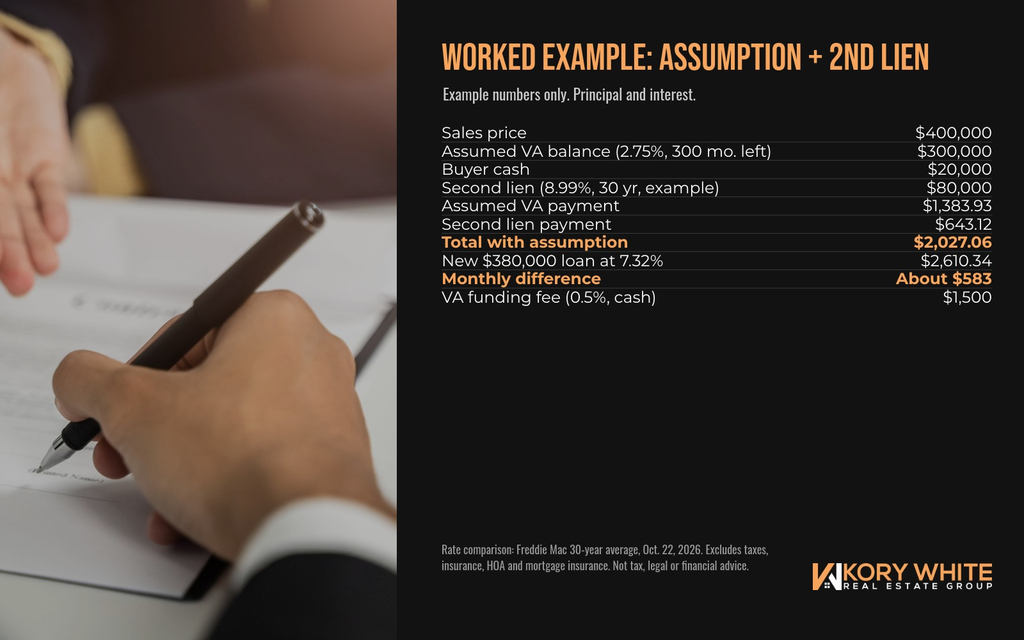
“Worked example of a VA loan assumption in Texas with a second lien compared to a new 7.32% mortgage”
That said, the assumption doesn’t win every time. A large gap financed at a high second-lien rate can wipe out the savings. So always compare the blended payment against a new loan before you commit. I walk through numbers like these on The Kory White Show, including when an assumption is worth it and when it isn’t.
Step-by-Step: How to Assume a VA Loan in Texas From Listing to Closing
Here is every step, in order. Sellers handle some steps, buyers handle others, and a few need both.
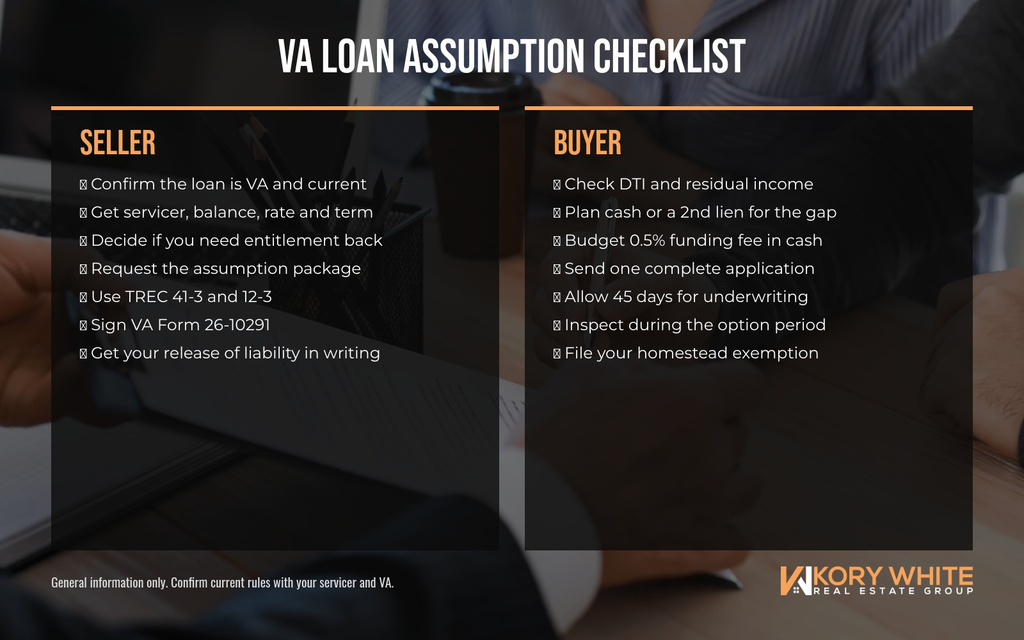
Seller and buyer checklist for a VA loan assumption in Texas
Step 1: The Seller Confirms the Loan Details
Before listing, the seller gathers:
- Servicer name and loan number
- Confirmation that it’s a VA-guaranteed loan
- Current balance, rate, monthly payment and remaining term
- Escrow balance for taxes and insurance
- Payment status. The loan must be current or brought current by closing.
- Any partial claim or other junior lien from past loss mitigation. VA requires repayment in full at transfer for partial claims from its COVID-19 recovery program.
Get the most recent statement, the note and the deed of trust. The buyer will need copies.
Step 2: The Seller Decides on Entitlement
Decide whether you need your VA entitlement back. If yes, you’ll want a veteran buyer who can substitute. If not, any qualified buyer works. Either way, plan to ask for a release of liability.
Step 3: Ask the Servicer for the Assumption Package
Call the servicer and ask for its assumption package and fee schedule in writing. Ask whether it has VA automatic authority, because that changes the timeline. The seller usually has to authorize the servicer to talk with the buyer and agents.
Step 4: Price and Market the Home as Assumable
Even with a low rate, the price is still based on market value. The low rate is a feature buyers pay attention to, not a reason to ignore comparable sales. Put the rate, approximate balance and “VA assumable, buyer to qualify with servicer” in the listing remarks so the right buyers find it.
Step 5: The Buyer Gets Pre-Qualified
Buyers should run their numbers before writing an offer. That means checking DTI and residual income against the assumed payment, and lining up second-lien financing if needed. A mortgage pre-approval for the second loan also shows the seller you’re serious. If you’re comparing second-lien options, it helps to apply with more than one lender.
Step 6: Write the Texas Contract With the Right Addenda
In Texas, a VA assumption usually uses the TREC One to Four Family Residential Contract (Resale) plus a few promulgated addenda.
TREC Loan Assumption Addendum (TREC 41-3)
The TREC Loan Assumption Addendum (TREC No. 41-3) sets the terms of the assumption. Here’s what each paragraph does:
- A. Credit documentation: the buyer delivers credit and income documents to the seller within the number of days you set.
- B. Buyer’s credit approval: if the documents are late, the seller can terminate and keep the earnest money. However, if they arrive and the seller finds the buyer’s credit unacceptable, the seller can terminate within 7 days and the earnest money goes back to the buyer.
- C. Loan being assumed: this lists the balance, payment and lender. If the balance at closing varies by more than the amount you write in, either party can terminate unless the other covers the difference. Also, the seller delivers the note, deed of trust and latest statement within 7 days.
- D. Assumption terms: the buyer can terminate if the noteholder demands a higher assumption fee than agreed and the seller won’t cover it, raises the rate above a set limit, or changes the loan documents.
- E. Consent: if the noteholder won’t consent, either party can terminate and the buyer gets the earnest money back.
- F. Seller’s liens: unless the noteholder releases the seller from liability, the deal requires a vendor’s lien and deed of trust to secure assumption.
- G. Escrow: the seller transfers the escrow account to the buyer, and in turn the buyer reimburses the seller for it.
TREC Release of Liability and VA Entitlement Addendum (TREC 12-3)
Next, add the TREC Addendum for Release of Liability on Assumed Loan and/or Restoration of Seller’s VA Entitlement (TREC No. 12-3):
- Part A sets a deadline to apply for the seller’s release of liability.
- Part B sets a deadline to apply for restoration of the seller’s VA entitlement.
- For each one, you choose whether the contract terminates if approval isn’t in by closing, or whether closing goes forward anyway.
- VA’s rule: the form notes that VA won’t restore entitlement unless the buyer is a veteran with enough unused entitlement who otherwise qualifies.
- Cost: under this form, the seller pays the cost of securing the release and restoration.
Other Forms and Timing
Add the TREC Third Party Financing Addendum if the buyer is using a second lien.
Above all, watch your dates. Servicers often take longer than a normal 30-day closing, so build in enough time. Sellers should also understand that once they sign, backing out is hard. Here’s why Texas contracts leave sellers little room to back out.
Step 7: Inspections and the Option Period
Of course, everything about due diligence still applies. Order inspections during the option period. VA doesn’t require a new appraisal for an assumption, but a second-lien lender usually will, and a buyer may want one anyway to confirm value.
Step 8: Submit a Complete Assumption Application
In practice, this is where most delays start. The servicer’s clock doesn’t begin until the package is complete. A typical package includes:
- VA Form 26-6381, Application for Assumption Approval and/or Release from Personal Liability to the Government on a Home Loan
- The executed sales contract and addenda
- Buyer’s credit authorization and full income, asset and debt documentation
- COE and VA Form 26-8106 if the buyer is substituting entitlement
- VA Form 26-10291, signed by the selling veteran
- Second-lien terms, if any
- The processing fee, if the servicer collects it upfront
Send everything at once and keep proof of the date the servicer received it.
Step 9: The Servicer Underwrites the Buyer
Timelines under VA Circular 26-23-10:
| Servicer type | VA deadline |
|---|---|
| Servicer has VA automatic authority | Decide within 45 calendar days of a complete package |
| No automatic authority | Send the package to VA within 35 calendar days; VA decides within 10 business days |
| After VA approval | Close within 30 calendar days of VA’s decision |
In late 2023, VA warned servicers in Circular 26-23-27 that refusing to process assumptions, missing these deadlines or denying buyers over servicer-made overlays can cost them VA’s guaranty on the loan. If a servicer stalls, your agent and the seller can escalate through VA’s Regional Loan Center.
Step 10: Approval, or an Appeal
Once the servicer approves, it notifies both the buyer and seller. On the other hand, if it denies, the notice must give the reasons and explain that the seller or buyer can appeal to VA within 30 calendar days. On appeal, VA aims to decide within 10 business days of receiving the complete package.
Step 11: Title, Survey, HOA and Insurance
While underwriting runs, the Texas title company:
- Orders the title commitment and clears any liens
- Requests the survey, or a T-47 affidavit if an existing survey will be used
- Gets the HOA resale certificate and transfer fees, if there’s an HOA
- Confirms property tax status for prorations
The buyer sets up homeowners insurance effective at closing and names the servicer as mortgagee. Texas premiums vary widely, so shop early. Here’s what’s driving Texas homeowners insurance costs.
Step 12: Review the Numbers Before Closing
The settlement statement should show the exact payoff of any amount needed to bring the loan current, the 0.5% funding fee (in cash), the processing fee, escrow reimbursement to the seller, prorated taxes and the equity paid to the seller. Check each line against the contract.
Step 13: Close at the Title Company
At closing, the buyer signs an assumption agreement taking over the note and deed of trust. The seller signs the deed. Under the TREC 12-3 addendum, the deed includes any assumption clause VA or the lender requires. If the seller isn’t released from liability, expect the vendor’s lien and deed of trust to secure assumption from Paragraph F of the 41-3 addendum. Any second lien closes at the same time.
Step 14: Recording
The title company records the deed and any second-lien deed of trust with the county clerk.
Step 15: What the Servicer Does After Closing
Behind the scenes, the servicer has to:
- Remit the funding fee to VA within 15 calendar days
- Report the transfer of ownership and release of liability to VA’s servicing system
- Send VA the assumption package within 45 calendar days of closing
Step 16: The Seller Confirms the Release and Entitlement
Next, sellers, don’t assume it happened. Ask the servicer for written confirmation of your release of liability. If the buyer substituted entitlement, request an updated COE from VA to confirm your entitlement was restored.
Step 17: The Buyer Takes Over
The buyer’s first payment is the first one due after closing. Then the buyer should:
- Confirm the servicer updated the borrower name and escrow
- File a homestead exemption with the county appraisal district. Here’s how in Harris County and Dallas County.
- Set up utilities. In deregulated parts of Texas, you can compare plans with Ambit Energy.
What Texas Sellers Should Know Before Offering a VA Assumption
- Ask for the release of liability. Without it, you can stay liable to VA if the buyer defaults later. The TREC 41-3 addendum warns sellers about this in its notice.
- Understand your entitlement. Without substitution, part of your VA benefit stays tied up until the loan is paid off.
- Notify the servicer before you sell. Under federal law, if the property is transferred without notifying the holder first, the holder can demand the loan be paid in full.
- Price on value, not just the rate. The appraisal for any second lien will still look at comparable sales.
Want to know what your home could sell for, assumable rate included? 🏡 See What Your Home Could Be Worth
What Texas Buyers Should Know Before Assuming a VA Loan
- Plan for the gap. The equity gap is usually the biggest hurdle.
- Budget for a longer closing. Up to 45 days for underwriting, plus closing time.
- Run the blended payment. Compare the assumed loan plus any second lien against a new loan.
- Read the note. The TREC addendum tells buyers to review the note and deed of trust if they’re concerned about future terms.
- Remember property taxes reset. Your taxes are based on the current appraised value and your own exemptions, not the seller’s bill.
If you’re still deciding whether now is the time, my rent vs. buy analysis for Texas runs today’s numbers.
👉 Search Homes for Sale or Lease
Common Mistakes That Kill VA Assumptions
- Sending an incomplete package. The 45-day clock doesn’t start until it’s complete.
- Closing dates that are too tight. A 30-day close rarely works.
- Forgetting the funding fee must be cash. You can’t add it to the assumed balance.
- Ignoring past-due amounts or partial claims. The seller must clear these at or before closing.
- Skipping the release of liability. The seller stays exposed.
- Assuming any veteran buyer restores entitlement. It takes substitution, occupancy and enough entitlement.
- Underestimating the second-lien payment. It counts in DTI and can erase the savings.
📘 Download the Texas Home Buyer’s Guide
Frequently Asked Questions About VA Loan Assumptions in Texas
Can a non-veteran assume a VA loan in Texas?
Yes. A non-veteran can assume a VA loan if they meet VA credit and income standards and the loan is current. The seller’s entitlement stays tied to the loan unless a veteran buyer substitutes theirs.
How long does a VA loan assumption take?
A servicer with VA automatic authority must decide within 45 calendar days of a complete package. If VA must approve it, the servicer has 35 days to send it to VA, VA decides within 10 business days, and closing should follow within 30 days. Plan your contract dates around that.
How much is the VA funding fee on an assumption?
The VA funding fee on an assumption is 0.5% of the loan balance. The buyer pays it in cash at closing and can’t finance it. Buyers who are exempt, such as veterans receiving service-connected disability compensation, don’t pay it.
Does the seller get their VA entitlement back after an assumption?
Only with substitution of entitlement. That requires a veteran buyer who will live in the home and has enough entitlement. Otherwise, the seller’s entitlement stays tied up until the loan is paid off.
Is a release of liability the same as restoring entitlement?
No. A release of liability ends the seller’s personal responsibility for the debt. Restoring entitlement gives the seller their VA home loan benefit back. You can get a release without restoration.
Does a VA assumption require an appraisal?
VA doesn’t require a new appraisal for an assumption. However, a lender providing a second lien usually does, and buyers may order one to confirm value.
Can the servicer refuse a VA assumption?
A servicer can deny a buyer who doesn’t qualify or a loan that isn’t current. It can’t refuse to process a qualified assumption or deny over its own extra rules. VA has said it can withhold its guaranty from servicers that do. Also, the buyer or seller can appeal a denial to VA within 30 days.
Can I assume a VA loan with a second mortgage?
Yes. VA allows a second lien behind the assumed loan. The second loan’s payment counts in your debts, it can’t give you cash back, and it can’t cover the funding fee by adding it to the VA balance.
What Texas forms are used for a VA assumption?
Most deals use the TREC resale contract with the Loan Assumption Addendum (TREC 41-3) and the Release of Liability and Restoration of VA Entitlement Addendum (TREC 12-3). Add the Third Party Financing Addendum if there’s a second lien.
What happens if the seller transfers the home without servicer approval?
The servicer can demand the full loan balance. Federal law lets the holder call the loan if the property is disposed of without notifying the holder first. Always go through the assumption process.
Ready to Buy or Sell With a VA Assumption?
A VA assumption can save a Texas buyer hundreds a month, and it can help a veteran seller stand out in a slower market. It just has more steps than a normal sale, and the seller’s entitlement is on the line.
If you’re thinking about selling a home with a VA loan or assuming one in DFW, Houston or anywhere in Texas, let’s look at your numbers and the right contract terms together.
📅 Schedule a Free 15-Minute Consultation
Not ready for a call yet? I break down how deals like this work on The Kory White Show.
About Kory White Real Estate Group
Kory White Real Estate Group helps buyers, sellers, investors and relocating clients throughout Texas, including Dallas-Fort Worth, Greater Houston, Austin, San Antonio and surrounding communities. Services include buying, selling, relocation, new construction, first-time buyers, luxury, investments and leasing.
We help clients understand the home, the numbers, the market, and the deal.
From Sugar Land to Sherman. From Manvel to Mansfield.
Dallas: 469-336-3027 Houston: 281-738-4446 Website: korywhiterealestategroup.com
For agents: VA assumptions are a real listing advantage right now, if you can run the process. I talk deal strategy and lead conversion on Mentors + Masterminds = Escrows, and if you want coaching, systems and VA support behind your business, here’s what I’m building with CoFounders.
Texas law requires all license holders to provide the Information About Brokerage Services (IABS) and the TREC Consumer Protection Notice.
This article is general information, not legal, tax or financial advice. VA rules, fees and servicer procedures can change. Confirm current requirements with your loan servicer, VA and a licensed professional before acting.



Join The Discussion